


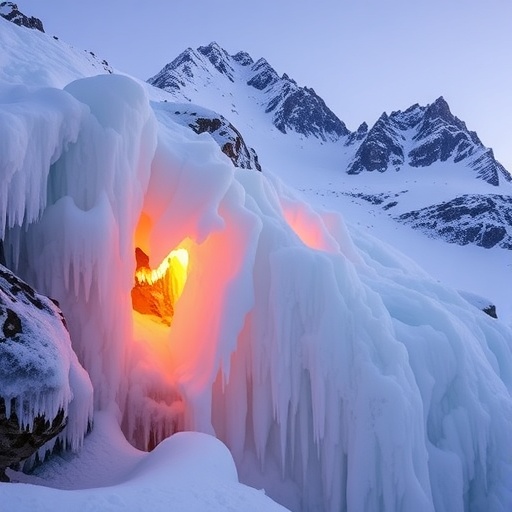
In the relentless pursuit to unravel the chronicles of our planet’s past climate and environmental shifts, a team of researchers from Ca’ Foscari University of Venice and the Austrian Academy of Sciences embarked on a remarkable journey to the Weißseespitze glacier in the Ötztal Alps, straddling the border of Austria and Italy. In 2018, they drilled deep into the glacier’s icy core, extracting a nearly 10-meter-long ice sample that would soon reveal a treasure trove of atmospheric history extending over millennia. This frozen archive, locked within the layers of ice, preserves nuanced chemical signatures that narrate the story of air pollution across centuries—from the Roman Empire through the Early Modern Period.
Ice cores serve as pristine time capsules, encapsulating particulate matter deposited by atmospheric processes that settled as snow and later compressed into ice. Unlike many environmental records, these cores capture both natural and anthropogenic influences on the atmosphere, providing insights into how human activity has progressively altered our environment. The Weißseespitze ice core uniquely offers a window into the pre-industrial era centrally located in the Alps—an area intimately tied to early human settlements and industrial activity, allowing unprecedented evaluation of historical pollution trends in a critical transitional epoch.
Using advanced argon isotope dating coupled with radiocarbon constraints, the researchers meticulously established an age-depth profile for the ice core. Surface ice was determined to have formed approximately between 1552 and 1708 CE, whereas the basal ice layers extended back to a period ranging from 349 BCE to 420 CE. This precise dating was essential to correlate chemical signatures with historical environmental events and human impacts. Subsequent chemical analyses identified concentrations of 18 distinct elements, along with organic markers such as levoglucosan—a biomarker indicative of biomass burning—and various carboxylic and dicarboxylic acids, illuminating both pollution sources and natural processes that influenced the Alps over centuries.
Intriguingly, the core’s geochemical record revealed exceptionally low concentrations of heavy metals such as lead during the period between 700 and 1200 CE, underscoring an era of relatively unpolluted atmospheric conditions typical of the pre-industrial landscape. However, starting around 950 CE, distinct spikes in arsenic, lead, copper, and silver emerged. These perturbations directly correspond to increased medieval mining and smelting activities occurring in the Alpine region and wider Europe, affirming the impact of burgeoning metallurgical enterprise in atmospheric chemistry centuries prior. Embedded within these peaks are also signatures of major volcanic eruptions and climatic dryness, testifying to the intertwined effects of natural phenomena and human endeavors on atmospheric composition.
Further corroborating the nexus of environmental and anthropogenic factors, researchers noted a significant surge in microcharcoal particles corresponding with the elevated metal concentrations from roughly 902 to 1280 CE. This concurrence points to heightened fire activity and local biomass burning, likely exacerbated by a century-long drought. Dry conditions facilitate cycles of vegetation growth followed by desiccation, thereby creating highly combustible biomass accumulations that ignite more frequently and intensely. Historical records suggest that such fires were further influenced by increased land use for agriculture and grassland management, and potentially exacerbated by socio-political conflicts involving deliberate or accidental burning of landscapes.
Despite the detailed records uncovered, notable challenges remain. While the integration of argon-39 dating substantially improved the chronology of ice layers, uncertainty margins still complicate the pinpointing of exact temporal windows for individual chemical pulses. Therefore, definitive attribution of certain spikes to specific historical or volcanic events remains nuanced and necessitates further research. However, the clarity achieved marks remarkable progress in refining alpine ice core chronologies, shedding illuminating light on a region and timescale previously difficult to resolve in such detail.
Alarmingly, the pristine ice encapsulating this invaluable environmental record is rapidly vanishing. Revisits to the Weißseespitze drilling site in 2025 revealed that the ice thickness had precipitously diminished to only 5.5 meters from the original nearly 10 meters sampled in 2019. The harsh reality of accelerated glacier melt driven by climate warming imposes an urgent imperative to retrieve and preserve these climate archives before they disappear indefinitely. The loss would signify not merely the physical loss of frozen water but the irreversible erasure of irreplaceable environmental and historical memory ensconced within.
The implications of this melting extend beyond regional concerns. Alpine glaciers, foretold to vanish within upcoming decades, function as critical natural recorders of atmospheric history that span from the regional to global scale. Their disappearance would introduce significant gaps in the continuum of climate data essential for enhancing models of future climate variability and human-environment interactions. Protecting these glaciers thus transcends conservation of ice alone; it embodies stewardship over the Earth’s collective memory and the scientific understanding vital to confronting rapid environmental change.
Comparison of ancient and modern pollution levels extracted from the ice core paints a sobering picture. While historical anthropogenic emissions constituted only about 7% of the total pollution recorded in the core—dominated primarily by stable natural backgrounds—the situation today starkly contrasts. Modern industrial and urban activity has dramatically increased atmospheric pollutant concentrations well beyond natural baseline levels, altering air chemistry in ways historically unmatched. The Weißseespitze record underscores how anthropogenic influence emerged incrementally but now dominates the altered atmospheric landscape.
The interdisciplinary approach undertaken—combining ice core drilling, isotope geochronology, elemental chemistry, and organic marker analysis—exemplifies the power of integrated technologies in environmental reconstruction. This comprehensive methodology not only elucidates local pollutant histories but also enables correlation with broader climatic and volcanic events, building a richer narrative of Earth’s dynamic past. As such, these findings provide critical empirical data imperative for improving climate reconstructions and for informing policy responses aimed at limiting further atmospheric degradation.
Ultimately, the story unfolding from the Weißseespitze ice cores stands as a stark reminder of the fragility of our planet’s archives and the accelerating pace at which climate change threatens to erase them. The research champions urgent action to sample and protect melting glaciers globally before these natural vaults of memory are lost forever. Safeguarding these frozen chronicles equips humanity with the vital knowledge needed to understand past environmental shifts and to adapt and mitigate in an increasingly uncertain future.
News Publication Date:
13-Mar-2026
Web References:
10.3389/feart.2026.1680019
Cite Scienmag News
Miles G. (March 13, 2026). Race Against Time to Preserve Alpine Ice Cores Revealing Medieval Mining, Fires, and Volcanic Activity. Scienmag. https://scienmag.com/race-against-time-to-preserve-alpine-ice-cores-revealing-medieval-mining-fires-and-volcanic-activity/
Miles G. "Race Against Time to Preserve Alpine Ice Cores Revealing Medieval Mining, Fires, and Volcanic Activity." Scienmag, 13 March 2026, https://scienmag.com/race-against-time-to-preserve-alpine-ice-cores-revealing-medieval-mining-fires-and-volcanic-activity/. Accessed 28 August 2026.
Miles G. "Race Against Time to Preserve Alpine Ice Cores Revealing Medieval Mining, Fires, and Volcanic Activity." Scienmag. March 13, 2026. https://scienmag.com/race-against-time-to-preserve-alpine-ice-cores-revealing-medieval-mining-fires-and-volcanic-activity/


