


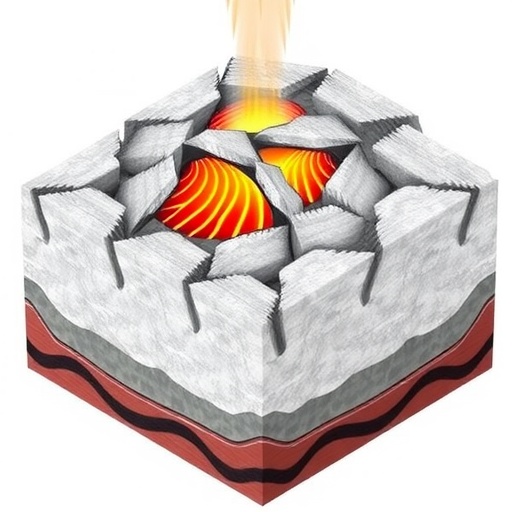
In the constantly shaking crust of our planet, volcanic eruptions represent some of the most awe-inspiring and enigmatic natural phenomena. Among these, large silicic volcanic systems—the massive underground reservoirs of silica-rich magma—have long baffled scientists seeking to predict the exact timing and dynamics of their catastrophic eruptions. A groundbreaking study published in Nature Communications in 2026 by Keller, Townsend, Troch, and colleagues sheds new light on the precise mechanisms that can accelerate the onset of eruptions in these vast systems. Their discovery challenges longstanding models and opens exciting new doors for volcanic hazard assessment.
Volatiles—primarily water vapor, carbon dioxide, and sulfur gases dissolved in magma—play a pivotal role in volcanic activity. When magma ascends, the reduction in pressure causes these gases to exsolve, generating bubbles that inflate the magma, increase its buoyancy, and drive explosive eruptions. However, the new study reveals that before eruption onset, a process termed “volatile resorption” can occur deep within the magma chamber. This counterintuitive mechanism involves dissolved volatiles being drawn back into the melt phase from gas bubbles, fundamentally altering the physical properties of the magma prior to eruption.
Using a combination of sophisticated thermodynamic modeling and high-resolution fluid dynamic simulations, the research team reconstructed the complex interplay between bubble growth, volatile exchange, and magma rheology inside large silicic magma reservoirs. Their findings indicate that volatile resorption significantly reduces the bubble pressure and viscosity contrast within the magma, thereby expediting the conditions required for eruption initiation. This process influences the timescale over which pressure accumulates and overcomes the tensile strength of the overlying crust.
The implications of these results are profound. Traditional models have typically assumed that once exsolved gases form bubbles, they continue expanding until eruption, driving the magma upwards. However, this study outlines a phase in which volatiles can be reabsorbed into the melt, temporarily stabilizing the magma chamber and paradoxically priming it for a sudden, more energetic eruption. The research implies that volatile resorption facilitates the rapid pressurization of magma, effectively compressing eruption timelines.
To validate their models, the researchers leveraged geochemical analyses of melt inclusions—tiny pockets of trapped magma preserved in erupted crystals—from several recent silicic eruptions worldwide. These inclusions exhibited volatile concentrations and isotopic signatures consistent with cyclical resorption events predicted by the simulations. Moreover, laboratory experiments using synthetic silicic melts under controlled pressure and temperature conditions reproduced the volatile exchange mechanisms, lending further support to the study’s conclusions.
This new conceptual framework challenges volcanologists to reconsider how monitoring signals such as volcanic gas emissions, seismicity, and ground deformation are interpreted. Since volatile resorption modulates the availability and partitioning of gases, it can mask typical warning signs or produce misleading signals. As a result, the window for eruption prediction might be narrower than previously thought, demanding enhanced instrumentation and real-time data analysis.
Furthermore, the research opens avenues for revisiting the hazard assessments associated with some of the world’s most dangerous volcanoes, including supervolcano calderas. Given their substantial magma reservoirs composed of highly viscous silicic magma, these volcanoes might be even more susceptible to volatile resorption-induced rapid destabilization. This knowledge underscores the necessity of integrating advanced petrologic and fluid dynamic models into volcanic risk mitigation strategies worldwide.
The authors also explore how volatile resorption influences the textural evolution of magma during storage and ascent. Reabsorption of volatiles can lead to complex overpressure cycles within magma pockets, driving crystal nucleation and growth, altering melt viscosity, and promoting the development of shear zones. These physical changes affect how magma fragments and interacts with surrounding rock during eruption, influencing eruption style and deposit characteristics.
From a geophysical perspective, incorporating volatile resorption into eruption models contributes to a more nuanced understanding of subsurface degassing processes. This factor may partially explain observed discrepancies between volatile fluxes measured at volcanoes and the expected gas release based on magma volume estimates. The research suggests that volatile resorption can sequester gases temporarily, creating episodic or pulsatory degassing patterns that complicate monitoring efforts.
This multidisciplinary study combining experimental petrology, numerical simulations, and field observations exemplifies the power of integrated science for solving planetary mysteries. It not only advances fundamental knowledge of magmatic systems but offers tangible pathways to enhance volcanic forecasting capabilities. By deciphering hidden volatile dynamics, scientists move closer to anticipating eruptions with improved accuracy and providing precious warnings to vulnerable communities.
In conclusion, the revelation of volatile resorption as a critical accelerator of eruption onset in large silicic systems signifies a paradigm shift in volcanology. It affirms that magma chambers are dynamic, evolving environments governed by subtle phase interactions rather than static reservoirs simply filling and spilling over. Future work will likely build upon these insights to refine predictive models and develop innovative techniques capable of capturing volatile behavior in real-time below the surface.
This discovery stands as a testament to the complexity and marvel of Earth’s inner workings. As humanity continues to grapple with the challenges of living alongside restless volcanic giants, the fresh understanding of volatile resorption offers hope for better preparedness and risk reduction. It also enhances our appreciation of the intricate dance between molten rock and gas that shapes our planet’s surface and challenges our scientific imagination.
The study by Keller et al. is a clarion call to the scientific community to embrace the nuanced roles of volatiles in volcanism and to develop the tools necessary to decode this volatile signature intricately embedded within eruptive processes. As we refine our grasp of magmatic behavior, the dream of accurately forecasting eruptions—a goal pursued for centuries—moves tantalizingly closer to reality.
Cite Scienmag News
Violet Maxwell. (March 13, 2026). Volatile Resorption Speeds Eruption in Silicic Systems. Scienmag. https://scienmag.com/volatile-resorption-speeds-eruption-in-silicic-systems/
Violet Maxwell. "Volatile Resorption Speeds Eruption in Silicic Systems." Scienmag, 13 March 2026, https://scienmag.com/volatile-resorption-speeds-eruption-in-silicic-systems/. Accessed 4 September 2026.
Violet Maxwell. "Volatile Resorption Speeds Eruption in Silicic Systems." Scienmag. March 13, 2026. https://scienmag.com/volatile-resorption-speeds-eruption-in-silicic-systems/


