

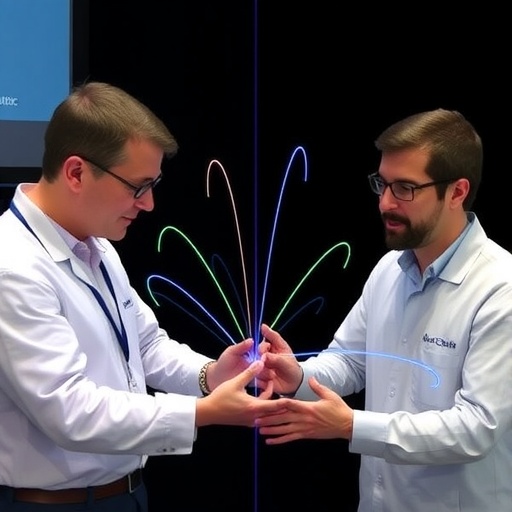
In a groundbreaking development at the crossroads of neuroscience and quantum computing, a team from the Mayo Clinic in Jacksonville, Florida, has clinched first place at the Berlin Quantum Hackathon 2026. This prestigious competition challenged global participants to push the boundaries of quantum-enabled technologies in real-world clinical contexts. The Mayo Clinic team’s revolutionary achievement was the creation of a quantum-powered model capable of decoding movement intentions directly from brain activity, marking a seminal advance toward restoring mobility for individuals living with paralysis.
The significance of this accomplishment resides in its translation of quantum computing from theoretical experimentation to tangible clinical application. While quantum computing has long been heralded for its potential in processing complex biological data, this project exemplifies a rare, comprehensive end-to-end solution—melding sophisticated quantum algorithms with clinical neurodata to answer an urgent medical question: how can we interpret brain signals indicating movement intent when the corresponding physical action is impeded or impossible?
Harnessing electroencephalogram (EEG) recordings, the research team specifically targeted the subtle neural cues generated when the brain attempts to command movement, despite paralysis or motor impairment preventing muscle response. These signals are notoriously faint and buried within the brain’s ongoing electrical “noise,” posing a formidable challenge for classical data processing techniques. By integrating quantum computing’s advanced pattern recognition capabilities with artificial intelligence, the team constructed a hybrid model capable of discerning when the brain intends to move the left hand versus the right.
At the core of this methodology was the deployment of quantum systems to navigate the multidimensional and noisy datasets typically produced by EEGs. Quantum algorithms exhibit a unique aptitude for handling superposed and entangled states, making them ideally suited for pattern detection across vast, intertwined neural networks. This approach significantly outperformed classical machine learning models by isolating critical neural patterns that previously went undetected, underlining the transformative potential of quantum-classical hybrid systems in biomedical engineering.
Dr. Rickey Carter, the project lead and professor of biostatistics at Mayo Clinic, emphasized a patient-centric framework as essential to their success. Instead of solely focusing on the computational intricacies, Carter’s team prioritized clinical relevance, rigorously refining their model to accommodate edge cases—instances where typical algorithms might falter. This mindset enabled them to optimize quantum processing efforts precisely where the technology’s superiority mattered most, ensuring their solution addressed actual patient needs rather than abstract theoretical problems.
The implications of such advancements are profound. Should subsequent research validate these findings, the technology could serve as the foundation for next-generation assistive devices and neuroprosthetics. By accurately interpreting a patient’s intended movements at the neural level, these systems could restore a degree of motor control, dramatically enhancing independence and quality of life for people paralyzed by spinal cord injuries, stroke, or neurodegenerative diseases.
Furthermore, this breakthrough highlights the broader versatility of quantum computing in medicine. Beyond neuroengineering, quantum algorithms could revolutionize drug discovery processes, optimize radiation therapy planning, and unravel complex biological data structures that stymie classical computational methods. Mayo Clinic’s initiative thus sets a precedent for interdisciplinary collaboration and innovation within computational biology and medical technology.
Dr. Charles Bruce, Mayo Clinic Florida’s chief innovation officer, reflected on the broader collaborative ethos driving this success. Highlighting the fusion of biology, data science, and quantum physics, Bruce noted the team’s initial lack of prior quantum computing experience as a testament to the accessibility and democratizing potential of the field. “Progress is built collectively,” he remarked, underscoring how cross-pollination of expertise fuels breakthroughs that no single discipline could achieve in isolation.
Comprising researchers Rickey Carter, Ph.D., Miko Wieczorek, Michele Dougherty, Ph.D., Feifei Li, Ph.D., and Charles Bruce, M.B., Ch.B., the team’s work was fostered by Mayo Clinic’s Quantum Sensing and Computing program. This initiative actively explores the intersections of quantum technologies with both fundamental research and patient-centered care, striving to bridge the gap between scientific discovery and clinical implementation.
The Berlin Quantum Hackathon, hosted by Kipu Quantum—a Berlin-based quantum software enterprise—and supported by the State of Berlin’s Quantum Initiative along with Charité-Berlin University Medicine, challenged over 180 teams worldwide to develop quantum-hybrid solutions. The multi-week competition tested these models in industrially relevant scenarios, and Mayo Clinic’s victory signifies a pivotal moment in demonstrating quantum computing’s maturity as a practical tool in healthcare innovation.
Enrique Solano, CEO of Kipu Quantum, commented on the milestone, asserting that quantum computing is cementing its capacity to solve industrial and medical challenges via hybrid quantum-classical architectures. He foresees medical imaging and life sciences emerging as key areas where quantum applications will gain significant traction, heralding a new era of precision diagnostics and personalized medicine.
The team’s accomplishment not only validates the utility of quantum computing in deciphering complex neural phenomena but also acts as a beacon for ongoing quantum-enabled biomedical research. It highlights the potential for a future where individuals with motor impairments regain greater autonomy through technology that intimately understands and translates their cerebral intentions into meaningful action.
By pioneering these methodologies, Mayo Clinic is poised to lead a transformative journey, leveraging the frontiers of quantum computation to reshape clinical paradigms and therapeutic possibilities. As quantum hardware and algorithms continue to evolve, the integration of this technology into healthcare will likely expand, making the once-distant dream of restoring movement control from brain signals a tangible reality.
This landmark achievement resonates far beyond its immediate scientific community, signaling a compelling chapter in the narrative of medical innovation—one where quantum computers transcend theoretical constructs to become indispensable instruments in healing and human empowerment.
News Publication Date: March 5, 2026
Web References:
- Mayo Clinic: https://www.mayoclinic.org/
- Berlin Quantum Hackathon 2026: https://berlinquantumhackathon.com/
- Mayo Clinic News Network: https://newsnetwork.mayoclinic.org/
Cite this news
SCIENMAG. (March 12, 2026). Mayo Clinic Researchers Triumph in Global Quantum Hackathon with Innovative Brain-Based Movement Model. https://scienmag.com/mayo-clinic-researchers-triumph-in-global-quantum-hackathon-with-innovative-brain-based-movement-model/
SCIENMAG. "Mayo Clinic Researchers Triumph in Global Quantum Hackathon with Innovative Brain-Based Movement Model." Scienmag, 12 March 2026, https://scienmag.com/mayo-clinic-researchers-triumph-in-global-quantum-hackathon-with-innovative-brain-based-movement-model/. Accessed 28 August 2026.
SCIENMAG. "Mayo Clinic Researchers Triumph in Global Quantum Hackathon with Innovative Brain-Based Movement Model." Scienmag. March 12, 2026. https://scienmag.com/mayo-clinic-researchers-triumph-in-global-quantum-hackathon-with-innovative-brain-based-movement-model/


