


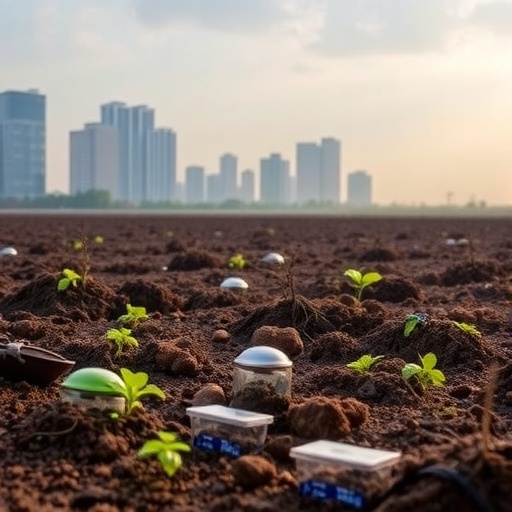
In the vast and intricate web of life beneath our feet, soil microbes play a fundamental role in maintaining ecosystem health and driving biogeochemical cycles. A groundbreaking new study by Zhao, He, Wang, and colleagues has now revealed that dormant microbes, rather than their active counterparts, dominate soil microbial communities across China. This research, recently published in Communications Earth & Environment, not only challenges prevailing assumptions about microbial activity but also elucidates how environmental factors such as water availability and nutrient resources govern microbial dormancy. The findings promise to reshape our understanding of soil ecology on a continental scale and open new avenues for predicting ecosystem responses in the face of climate variability.
Soil ecosystems are often described as dynamic microbial battlegrounds, where bacteria, fungi, and other microorganisms continuously compete, cooperate, and adapt. Traditionally, the focus has been on the metabolically active fraction of these communities because they are directly responsible for nutrient cycling, organic matter decomposition, and soil structure formation. However, this new research proposes that the majority of soil microbes across diverse landscapes exist in a state of dormancy, essentially ‘sleeping’ until environmental conditions become favorable for reactivation.
Using an unprecedented large-scale sampling regime, Zhao and colleagues collected soil samples from multiple locations spanning China’s diverse climates and terrestrial ecosystems, from arid deserts to humid forests. By employing advanced molecular techniques including quantitative PCR and metagenomic sequencing, the team quantified microbial biomass and activity levels. They applied novel biomarkers that distinguish active microbes from dormant or dead cells, allowing a fine-grained analysis of microbial community structure that surpasses traditional DNA-based surveys.
The results were striking: dormant microbes comprised the overwhelming majority of soil microbial communities across all studied sites. In fact, dormant populations outnumbered active cells by several folds, indicating a massive microbial seed bank residing in soil ecosystems. This dormant fraction held the potential to respond rapidly to changes in environmental conditions, serving as an ecological reservoir of genetic and metabolic diversity. Such dormancy may provide a survival mechanism that allows microbes to persist through periods of stress such as drought, nutrient depletion, or temperature extremes.
Crucially, the researchers identified water availability as the pivotal factor regulating the dormant-active microbial balance. Soils with higher moisture content supported greater proportions of active microbes, while arid and semi-arid soils harbored more dormant communities. This pattern underscores the direct influence of water as a driver of microbial metabolism and growth. Water not only facilitates nutrient dissolution and transport but also acts as a signal triggering microbial awakening from dormancy. Additionally, resource availability, particularly organic carbon and essential nutrients, modulated microbial activity levels, highlighting the complex interplay between biotic and abiotic factors controlling microbial life cycles.
The implications of these findings are profound for ecosystem modeling and climate change predictions. Dormant microbes represent a hidden reservoir of potential activity that can rapidly amplify biogeochemical processes when favorable conditions return. Traditional models that only account for active microbial pools may underestimate soil respiration, nutrient cycling rates, and feedbacks to the atmosphere. Recognizing the dominance of dormancy also reframes how we understand microbial responses to disturbances such as drought, land-use change, and pollution.
Furthermore, this dormancy phenomenon may serve as a microbial survival strategy that buffers ecosystems against environmental variability. By cycling through active and dormant states, microbial communities maintain resilience and functional stability. This dynamic holds particular importance for regions experiencing increasingly erratic precipitation patterns due to climate change. The capacity of dormant microbes to “spring to life” following rain events could influence the timing and magnitude of nutrient availability, plant productivity, and carbon fluxes.
On a methodological level, this study exemplifies the power of combining large-scale field sampling with cutting-edge molecular tools to unravel complex ecological patterns. The use of biomarkers to discriminate microbial activity states marks a significant advance in microbial ecology, enabling researchers to move beyond static inventories towards dynamic assessments of microbial function. Such approaches promise to deepen our understanding of microbial contributions to ecosystem services, from soil fertility to greenhouse gas emissions.
The geographic breadth of the study covering diverse eco-regions within China also allows for comparative insights. Despite variations in climate, vegetation, and soil type, dormancy remained a ubiquitous feature of soil microbial assemblages. This suggests that microbial dormancy is a fundamental and evolutionarily conserved trait, likely shaped by the intermittent and heterogeneous nature of terrestrial environments. Such universality opens avenues for applying these insights globally, refining microbial ecology frameworks used in earth system models worldwide.
Emerging from this research is a nuanced narrative where soil microbes balance between latent existence and metabolic bursts, orchestrated by environmental cues. This balance determines the tempo of critical soil processes that sustain terrestrial ecosystems. Understanding these mechanisms sheds light on how microbial communities adapt to fluctuating resource landscapes, influencing agroecosystem productivity and natural vegetation dynamics alike.
Potential applications of this knowledge include improved management of agricultural soils by optimizing irrigation and fertilization regimes to harness microbial activity when most beneficial. Moreover, incorporating microbial dormancy dynamics into ecosystem monitoring could enhance early warning systems for soil degradation and desertification, particularly in vulnerable regions. As microbes underpin soil carbon storage, accounting for their dormancy patterns enhances predictions of carbon cycle feedbacks under future climate scenarios.
Looking ahead, the study by Zhao and colleagues lays a foundation for exciting research directions. Longitudinal experiments tracking microbial dormancy transitions under controlled environmental manipulations can unravel mechanistic drivers of dormancy induction and revival. Integrating microbial dormancy into ecosystem and climate models can improve forecasts of nutrient fluxes and greenhouse gas emissions. Finally, exploring the genetic regulation and metabolic pathways underpinning dormancy will deepen molecular-level understanding of microbial survival strategies.
In sum, this pioneering research illuminates the hidden majority of soil microbes lying dormant across China, governed primarily by water and resource availability. It challenges conventional wisdom by positioning dormancy as a dominant microbial state with critical ecological functions. As we strive to predict and mitigate environmental change, acknowledging the pivotal role of dormant soil microbes reshapes how we view and steward the world beneath our feet.
Cite Scienmag News
Gavin Prescott. (March 12, 2026). Dormant Microbes Govern China’s Soils via Water, Resources. Scienmag. https://scienmag.com/dormant-microbes-govern-chinas-soils-via-water-resources/
Gavin Prescott. "Dormant Microbes Govern China’s Soils via Water, Resources." Scienmag, 12 March 2026, https://scienmag.com/dormant-microbes-govern-chinas-soils-via-water-resources/. Accessed 3 September 2026.
Gavin Prescott. "Dormant Microbes Govern China’s Soils via Water, Resources." Scienmag. March 12, 2026. https://scienmag.com/dormant-microbes-govern-chinas-soils-via-water-resources/


