


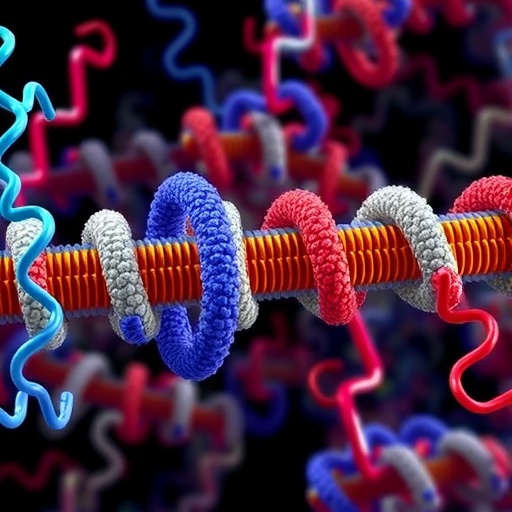
In a groundbreaking advance that could revolutionize the understanding of cellular signaling, a team of researchers has unveiled the dynamic molecular choreography underpinning G-protein-coupled receptor (GPCR) activation and G-protein recognition. GPCRs, which orchestrate a vast array of physiological responses through selective activation of heterotrimeric G proteins, represent one of the most large and versatile protein families in the human body. Despite decades of structural studies furnishing static images of GPCR-G protein complexes, the intricacies of their dynamic interactions and the processes guiding G-protein activation and dissociation have remained enigmatic—until now.
The study focuses on the neurotensin receptor type 1 (NTSR1), a class A GPCR critical for neurotransmission and implicated in various neurological processes. By employing state-of-the-art cryo-electron microscopy (cryo-EM) techniques with temporal resolution, the researchers captured structural snapshots of NTSR1 engaging with minimally modified forms of Go and Gq G-protein subtypes. These structures reveal subtle yet decisive rearrangements occurring at the intracellular interface of the receptor, which tailor its conformation to selectively accommodate distinct G-protein partners. Such dynamic adaptability of the receptor’s intracellular domains sets the stage for subtype-specific signal propagation.
Beyond the static binding modes, the team pushed the envelope by performing time-resolved cryo-EM analyses of NTSR1 bound to Gi. This approach permitted the visualization of the sequential conformational intermediates as the receptor-G protein complex traversed the path from GDP-bound inactive states toward nucleotide exchange and subsequent G-protein dissociation. More than twenty intermediate structures were characterized, providing an unprecedented time-lapse molecular movie illuminating the activation-deactivation cycle in exquisite detail.
Crucially, the data uncovered four fundamental mechanistic pillars underlying G-protein recognition and activation. Firstly, the binding of guanine nucleotides GDP and GTP triggers the release of Gi from actively engaged receptor complexes that exist in both canonical and non-canonical conformations. Intriguingly, these two conformational states differ in their kinetics of nucleotide-induced disassociation, hinting at multiple signaling modes mediated by a single receptor. This multiplicity offers a versatile regulatory mechanism enabling cells to fine-tune receptor output.
Secondly, NTSR1 employs a conserved set of intracellular conformational adjustments to interface with different G-protein subtypes. This shared framework allows the receptor not only to select among diverse transducers but also to promote the activation of one subtype preferentially. The interplay between universality and specificity embedded in these rearrangements is essential to fine-tune the functional selectivity that underlies GPCR signaling diversity observed in physiological contexts.
Thirdly, separation of the Gα subunit from its Gβγ counterparts involves a carefully orchestrated stepwise remodeling of the Gα “switch” regions I to III. These structural elements, previously postulated to be critical signal transducers, are now shown to undergo distinct conformational changes facilitating the release of Gβγ during activation. Such a stepwise mechanism ensures tight regulation of downstream signaling cascades and may represent a general principle applicable across G-protein families.
Finally, the dissociation trajectories of Gi differ markedly from those of Gs. The researchers detailed divergent pathways for receptor-G protein complex disassembly, with canonical and non-canonical NTSR1–Gi complexes following separate routes. This divergence implies that subtype-specific dissociation mechanisms might contribute to the fidelity and multiplicity of physiological responses, potentially influencing drug efficacy and receptor signaling bias.
This comprehensive structural and kinetic dissection not only advances fundamental understanding of GPCR signaling but also opens new avenues for therapeutics targeting G-protein pathways. Since GPCRs are drug targets for a significant portion of approved medications, the ability to decipher and eventually manipulate their dynamic activation processes could yield drugs with enhanced specificity and reduced side effects. Understanding the nuanced molecular events involved in G-protein coupling selectivity, nucleotide exchange, and subunit dissociation allows for the rational design of biased ligands and allosteric modulators capable of tailoring receptor outputs.
Moreover, the study highlights the power of integrating cryo-EM advancements, highly engineered protein constructs, and computational simulations to capture fleeting molecular species crucial for signaling. The more than twenty intermediates characterized in this work serve as a testament to the technological leaps that enable researchers to move beyond static “snapshots” toward mapping continuous biological processes at near-atomic resolution in physiologically relevant timeframes.
In summary, the findings draw a rich and dynamic portrait of GPCR-G protein interactions, revealing an intricate ballet of conformational changes that drive highly selective recognition and activation. The discovery of multiple active conformations and divergent dissociation pathways revolutionizes classical views of GPCR signaling as a singular event. Instead, it emphasizes the fluid, multi-step nature of these molecular machines, attuned to fine-tune signaling outputs in response to cellular context and ligand environment.
Such insights will undoubtedly catalyze a paradigm shift in GPCR research and drug development, inspiring new strategies to harness receptor signaling complexity for clinical benefit. As these molecular revelations unfold, the prospect of designing therapeutics that exploit the dynamism of GPCR-G protein crosstalk beckons with unprecedented promise.
Cite Scienmag News
Denise Maddox. (March 12, 2026). Unveiling GPCR’s Dynamic G-Protein Activation Mechanism. Scienmag. https://scienmag.com/unveiling-gpcrs-dynamic-g-protein-activation-mechanism/
Denise Maddox. "Unveiling GPCR’s Dynamic G-Protein Activation Mechanism." Scienmag, 12 March 2026, https://scienmag.com/unveiling-gpcrs-dynamic-g-protein-activation-mechanism/. Accessed 5 September 2026.
Denise Maddox. "Unveiling GPCR’s Dynamic G-Protein Activation Mechanism." Scienmag. March 12, 2026. https://scienmag.com/unveiling-gpcrs-dynamic-g-protein-activation-mechanism/


