


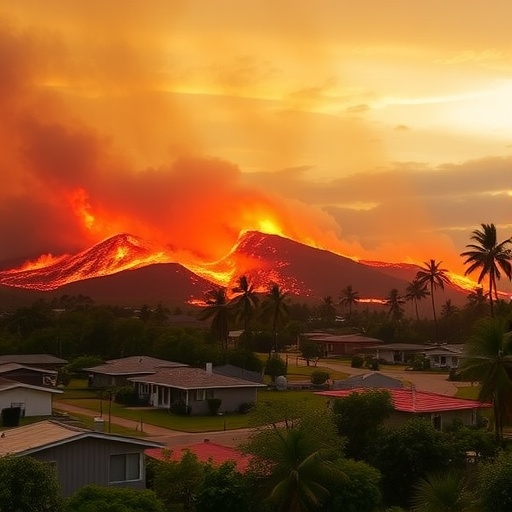
In the wake of increasingly severe climate events, a breakthrough study illuminates the profound and far-reaching psychological repercussions of wildfires, extending well beyond the immediate geographic confines of the fire zones. Published in the prestigious journal JAMA Psychiatry, this cross-sectional study meticulously examines the intersection of wildfire exposure, socioeconomic disruption, and mental health outcomes, underscoring the intricate linkage between environmental catastrophes and the human psyche. The findings presented here mark a pivotal advancement in the understanding of post-disaster mental health, with significant implications for public health policy, disaster response frameworks, and climate resilience strategies worldwide.
The research team, led by Dr. Ruben Juarez at the University of Hawaii, applied rigorous epidemiological methodologies to assess the gradients of psychological distress in populations exposed to wildfire events. Their results reveal a disturbing trend: mental health deterioration is not confined to those directly impacted by fire destruction but cascades into peripheral communities, amplifying the psychological burden across larger geographic and social spectra. This phenomenon suggests that the trauma of wildfires creates a ripple effect, exacerbated by the interconnectedness of social and economic structures in affected regions.
Central to the study’s findings is the role of socioeconomic consequences as a mediator of psychological distress. The researchers highlight housing instability and economic uncertainty as critical stressors that compound mental health challenges. The displacement of communities and the loss of livelihoods due to fires introduce a cascade of stressors that precipitate anxiety, depression, and other forms of psychological distress. This multifactorial chain underscores the need for a holistic approach in addressing mental health, which must encompass not only clinical interventions but also socioeconomic stabilization and support mechanisms.
One of the study’s defining contributions lies in its emphasis on graded psychological distress, moving beyond a binary affected/unaffected model. By quantifying mental health outcomes along a continuum of fire exposure and socioeconomic disruption, the research delineates nuanced gradients of risk. Such an approach allows for more precise identification of vulnerable populations and tailors intervention strategies accordingly. This gradient model challenges existing paradigms that often overlook subtle yet impactful psychological effects in populations not immediately proximate to fire events.
The intersection of environmental science, psychiatry, and economics within this study exemplifies an interdisciplinary approach that is crucial for advancing disaster research. By integrating earth sciences data on wildfire patterns with psychological assessments and socioeconomic analyses, the study creates a comprehensive framework for understanding the multi-dimensional impacts of climate-related disasters. This methodological synergy heralds a new era in science where cross-sector collaboration is key to devising effective public health responses.
Clinically, the study advocates for the urgent integration of mental health services into disaster recovery programs. Traditional disaster response often prioritizes physical infrastructure restoration and acute injury treatment, frequently sidelining the long-term psychological consequences. This study’s evidence compels policymakers and healthcare providers to embed mental health care as a core component of resilience-building strategies, ensuring ongoing support for affected individuals well after the flames are extinguished.
Furthermore, the research calls attention to the critical importance of housing security and economic recovery as foundational pillars in mitigating psychological distress post-wildfire. Stabilizing these domains not only alleviates immediate stress but also fosters a sense of safety and normalcy crucial for psychological healing. This insight shifts the paradigm towards a more integrated approach, advocating for socio-economic policy reforms alongside mental health initiatives in disaster-affected regions.
The implications of this study extend beyond wildfire events, serving as a model for understanding the psychological impacts of a broad spectrum of natural disasters exacerbated by climate change. As wildfires become more frequent and intense globally due to rising temperatures and altered precipitation patterns, the findings represent a clarion call for proactive mental health preparedness and socio-economic support systems. By anticipating the indirect and extended psychological impact zones, emergency response systems can be better tailored to reach populations at risk.
The study further highlights the pervasive nature of psychological stressors that emerge from climate-related disasters, which can manifest in elevated rates of psychiatric disorders, exacerbations of pre-existing mental illness, and increased demand for psychological assessment services. It emphasizes the need for scalable mental health interventions, community outreach, and culturally sensitive care models to effectively address diverse populations impacted by these crises.
Researchers also point out that psychological distress from wildfire exposure can have intergenerational effects, potentially influencing family dynamics, childhood development, and community cohesion. Thus, mental health initiatives must consider not only individual treatment but also family-centered and community-wide interventions to foster resilience and recovery at broader levels.
In light of these findings, disaster response frameworks must evolve to include robust data collection and monitoring systems for psychological distress alongside physical damage assessments. This dual-focus approach ensures that recovery efforts address both tangible and intangible losses, improving overall community resilience and long-term recovery trajectories.
To conclude, this study by Juarez et al. is a seminal contribution to our understanding of the complex human impacts of climate-induced natural disasters. It compels an interdisciplinary, multisectoral approach to disaster recovery that integrates mental health care, housing security, and economic stabilization as inseparable elements. As climate change continues to pose formidable challenges, such nuanced, evidence-based insights are indispensable for shaping resilient societies that can withstand and rebound from environmental shocks.
Corresponding Author: To engage with the study’s lead author, Ruben Juarez, PhD, please contact rubenj@hawaii.edu.
Journal: This pivotal research is published in JAMA Psychiatry, a leading journal renowned for advancing psychiatric science and clinical practice.
Cite Scienmag News
Glenn Wilkins. (March 11, 2026). Impact of the 2023 Maui Wildfires on Housing, Employment, and Mental Health: A Scientific Perspective. Scienmag. https://scienmag.com/impact-of-the-2023-maui-wildfires-on-housing-employment-and-mental-health-a-scientific-perspective/
Glenn Wilkins. "Impact of the 2023 Maui Wildfires on Housing, Employment, and Mental Health: A Scientific Perspective." Scienmag, 11 March 2026, https://scienmag.com/impact-of-the-2023-maui-wildfires-on-housing-employment-and-mental-health-a-scientific-perspective/. Accessed 5 September 2026.
Glenn Wilkins. "Impact of the 2023 Maui Wildfires on Housing, Employment, and Mental Health: A Scientific Perspective." Scienmag. March 11, 2026. https://scienmag.com/impact-of-the-2023-maui-wildfires-on-housing-employment-and-mental-health-a-scientific-perspective/


