


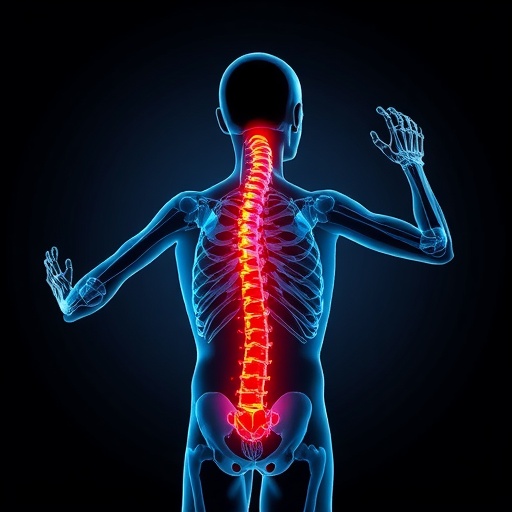
In a groundbreaking advance poised to redefine the future of neurorehabilitation, scientists at Brown University, in collaboration with Rhode Island Hospital and VA Providence Healthcare, have pioneered a novel approach to restoring both motor and sensory functions in individuals with complete spinal cord injuries. Published in Nature Biomedical Engineering, this clinical trial demonstrates that precisely targeted electrical stimulation above and below spinal lesions can effectively reestablish bidirectional communication between the brain and paralyzed limbs, enabling controlled movement and sensory perception where none existed before.
Spinal cord injuries commonly disrupt the transmission of motor commands from the brain to muscles and sever sensory feedback pathways essential for coordinating movement. Traditional rehabilitation methods often fail to restore this intricate sensorimotor loop, leaving patients unable to walk or sense limb positions accurately. The current study addresses these dual deficits through perilesional neuromodulation—implanting electrode arrays above and below the injured spinal segments to deliver patterned electrical stimulation designed to emulate natural spinal cord signals responsible for both voluntary muscle contraction and somatosensory feedback.
The clinical trial involved three participants paralyzed from the waist down following complete spinal cord lesions. Surgeons implanted miniature electrode arrays strategically placed proximal and distal to the injury site. Below-lesion stimulation focused on activating spinal circuits that command leg muscle activity, while stimulation above the lesion targeted sensory networks to simulate feedback from the lower limbs. This dual-site patterned stimulation represents the first successful attempt at integrating simultaneous motor facilitation and sensory substitution in humans with total paralysis, yielding encouraging functional outcomes.
Control over stimulation parameters was decentralized to the participants themselves through an innovative interface affectionately dubbed the “DJ board.” This control device, outfitted with an array of knobs and sliders, allowed subjects to modulate stimulation intensity, location, and frequency to achieve optimal flexion and relaxation patterns in leg muscles. This user-driven tuning not only personalized the therapeutic regimen but also empowered participants to engage dynamically in their own recovery, enhancing motivation and neuroplastic potential.
To refine these manually tuned patterns, researchers applied advanced machine learning algorithms capable of navigating the enormous parameter space inherent in spinal stimulation. Thomas Serre’s team at Brown trained predictive models correlating stimulation variables with desired muscle activation and sensory perception outcomes, enabling rapid convergence on highly effective, individualized neuromodulation schemes. This computational approach surmounted the limitations of trial-and-error optimization, ensuring precision in therapy delivery and robust adaptability.
Sensory feedback presented distinct challenges due to the disrupted ascending sensory pathways common in spinal injuries. Direct electrical stimulation of sensory nerves associated with the legs was impractical because these pathways were severed. Instead, the team adopted a sensory replacement strategy whereby stimulation above the lesion elicited perceivable sensations in intact dermatomes such as the chest or arms. Participants learned to reinterpret these artificial sensations as proxies for leg position and movement—an innovative form of sensory neuroplasticity that effectively substituted missing proprioceptive input.
Experimental validation demonstrated that participants could accurately identify knee angles based solely on varying intensities of sensations induced via spinal stimulation. Blindfolded during testing, subjects reported with high fidelity the flexion degree of their knees, signifying that the artificial sensory feedback was meaningful and actionable. This breakthrough has profound implications for restoring the sense of limb position, critical not only for walking but also for essential daily activities like transferring in and out of wheelchairs.
When combined, the motor and sensory stimulations facilitated remarkably coordinated walking motions on a treadmill, with participants harnessing stimulation to engage leg muscles while simultaneously perceiving foot contact with the ground. Supported by ceiling harnesses and physical therapy guidance, these individuals executed purposeful, rhythmic stepping, augmented by sensory cues that brought a new level of intentionality to their movements. Such integrated sensorimotor restoration significantly exceeds previous approaches that addressed movement or sensation in isolation.
Importantly, none of the participants reported adverse effects attributable to the electrode implants or electrical stimulation paradigms over the two-week in-hospital study. This safety profile paves the way for longitudinal studies targeting neurorehabilitation outside clinical settings. Researchers anticipate that prolonged use of coordinated spinal stimulation could catalyze neuroplastic remodeling, ultimately fostering improved voluntary motor control and functional independence in daily environments.
The multi-institutional collaboration drew on expertise spanning bioengineering, neurosurgery, cognitive neuroscience, and neurotechnology, exemplifying the power of interdisciplinary research to tackle complex biomedical challenges. This effort was supported by major federal funding entities including the Defense Advanced Research Projects Agency, the Department of Veterans Affairs, and the National Institutes of Health, underscoring the strategic importance of restoring sensorimotor function in spinal cord injury populations.
Looking forward, the team envisions augmenting their stimulation protocols with adaptive feedback loops and closed-loop control systems to further enhance precision and responsiveness. The integration of real-time sensory input with motor output modulation holds promise for developing next-generation neuroprosthetics capable of fully reinstating the seamless sensorimotor integration critical to human mobility. Such advances could revolutionize therapeutic paradigms for millions worldwide living with debilitating nervous system trauma.
This study marks a pivotal milestone in spinal cord injury research, illustrating the feasibility of bidirectional neurostimulation to replace lost sensorimotor function. By restoring both the ability to move and to perceive limb position, the researchers have brought us closer to the dream of fully regaining control and autonomy for individuals living with paralysis. This innovative approach is not merely an incremental advance but a transformative leap toward harnessing the power of neurotechnology to rewrite the lived experience of spinal cord injury.
News Publication Date: 11-Mar-2026
Web References: http://dx.doi.org/10.1038/s41551-026-01627-5
Cite Scienmag News
Cassandra Pierce. (March 11, 2026). Breakthrough Study Shows Electrical Stimulation Restores Limb Movement and Sensory Feedback After Spinal Cord Injury. Scienmag. https://scienmag.com/breakthrough-study-shows-electrical-stimulation-restores-limb-movement-and-sensory-feedback-after-spinal-cord-injury/
Cassandra Pierce. "Breakthrough Study Shows Electrical Stimulation Restores Limb Movement and Sensory Feedback After Spinal Cord Injury." Scienmag, 11 March 2026, https://scienmag.com/breakthrough-study-shows-electrical-stimulation-restores-limb-movement-and-sensory-feedback-after-spinal-cord-injury/. Accessed 3 September 2026.
Cassandra Pierce. "Breakthrough Study Shows Electrical Stimulation Restores Limb Movement and Sensory Feedback After Spinal Cord Injury." Scienmag. March 11, 2026. https://scienmag.com/breakthrough-study-shows-electrical-stimulation-restores-limb-movement-and-sensory-feedback-after-spinal-cord-injury/


