


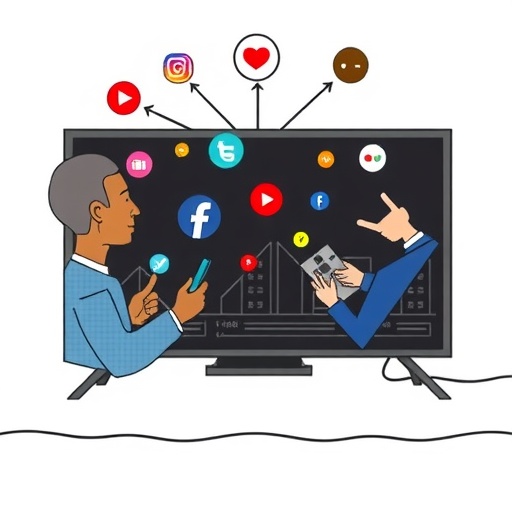
In a groundbreaking study conducted at the University of Illinois Urbana-Champaign, communication professor Stewart Coles has uncovered nuanced insights into how political and racial identities intricately shape television viewing behaviors. The research reveals that social media endorsements for TV programs resonate differently across racial and partisan lines, significantly influencing the intentions of viewers regarding media consumption. This pioneering investigation provides a layered understanding of how identity cues extend beyond mere content preferences to affect engagement with entertainment media.
At the heart of Coles’ research lies the finding that social media users are more inclined to watch television programs endorsed by individuals who share their political affiliations. However, this partisan effect does not operate in isolation. The study highlights that racial identity, along with the individual’s perceptions of racial and political ingroup norms—that is, beliefs about which groups watch and approve of certain content—and cues about a program’s intended audience, critically affect their willingness to engage with media content.
Coles meticulously surveyed 1,259 politically diverse Black and white Americans, encompassing both Democrats and Republicans, to examine how their intentions to view a fictional TV program shifted based on the race and party affiliation of the endorser. The study uncovered that racial distinctions in viewing interest were starkly more pronounced among Republicans than Democrats. Specifically, white Republicans exhibited the weakest desire to watch the program regardless of endorsement, whereas Black Republicans demonstrated the strongest viewing intentions. This divergence suggests a complex intersection of race and partisanship influencing media preferences.
Contrary to previous assumptions that the conservative Republican viewership has a narrow, homogeneous media diet, Coles’ findings propose that such patterns may be predominantly applicable to white Republicans. Black Republicans, by contrast, maintain broader or different media engagement tendencies. This finding challenges oversimplified narratives about ideological media consumption and underscores the diversity within political groups shaped by racial identity.
Published in the prestigious journal Human Communication Research, the study extends existing knowledge by illustrating how partisan divides in entertainment media are not merely a product of political allegiance but are further complicated by layered social identities. Viewers’ intentions were influenced by their understanding of who else within their racial and political groups would approve of or be consuming the program. This intricate social signaling affects decisions to watch, reinforcing the role of collective identity norms in media engagement.
The research employed an innovative methodology by exposing participants to manipulated Twitter endorsements of a fictional TV show. Each endorsement was carefully crafted to simulate tweets from individuals varying in both racial background and political party, effectively isolating how these combined cues impacted participants’ interest. Participants rated their likelihood of viewing the show and their inclination to seek additional information or watch a free episode after the survey, enabling detailed measurement of exposure intentions.
A critical insight emerged regarding how perceptions of a program’s intended audience influenced participants’ responses. For white viewers, exposure intentions waned when endorsements came from political outgroup members whose race suggested they did not belong to the viewer’s social cohort. For example, white Democrats were less inclined to watch when the audience was perceived as white Republicans, and similarly, white Republicans showed decreased interest when they thought the intended audience included Democrats of any race. In stark contrast, Black participants’ intentions were relatively unaffected by the race or party of the endorser, highlighting distinct dynamics in media consumption within racial groups.
This study underscores the sensitivity of white partisans to social signals about viewership, suggesting that their entertainment choices are double-filtered through political affiliation and racial group norms. These findings have implications for understanding the social psychology underlying media preferences and broadcast marketing strategies, particularly in an era where audience segmentation increasingly depends on demographic and ideological factors.
Another profound aspect of Coles’ research is the powerful influence of social media endorsements in shaping viewing norms and behaviors. Even in the largely private context of television watching, exposure to political and racial cues from online strangers effectively swayed intentions. This underscores social media’s expanding role not only as a platform for political discourse but as a potent vector in cultural consumption and identity affirmation.
The research opens avenues for future exploration of offline influences, questioning how endorsements from known individuals within one’s social network might further reinforce or complicate these identity-driven viewing patterns. It also invites consideration of how entertainment producers might harness these dynamics to craft content and promotion strategies that resonate across diverse social constituencies.
In sum, Stewart Coles’ investigation illuminates the complexity of media consumption behaviors shaped by intersecting identities. It reveals how the interplay of racial and partisan cues transmitted through social media shapes exposure intentions, highlighting the multifaceted nature of political identity beyond traditional partisan lines. This nuanced understanding has far-reaching implications for scholars, media practitioners, and cultural commentators interested in the evolving landscape of audience engagement.
Cite Scienmag News
Courtney Benton. (March 10, 2026). How Racial and Political Signals on Social Media Influence TV Audience Preferences. Scienmag. https://scienmag.com/how-racial-and-political-signals-on-social-media-influence-tv-audience-preferences/
Courtney Benton. "How Racial and Political Signals on Social Media Influence TV Audience Preferences." Scienmag, 10 March 2026, https://scienmag.com/how-racial-and-political-signals-on-social-media-influence-tv-audience-preferences/. Accessed 3 September 2026.
Courtney Benton. "How Racial and Political Signals on Social Media Influence TV Audience Preferences." Scienmag. March 10, 2026. https://scienmag.com/how-racial-and-political-signals-on-social-media-influence-tv-audience-preferences/


