


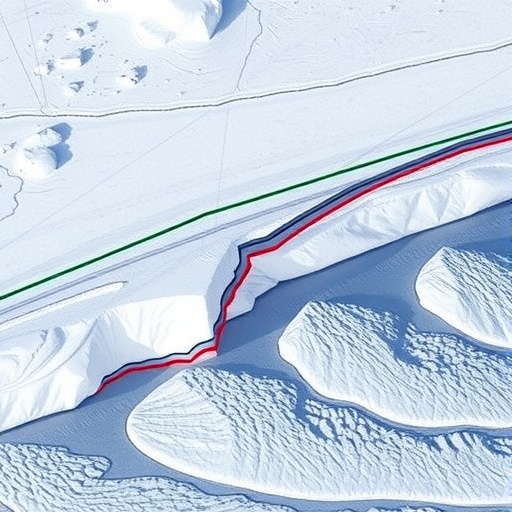
In a groundbreaking study that redefines our understanding of Earth’s most severe and enduring ice ages, researchers at the Earth-Life Science Institute (ELSI) at the Institute of Science Tokyo have unveiled a novel mechanism explaining why some Neoproterozoic snowball Earth events extended for tens of millions of years. Their cutting-edge numerical geochemical models reveal that chemical weathering processes did not cease beneath thick ice sheets as previously thought, but rather persisted actively, substantially consuming atmospheric carbon dioxide (CO₂) and thus prolonging global glaciation periods.
For decades, the scientific consensus held that during snowball Earth episodes—intervals when ice sheets engulfed the planet from poles to near the equator—continental surfaces were immobilized by ice, halting silicate weathering reactions that normally act to draw down atmospheric CO₂ through chemical interactions between water and rock. This cessation was believed to allow volcanic outgassing to accumulate CO₂ in the atmosphere steadily, eventually generating enough greenhouse warming to terminate these harsh glaciations. However, this classical framework struggled to explain the stark discrepancy in duration between two major Neoproterozoic glaciations: the extended Sturtian event and the comparatively brief Marinoan glaciation.
Challenging these assumptions, the new research led by Shintaro Kadoya and Mohit Melwani Daswani suggests that subglacial weathering—chemical reactions occurring between meltwater and subterranean bedrock beneath ice sheets—played an integral role in modulating atmospheric carbon levels during these epochs. By simulating water-rock interactions in subglacial environments, their models demonstrate how geothermal heat flux and insulation by ice thickness facilitated the creation of meltwater at glacier bases. This meltwater, circulating through crushed bedrock generated by glacial erosion, enabled silicate weathering to persist even as Earth’s surface remained globally frozen.
The team’s numerical simulations meticulously track the dynamic evolution of dissolved element concentrations, secondary mineral formation, and fluid chemistry under snowball Earth conditions. A pivotal insight emerged: the rate of subglacial weathering is governed by a delicate balance between the availability of meltwater and the supply of fresh rock produced by glacial scraping and erosion. When this balance stabilizes, the system attains a chemical steady state, allowing silicate weathering to continue efficiently regardless of the absolute quantities of water and rock.
Remarkably, under realistic snowball Earth scenarios, the models predict that subglacial weathering could consume CO₂ at rates commensurate with volcanic emissions, effectively suppressing atmospheric greenhouse gas accumulation. This realization provides a robust mechanism explaining why the Sturtian glaciation persisted so dramatically longer than the Marinoan event—variability in subglacial hydrological conditions and erosion rates may have controlled the intensity of chemical weathering beneath ice sheets, thus modulating the timeline of Earth’s global recoveries from these frozen states.
Such findings disrupt long-standing climate paradigms by revealing that glaciers themselves were not inert, frozen barriers to chemical weathering but rather dynamic, chemically active environments fundamentally intertwined with Earth’s carbon cycle. The research also illustrates how changes in meltwater availability—perhaps linked to geothermal heat flux variations or differences in ice sheet dynamics—and rock freshness could have tipped the balance toward either prolonged glaciation or relatively rapid deglaciation across different Neoproterozoic intervals.
Beyond their direct impact on atmospheric CO₂, these subglacial weathering processes likely influenced ocean chemistry and nutrient supply in profound ways. The release of essential elements such as phosphorus and other bioavailable nutrients into glacial meltwaters may have primed post-glacial oceans for bursts of biological productivity once ice finally retreated. This adds a crucial dimension to our understanding of how extreme global climate events intertwined with biogeochemical cycles and, ultimately, the evolution of early complex life.
By casting subglacial environments as chemically reactive and climatically significant, rather than purely mechanical or inert interfaces, this study highlights an important and previously overlooked feedback mechanism within Earth’s climate system. In doing so, it illuminates why Earth’s climate history exhibits such variability in glaciation durations and offers fresh perspectives on the interplay between geological processes and atmospheric evolution during critical intervals.
The research team’s integrated modeling approach sheds light on the nuanced processes governing snowball Earth glaciations, emphasizing the necessity of incorporating subglacial feedbacks into future climate and carbon cycle models. These insights not only enrich our comprehension of Earth’s deep past but could also inform our understanding of planetary climate regulation mechanisms on other worlds experiencing extreme ice ages or frozen surface conditions.
As Earth’s climate system transitions over geological timescales, this pioneering work underscores the multifaceted nature of weathering reactions beneath continental ice sheets and their pivotal role in slowing the pace of greenhouse gas accumulation, thereby extending the longevity of climate extremes. Scientists now recognize that the coupling between geology, hydrology, and atmospheric chemistry beneath ice sheets is a critical element in the complex story of snowball Earth episodes.
This transformative view serves as a clarion call for renewed interdisciplinary investigations, combining geochemistry, glaciology, and climate modeling, to unravel the intricate feedbacks that governed Earth’s earliest major environmental crises. The legacy of these findings promises to reshape prevailing theories about Earth’s climatic evolution, the stability of its atmosphere, and the pathways through which planetary surfaces recover from cataclysmic global glaciations.
News Publication Date: 22-Jan-2026
Web References:
https://www.sciencedirect.com/science/article/pii/S0012821X26000208?via%3Dihub
References:
Kadoya, S., & Melwani Daswani, M. (2026). Continued continental weathering during snowball Earth mitigated greenhouse gas buildup and prolonged global glaciation. Earth and Planetary Science Letters. https://doi.org/10.1016/j.epsl.2026.119837
Cite Scienmag News
Violet Maxwell. (March 10, 2026). Subglacial Weathering Could Have Delayed Earth’s Recovery from Snowball Earth. Scienmag. https://scienmag.com/subglacial-weathering-could-have-delayed-earths-recovery-from-snowball-earth/
Violet Maxwell. "Subglacial Weathering Could Have Delayed Earth’s Recovery from Snowball Earth." Scienmag, 10 March 2026, https://scienmag.com/subglacial-weathering-could-have-delayed-earths-recovery-from-snowball-earth/. Accessed 3 September 2026.
Violet Maxwell. "Subglacial Weathering Could Have Delayed Earth’s Recovery from Snowball Earth." Scienmag. March 10, 2026. https://scienmag.com/subglacial-weathering-could-have-delayed-earths-recovery-from-snowball-earth/


