


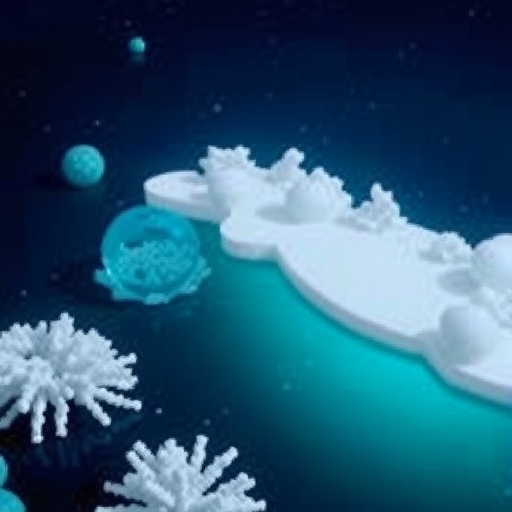
The ocean’s depths have long been a realm of mystery, not least because of the ubiquitous phenomenon known as marine snow—tiny particles drifting through the water column like microscopic snowfall. While these particles may seem innocuous, they harbor a complex microenvironment where critical biochemical processes unfold, shaping global carbon cycles in ways scientists are only beginning to understand. Recently, researchers from Rutgers University-New Brunswick have uncovered a significant factor affecting these particles: bacteria that catalyze the dissolution of calcium carbonate, a key component of marine snow, thereby influencing the ocean’s capacity to sequester carbon.
Marine snow is composed primarily of organic detritus and inorganic materials, including calcium carbonate (CaCO3) derived from the shells of marine organisms. This calcite, the crystalline form of calcium carbonate, serves as ballast, helping particulate matter sink through the water column, transporting carbon from the atmosphere to the seabed. However, a perplexing inconsistency has troubled oceanographers: calcium carbonate tends to dissolve in the upper layers of the ocean despite chemical conditions there not favoring such mineral dissolution. The new study provides compelling evidence that microbial activity within marine snow particles creates acidic microenvironments that enable this dissolution process.
Lead author Benedict Borer, an assistant professor specializing in marine and coastal sciences, describes marine snow particles as “megacities” for microbial life. Within the minuscule internal spaces of these aggregates, dense colonies of bacteria metabolize organic substrates, respiring oxygen and producing carbon dioxide. The accumulation of CO2 acidifies the local environment, lowering pH levels around calcite grains and thus accelerating their dissolution. This process effectively reduces the mass of the calcite ballast, consequently decreasing the sinking velocity of marine snow and impairing the efficiency of carbon sequestration in the deeper ocean.
To probe this intricate mechanism, Borer and his team engineered a sophisticated three-layer microfluidic chip designed to mimic marine snow as it sinks through a stratified water column. The central channel housed calcite particles colonized by marine bacteria, while flanking channels circulated artificial seawater to simulate ocean currents and gradients. This microcosm allowed precise control over ambient conditions such as temperature, pressure, oxygen concentration, and bacterial abundance, enabling detailed observation of how microbial metabolic rates influence calcite chemistry under realistic scenarios.
Experimental data revealed that as bacterial populations thrived within the artificial marine snow, their respiration-generated acidity chemically eroded calcite particles. This microbial-enhanced dissolution is particularly striking because it occurs in regions where classical ocean chemistry models predict calcite should remain stable or even precipitate. The acknowledgment of these microscale processes necessitates a reassessment of how sedimentation rates and carbon export in global biogeochemical models are conceptualized, emphasizing the disproportionate influence of microbial niches on large-scale oceanic carbon fluxes.
This discovery also holds profound implications for climate science, as the biological carbon pump—the mechanism by which oceanic phytoplankton fix atmospheric CO2 into organic matter and carbonate shells that descend into the ocean interior—is critical for modulating Earth’s climate. The efficiency of this pump depends heavily on how effectively carbon-laden particles sink and are sequestered in the deep ocean. If bacterial activity reduces calcite ballast, particles linger longer in shallower, more oxygenated waters, where remineralization returns CO2 to the atmosphere, potentially diminishing the ocean’s role as a carbon sink.
Moreover, these findings underscore a feedback loop whereby increased bacterial respiration could accelerate the release of CO2, a potent greenhouse gas, counteracting efforts to mitigate climate change. The dual role bacteria play—both in breaking down organic carbon and dissolving inorganic calcium carbonate—adds complexity to the interplay between marine biology and ocean chemistry, challenging existing paradigms that often treat these processes separately.
While the findings are derived from laboratory simulations, the authors stress the necessity of validating these mechanisms in situ across diverse oceanic environments. Natural marine snow exhibits tremendous heterogeneity in composition, microbial assemblages, and physical dynamics, all of which likely modulate the rate and extent of calcite dissolution. Future oceanographic expeditions combining microfluidic technologies, molecular biology, and geochemical measurements will be crucial to quantify the global impact of microbial-enhanced calcite dissolution on the marine carbon cycle.
Borer also highlights the urgency of integrating microbial ecology into future climate models. Current Earth system models typically emphasize physical and chemical oceanographic processes but often omit the nuanced contributions of microbial metabolisms residing within microscopic particles. Recognizing and incorporating these microbial interactions could refine projections of oceanic carbon sequestration under scenarios of warming, acidification, and changing nutrient regimes.
The implications extend beyond modeling into the realm of geoengineering. Strategies proposed to enhance the biological carbon pump, such as fertilizing phytoplankton blooms to increase carbon export, must consider how microbial activity within sinking particles might alter the fate of carbon. An understanding of microbial calcite dissolution dynamics could help identify potential pitfalls or optimize interventions to bolster natural carbon sinks.
The broader oceanographic community is taking note of this paradigm shift, with the new study positioned as a pivotal contribution to unraveling one of the ocean’s longest-standing chemical mysteries. By illustrating how microbial processes at the micro-scale have macro-scale consequences, this research serves as a critical reminder of the interconnectedness of biological, chemical, and physical systems within the ocean.
In sum, the revelation that bacteria within marine snow drive calcium carbonate dissolution near the ocean surface offers a transformative perspective on the ocean’s carbon cycle. This mechanism potentially dampens the ocean’s ability to sequester carbon by slowing particulate sinking rates and enhancing CO2 release; an effect that could exacerbate climate warming. As researchers delve deeper into these microbial microcosms, they hope to capture the nuanced feedbacks governing Earth’s future climate, navigating a delicate balance where the ocean’s tiny inhabitants wield outsized influence.
News Publication Date: Not specified
Web References:
- https://marine.rutgers.edu/team_mf/benedict-borer/
- https://www.whoi.edu/ocean-learning-hub/ocean-topics/how-the-ocean-works/cycles/biological-carbon-pump-ocean-topic
- DOI: 10.1073/pnas.2510025123
References: Proceedings of the National Academy of Sciences (PNAS), DOI: 10.1073/pnas.2510025123
Cite Scienmag News
Eleanor Cresswell. (March 9, 2026). Scientist Explores Ocean’s Marine ‘Snow’ for Clues to Future Climate. Scienmag. https://scienmag.com/scientist-explores-oceans-marine-snow-for-clues-to-future-climate/
Eleanor Cresswell. "Scientist Explores Ocean’s Marine ‘Snow’ for Clues to Future Climate." Scienmag, 9 March 2026, https://scienmag.com/scientist-explores-oceans-marine-snow-for-clues-to-future-climate/. Accessed 28 August 2026.
Eleanor Cresswell. "Scientist Explores Ocean’s Marine ‘Snow’ for Clues to Future Climate." Scienmag. March 9, 2026. https://scienmag.com/scientist-explores-oceans-marine-snow-for-clues-to-future-climate/


