


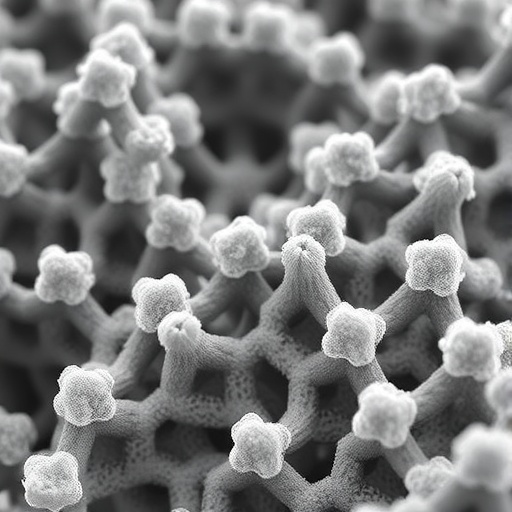
In the intricate world of catalysis, zeolites have long stood as pivotal materials, prized for their unique and confined nanoporous structures that create unparalleled environments for organic transformations. These crystalline aluminosilicate minerals serve as molecular sieves, enabling selective catalytic processes that are fundamental to the chemical industry. Despite their widespread use, delving into the mechanistic pathways behind zeolite-catalyzed reactions has presented persistent challenges, chiefly due to the prohibitively high costs and complexities associated with experimental investigations. Traditional computational methodologies, albeit insightful, have struggled to keep pace because they rely heavily on manual intervention and lack efficient scalability. This bottleneck has limited the throughput and breadth of transition-state searches within these confined spaces, impeding comprehensive mechanistic elucidation and the design of next-generation catalysts.
A breakthrough is on the horizon with the introduction of the pore transition-state finder, or PoTS, an innovative automated pipeline specifically engineered to locate transition states (TS) within zeolite nanopores. The development of PoTS represents a paradigm shift in computational catalysis, blending state-of-the-art density functional theory (DFT) calculations with sophisticated docking algorithms and advanced transition-state search techniques. This integrated workflow drastically minimizes the need for manual structural manipulation, considerably enhancing efficiency and accuracy. At its core, PoTS initiates by identifying gas-phase transition states using DFT, which are then precisely docked into active sites framed within the zeolite’s porous architecture. The system then leverages these reaction modes to seed condensed-phase TS searches employing the dimer method, an approach known for its robustness in navigating complex potential energy surfaces.
By automating the cumbersome and oftentimes subjective steps of previous methodologies, PoTS not only accelerates the TS location process but also significantly improves success rates. This is a critical advancement because traditional transition-state searches tend to be plagued by failures stemming from poor initial guesses or inadequate exploration of reaction coordinates. Furthermore, PoTS circumvents the need for prolonged path-following calculations, a typically resource-intensive component, by intelligently using the gas-phase TS as a springboard into the more complex zeolite environment. This strategic innovation slashes computational overhead and expedites the discovery of kinetically relevant transition states that are intimately influenced by the zeolite framework’s restrictive geometry and chemical microenvironment.
The implications of PoTS are far-reaching, especially when applied to a comprehensive DFT-level dataset comprising a variety of zeolite-confined transition states. In experimental cross-validation, PoTS demonstrated remarkable congruence, reproducing observed catalytic behaviors with a precision that enhances confidence in computational predictions. This alignment with experimental data bolsters the reliability of the underlying theoretical framework and sets a new benchmark for computational catalysis research. It provides researchers with a powerful tool to probe the subtleties of reaction mechanisms at an atomic level within zeolite pores, enabling them to visualize and quantify how confinement effects modulate activation barriers and reaction pathways—a key to rational catalyst design.
However, as with any groundbreaking technology, PoTS encounters intrinsic challenges that reflect both computational and theoretical limitations. Some transition-state searches within the zeolite matrix remain unsuccessful, attributed to the complex interplay between the zeolite’s structural heterogeneity and the dynamic nature of chemical species under catalytic conditions. Additionally, certain reaction types, such as alkene cracking, present unique theoretical complexities that PoTS must surmount. These reactions often involve extensive molecular rearrangements and multiple competing pathways, factors that strain the current capabilities of simplified reaction mode initialization and DFT accuracy. Recognizing these hurdles, the developers of PoTS articulate a clear trajectory for future advancements to refine search algorithms, expand reaction mode libraries, and incorporate higher-fidelity quantum chemical methods.
The promise of PoTS extends beyond high-throughput capabilities and mechanistic insight. It acts as a critical enabler for the rational design of zeolite-based catalysts tailored for specific organic transformations. By demystifying the transition states and energy landscapes associated with reactions inside nanopores, PoTS paves the way for targeted modifications of zeolite frameworks—be it through compositional tuning, pore size adjustment, or strategic doping. Such innovations could optimize catalytic efficiency, selectivity, and stability, driving forward applications in petrochemical refining, biomass conversion, and green chemistry initiatives. Ultimately, this level of control at the molecular scale redefines catalyst engineering, fostering sustainable and economically viable chemical processes.
From a methodological standpoint, PoTS exemplifies the confluence of machine learning, computational chemistry, and materials science. Its success hinges on the automated identification and docking of transition states, which requires sophisticated pose generation algorithms that can predict the optimal orientations and interactions of reactive intermediates within the zeolite architecture. Moreover, the use of the dimer method for TS searches capitalizes on its ability to locate saddle points on multidimensional potential energy surfaces without requiring full Hessian computations, thus offering an efficient means of exploring reaction coordinates. This integration of computational strategies under a unified pipeline showcases how modern catalysis research benefits from interdisciplinary techniques blending theoretical rigor with automation.
The scalability of PoTS is equally notable, as it supports large-scale screening efforts that were previously untenable due to manual workload and computational expense. Researchers can now rapidly execute hundreds or thousands of TS searches across varied zeolite topologies and reaction families, generating extensive datasets that feed into machine-learning models and inform catalyst development cycles. This high-throughput capacity also allows the identification of previously unknown reaction pathways or alternative catalytic sites within nanoporous structures, opening new frontiers in zeolite chemistry. By democratizing access to detailed transition-state information, PoTS empowers both academic and industrial scientists to accelerate innovation in heterogeneous catalysis.
Another critical aspect underscored by PoTS is the importance of combining gas-phase and condensed-phase calculations to capture the multifaceted nature of catalytic reactions in confinement. While gas-phase transition states offer a computationally tractable starting point, their subsequent adaptation inside zeolite pores incorporates environmental effects such as steric constraints, electrostatic interactions, and framework flexibility. This layered approach ensures the chemical realism of the TS structures and energy profiles derived from the pipeline, making PoTS a robust tool for predictive catalysis. The precision with which PoTS models these phenomena enhances our understanding of how molecular motions, active site accessibility, and zeolite acidity collectively orchestrate catalytic activity.
Despite the formidable achievements of PoTS, its developers acknowledge the necessity for ongoing refinement, particularly in addressing reactions with complex mechanism topologies and those susceptible to dynamic fluxionality. Enhancing the theoretical description of such systems might entail incorporating ab initio molecular dynamics or coupling to more expressive potential energy surface representations. Future work may also explore adaptive algorithms capable of dynamically adjusting search parameters based on real-time feedback from intermediate calculations. These enhancements aim to reduce the incidence of unsuccessful TS convergences and extend the pipeline’s applicability to an ever-wider array of catalytic processes confined within nanoporous materials.
In conclusion, the introduction of PoTS represents a monumental advance in catalysis research, seamlessly marrying automation with quantum chemical precision to unlock the mysteries of zeolite-catalyzed organic transformations. It addresses long-standing challenges by streamlining the transition-state search process, improving computational efficiency, and delivering results that resonate with experimental findings. By providing an accessible, scalable platform for the rapid elucidation of catalytic mechanisms within nanoporous environments, PoTS promises to catalyze new discoveries across a spectrum of chemical disciplines, ultimately fostering innovation that could redefine sustainable chemical manufacturing. As researchers continue to refine and expand this pipeline, the future of zeolite catalysis stands poised for unprecedented scientific and technological breakthroughs.
Cite Scienmag News
Bethany Barker. (March 9, 2026). Rapid Transition-State Discovery in Zeolite Nanopores. Scienmag. https://scienmag.com/rapid-transition-state-discovery-in-zeolite-nanopores/
Bethany Barker. "Rapid Transition-State Discovery in Zeolite Nanopores." Scienmag, 9 March 2026, https://scienmag.com/rapid-transition-state-discovery-in-zeolite-nanopores/. Accessed 4 September 2026.
Bethany Barker. "Rapid Transition-State Discovery in Zeolite Nanopores." Scienmag. March 9, 2026. https://scienmag.com/rapid-transition-state-discovery-in-zeolite-nanopores/


