


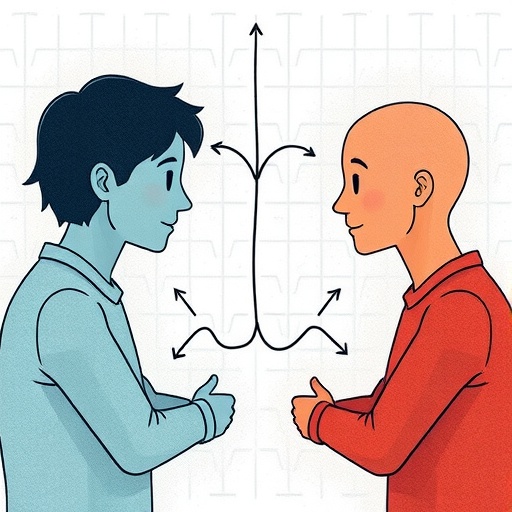
In recent years, the intersection of mental health and cognitive science has revealed intricate relationships between psychiatric symptoms and decision-making processes. A groundbreaking study published in Translational Psychiatry by Wise, Sookud, Michelini, and colleagues presents compelling evidence that mental health symptom dimensions across traditional diagnostic boundaries—known as transdiagnostic symptoms—are associated with how individuals engage in flexible, model-based inference during complex decision-making tasks. This research advances our understanding of mental health by moving beyond categorical diagnoses, emphasizing dimensional symptom profiles and their influence on cognitive control mechanisms within uncertain environments.
Traditional psychiatric nosology has long categorized mental health disorders into discrete, often rigid classifications such as depression, anxiety, or bipolar disorder. However, such categorizations frequently fail to capture the heterogeneity and overlapping features inherent in mental health conditions. The transdiagnostic approach adopted in this study challenges the classical paradigm by analyzing symptom dimensions that cut across traditional diagnostic categories. By doing so, the researchers explore how common cognitive processes are disrupted or preserved across a spectrum of psychiatric symptoms rather than within isolated disorders.
Central to this investigation is the concept of model-based inference, a sophisticated cognitive strategy that enables individuals to anticipate future outcomes by constructing and utilizing internal models of the environment. Unlike habitual, model-free decision-making, which relies on cached values from previous experiences, model-based inference is flexible and computationally demanding, incorporating prospective planning and probabilistic reasoning. This study probes how individuals exhibiting varying levels of transdiagnostic mental health symptoms engage differently with these model-based strategies when navigating complex, uncertain task environments.
The experimental paradigm employed involved participants undertaking decision-making tasks that simulate real-world complexity, where outcomes are contingent on sequences of actions rather than immediate choices. Sophisticated computational modeling allowed the research team to parse participants’ behavior into contributions from model-based and model-free systems. This dual-system framework, grounded in reinforcement learning theory, operationalizes the distinction between flexible, forward-looking strategies and habitual, feedback-driven learning.
One of the most striking findings from the research was the differential predictive power of distinct symptom dimensions on model-based inference. Contrary to simplistic assumptions that higher symptom severity uniformly impairs cognitive control, specific symptom clusters were linked with nuanced changes in participants’ engagement with model-based reasoning. For example, anxiety-related symptoms correlated with increased reliance on flexible model-based processes, possibly reflecting heightened environmental vigilance, while depressive symptoms showed the opposite pattern, aligning with known deficits in executive function and cognitive flexibility seen in depression.
Such dimension-specific associations bear significant implications for psychiatric treatment and cognitive remediation approaches. Understanding that anxiety symptoms may enhance certain adaptive decision-making processes suggests that therapies could leverage these intact or even heightened cognitive faculties. Conversely, recognizing that depressive symptomatology undermines model-based control underscores the need for interventions targeting cognitive flexibility, perhaps through cognitive training or neuromodulatory techniques.
Moreover, this study underscores the relevance of computational psychiatry—a burgeoning field applying mathematical and algorithmic frameworks to decode mental health disorders. By capturing nuanced decision-making patterns through computational models, the research transcends subjective symptom reports and the limitations of clinical observation alone, offering a mechanistic lens onto cognitive dysfunction in psychiatric illness.
The task environment utilized in this research was deliberately designed to be complex and dynamic, mirroring the uncertain, multifaceted challenges encountered in everyday life. This ecological validity strengthens the translational value of the findings, suggesting that impaired or altered model-based inference in clinical populations may contribute to difficulties in real-life planning, adaptability, and coping.
Further technical insights emerge from the reinforcement learning models applied, which assume participants balance two competing systems: the habitual or model-free system relying on cached action values and the cognitive-demanding model-based system mapping probabilistic state transitions. The relative weighting between these systems was quantitatively linked to individuals’ symptom profiles, enabling a continuous rather than categorical characterization of mental health influences on cognition.
Interestingly, the study’s sample included a broad range of symptom severities and diagnostic histories, enhancing the generalizability of the results. By integrating extensive clinical assessments with high-resolution behavioral and computational data, this research presents a powerful paradigm for dissecting the cognitive architecture underlying mental health disorders beyond conventional diagnostic silos.
The implications of these findings extend beyond academia into potential clinical applications. For example, computational assays derived from such tasks could serve as objective biomarkers for monitoring treatment efficacy or tailoring personalized interventions based on an individual’s cognitive profile and symptom constellation.
From a neuroscientific perspective, the study lays the groundwork for future investigations probing the neural correlates of transdiagnostic symptom dimensions and their modulation of decision-making circuitry, including prefrontal cortical networks implicated in cognitive control and planning. Advances in neuroimaging combined with computational modeling could reveal mechanistic underpinnings and therapeutic targets for various psychiatric conditions.
Furthermore, the research contributes to ongoing debates regarding the heterogeneity within psychiatric disorders and the push toward precision psychiatry. By illuminating how symptom dimensions influence fundamental cognitive computations, this study challenges one-size-fits-all treatment models and advocates for tailored strategies that consider cognitive profiles alongside symptomatology.
Critically, the authors acknowledge limitations related to cross-sectional design and the need for longitudinal studies that track how changes in symptom dimensions influence model-based inference over time. Additionally, expanding samples to include more diverse populations and comorbid conditions will be essential to refine the generalizability and clinical utility of these insights.
In summary, the pioneering work by Wise et al. represents a significant leap in bridging cognitive neuroscience with psychiatric research, showing that transdiagnostic mental health symptom dimensions predict individual differences in flexible model-based inference within complex, uncertain environments. This integrative computational approach opens new avenues for understanding mental health conditions through the lens of cognitive mechanisms, ultimately fostering more personalized and effective therapeutic strategies.
As mental health disorders continue to pose substantial challenges globally, innovative approaches such as this illuminate pathways toward nuanced characterization and intervention strategies. The intersection of transdiagnostic symptom assessment, computational modeling, and decision neuroscience promises to refine our grasp of psychiatric disorders, transcending the limitations of conventional diagnoses and harnessing cognitive phenotyping for clinical breakthroughs.
The future of mental health research and treatment likely depends on such integrative, mechanistic frameworks that reconcile behavioral data, computational methods, and clinical symptomatology. By focusing on fundamental cognitive operations like model-based inference, this work exemplifies the transformative potential of computational psychiatry to unravel the complexities of the mind and improve outcomes for those affected by mental illness.
Cite Scienmag News
Glenn Wilkins. (March 7, 2026). Mental Health Symptoms Shape Adaptive Decision-Making Strategies. Scienmag. https://scienmag.com/mental-health-symptoms-shape-adaptive-decision-making-strategies/
Glenn Wilkins. "Mental Health Symptoms Shape Adaptive Decision-Making Strategies." Scienmag, 7 March 2026, https://scienmag.com/mental-health-symptoms-shape-adaptive-decision-making-strategies/. Accessed 3 September 2026.
Glenn Wilkins. "Mental Health Symptoms Shape Adaptive Decision-Making Strategies." Scienmag. March 7, 2026. https://scienmag.com/mental-health-symptoms-shape-adaptive-decision-making-strategies/


