

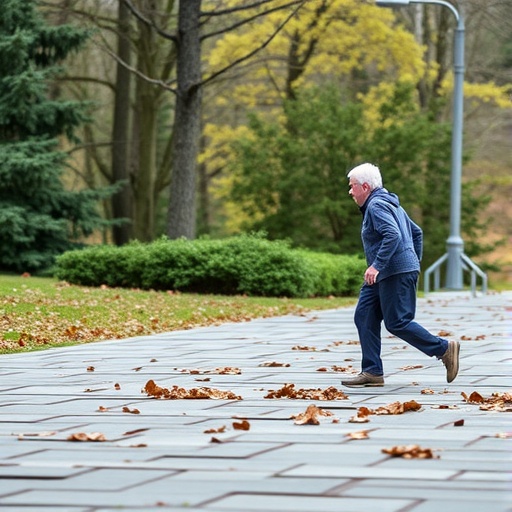
As populations worldwide increasingly age, the health and safety of older adults have surged to the forefront of public health priorities. Among the myriad challenges faced by the elderly, falls remain a persistent and often devastating concern that can significantly compromise quality of life. Recent research conducted by Pitskhelauri, Kareli, Dochviri, and colleagues sheds new light on this critical issue by rigorously examining the prevalence of falls and the intricate web of associated risk factors among older adults in Georgia. Their study, published in the prestigious journal BMC Geriatrics in 2026, emerges as a seminal contribution to geriatric health science and offers vital insights with implications well beyond the Georgian context.
Falls constitute one of the leading causes of injury-related morbidity and mortality among older adults globally. They frequently initiate a cascade of adverse outcomes, including fractures, head injuries, prolonged hospital stays, and in many cases, a downward spiral into loss of independence and increased need for institutional care. Understanding the epidemiology of falls within specific populations allows for tailored preventative strategies and healthcare policies, making localized studies like the Georgian one invaluable. The researchers embarked on an ambitious project to quantify fall prevalence and elucidate the interplay of intrinsic and extrinsic factors influencing fall risk in this unique demographic setting.
Central to the researchers’ inquiry was a comprehensive cross-sectional study design encompassing a broad spectrum of community-dwelling older adults. This large-scale analysis utilized structured interviews and standardized assessment tools to capture multifaceted data, ranging from medical history and physical performance measures to environmental and psychosocial determinants. Such methodological rigor ensures that the findings reflect a nuanced portrait of fall risk beyond mere statistical incidence, incorporating a holistic understanding of underlying mechanisms.
One of the study’s pivotal findings is the remarkable prevalence of falls reported among Georgian seniors, underscoring falls as a significant public health challenge within this population. The prevalence figures resonate with global trends yet reveal distinct patterns reflective of regional socio-cultural and environmental contexts. These fall events were not solely confined to those with advanced frailty but were widely distributed across different age cohorts, emphasizing the need for universal prevention measures rather than exclusive targeting of the frailest individuals.
Crucially, the research identifies a constellation of risk factors that independently and synergistically elevate fall risk. These include physiological declines such as impaired balance, muscle weakness, and sensory deficits, all characteristic of aging. Additionally, chronic comorbidities like cardiovascular diseases, diabetes, and cognitive impairments compound vulnerability. Intriguingly, the study also highlights the influence of psycho-social variables including fear of falling, depression, and social isolation, which can exacerbate physical frailty and precipitate falls by reducing activity levels and environmental engagement.
Environmental conditions emerged as another pivotal domain influencing fall risk. The Georgian older adult population often encounters housing environments with suboptimal safety measures—uneven flooring, poor lighting, and lack of assistive devices are commonplace. These physical barriers amplify the probability of accidental falls, demonstrating the critical importance of modifications at the infrastructure level in fall prevention. The researchers advocate for concerted public health initiatives aiming at home safety evaluations and adaptations to mitigate these extrinsic risk factors.
An intriguing aspect of the study lies in its exploration of preventive factors that may mitigate fall risk. Adequate nutritional status, regular physical activity emphasizing balance and strength training, and proactive management of chronic diseases were all shown to confer protective effects. These findings align with the broader gerontological literature but gain depth in the Georgian context, where traditional lifestyles and health behaviors add layers of complexity to intervention design.
The intersection of cultural elements and health-seeking behaviors provides a compelling dimension underscored by the study. The researchers note that cultural attitudes towards aging, fall incidents, and healthcare utilization significantly impact reporting accuracy and willingness to engage in preventative practices. This underlines the necessity of culturally sensitive health education programs that resonate with local beliefs and norms to enhance acceptability and adherence.
Methodologically, the study’s application of advanced statistical models enables discerning subtle interactions among multifactorial risks, facilitating identification of high-risk phenotypes warranting targeted intervention. For example, elders exhibiting both physical impairment and depressive symptoms represent a subgroup with disproportionately elevated fall incidence. The application of such precision public health approaches heralds a new frontier in geriatric care, moving beyond one-size-fits-all solutions.
The research also touches upon the economic ramifications of falls, which bear substantial direct costs through medical treatment and rehabilitation and indirect costs via caregiver burden and loss of productivity. The escalating healthcare expenditure associated with aging populations necessitates cost-effective preventive strategies. The study’s findings can inform cost-benefit analyses vital to policymakers seeking sustainable health system solutions.
Importantly, the authors call for integrative multi-disciplinary frameworks encompassing geriatricians, physical therapists, social workers, and community organizations to holistically address fall prevention. Such collaborative models are essential to navigate the complexities of risk factor interaction and to tailor interventions to individual and community needs. Enhanced training and resources for primary care providers likewise feature as recommended pillars of an effective fall prevention ecosystem.
In a forward-looking perspective, the study advocates leveraging technological innovations such as wearable sensors for real-time fall risk monitoring and telehealth platforms for remote rehabilitation guidance. The integration of data-driven approaches promises to revolutionize monitoring and personalized intervention delivery, particularly relevant in settings with limited healthcare access.
The implications of the Georgian study reverberate globally, providing a blueprint for other regions confronting similar demographic and health challenges. It underscores the universal urgency of fall prevention as integral to healthy aging paradigms. Embedding these insights into public health frameworks can dramatically reduce preventable injuries and empower older adults to maintain autonomy and vitality.
Overall, the research by Pitskhelauri and colleagues represents a landmark in understanding falls among older adults in Georgia. Its comprehensive approach encapsulates the biological, environmental, and socio-cultural determinants of fall risk with sophistication and clarity. The study’s enriching findings not only advance academic discourse but also chart a pragmatic roadmap toward mitigating a pervasive geriatric menace.
As societies worldwide grapple with the complexities of aging populations, this work offers a clarion call for urgent, informed, and culturally attuned preventative strategies to curtail the toll of falls. Harnessing interdisciplinary expertise, technological progress, and community engagement will be vital to translating these research insights into tangible health outcomes for older adults both in Georgia and globally.
Subject of Research: Prevalence of falls and associated risk-factors among older adults in Georgia.
Article Title: Prevalence of falls and associated risk-factors among Georgian older adults.
Article References:
Pitskhelauri, N., Kareli, M., Dochviri, T. et al. Prevalence of falls and associated risk-factors among Georgian older adults. BMC Geriatr (2026). https://doi.org/10.1186/s12877-026-07310-3
Image Credits: AI Generated


