


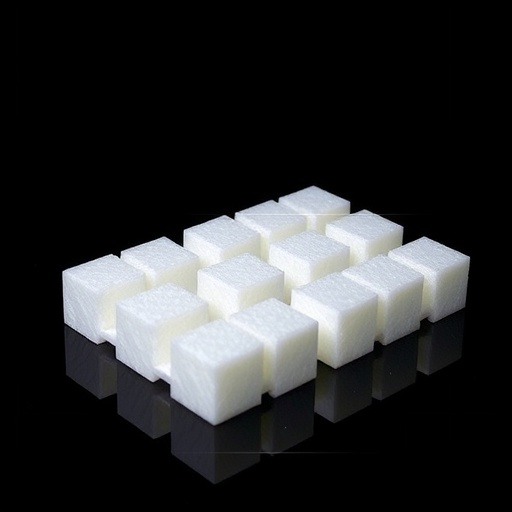
In a landmark advancement set to revolutionize energy-absorbing materials, researchers in aerospace engineering and materials science at Texas A&M University, in close collaboration with the DEVCOM Army Research Laboratory, have unveiled a groundbreaking hybrid “super foam” composite. This next-generation material boasts an impressive capacity to absorb up to ten times more energy than conventional foam padding, a feat that promises transformative implications for defense, automotive, aerospace, and consumer safety applications.
At the core of this innovation lies a novel manufacturing technique termed In-Foam Additive Manufacturing (IFAM). Unlike traditional foams that rely on random internal structures to dissipate energy, the IFAM process enables the precise 3D printing of a network of elastomeric plastic columns—referred to as struts—within the matrix of an ordinary open-cell foam. This meticulous engineering of the hybrid foam’s architecture fosters a synergistic interplay between the foam and these embedded struts, enabling unprecedented energy absorption and mechanical resilience.
One of the challenges that have historically hindered foam material optimization is the tradeoff between affordability and engineered precision. Conventional foams offer economic viability but lack control over internal microstructure, limiting their energy absorption capabilities. Conversely, cellular lattice materials deliver superior mechanical properties but come with high manufacturing costs and scalability issues. The introduction of IFAM deftly bridges this divide, leveraging computer-controlled additive manufacturing to tailor the foam’s internal skeleton with tunable parameters such as strut diameter, spacing, orientation, and elasticity.
The distinct mechanics underlying the super foam’s effectiveness stem from the cooperative load-sharing between the foam matrix and the embedded struts. During initial compression, the foam acts as a reinforcement, preventing premature buckling of the struts by providing a stabilizing scaffold. As compressive forces escalate, the struts activate by redistributing load throughout the foam network, mitigating stress concentration and enabling the composite to collectively dissipate greater amounts of energy. This dynamic, reciprocal interaction exemplifies a new era of material design founded upon synergy rather than simple additive performance enhancements.
Aerospace engineer Dr. Mohammad Naraghi, who leads the Nanostructured Materials Lab at Texas A&M’s College of Engineering, emphasizes the tunability of this composite system. By modulating the geometric and mechanical properties of the struts, researchers can calibrate the foam to prioritize energy absorption, stiffness, or comfort, or even tailor hybrids that harmonize multiple performance metrics. This bespoke adaptability opens exciting possibilities for diverse areas ranging from protective gear to automotive crash safety and ergonomic consumer products.
Foremost among the immediate applications of the super foam is the defense sector, where its integration into ballistic helmets and blast-resistant seating offers critical improvements. The Army-funded research highlights that such enhancements could reduce the severity of impact-related injuries in combat, simultaneously improving soldier mobility and endurance by adding minimal additional weight. The unique IFAM-fabricated composite develops a resilient yet lightweight cushioning solution that outperforms existing padding technologies while ensuring wearer comfort over extended missions.
Beyond military use, the hybrid foam’s potential extends to civilian applications, particularly in protective sports equipment and vehicular safety systems. Helmets for bicycles, motorcycles, and other high-impact activities could benefit immensely from this material’s superior energy dissipation, enhancing user safety against concussive forces. Furthermore, the foam’s deployability in vehicle bumpers and interior padding offers a promising route to advance crashworthiness, especially for passenger and child safety seats where shock absorption and tailored cushioning directly impact outcomes in collisions.
Intriguingly, the research team envisions that the super foam’s utility may transcend physical protection. Early investigations suggest the internal strut network could be engineered to achieve tailored acoustic damping properties. By tuning the hybrid foam’s microstructure, it could serve as an advanced sound insulator capable of filtering undesirable low-frequency noises commonly encountered in aircraft cabins, automobiles, and buildings. This dual mechanical-acoustic effectiveness represents a forward-thinking paradigm in multifunctional material design that could redefine comfort and safety standards.
In addition to these applications, the hybrid super foam heralds a new frontier in personalized comfort through zonal tuning in cushions and mattresses. Such materials allow different regions of a seating surface to exhibit varying degrees of firmness and elasticity, conforming intimately to users’ anatomical needs. This capability promises an end to the inadequacy of one-size-fits-all cushioning, replacing it with engineered ergonomics that promote health, posture, and enhanced user experience—extending the military-grade innovation into everyday life.
Collaboration between academia and mission-driven agencies like the ARL exemplifies the rapid translation of scientific innovation into impactful technology. Dr. Eric Wetzel of ARL underscores that combining Texas A&M’s fundamental material science expertise with the laboratory’s applied research capabilities catalyzes development pathways for realistic, scalable manufacturing. Such synergistic teamwork accelerates the readiness and deployment potential for cutting-edge materials designed to meet immediate and future Army requirements.
Ultimately, this hybrid super foam is an exemplary case of material science evolving from basic research to engineered solutions that address pressing needs across multiple domains. Its light weight, durability, and adaptable internal architecture afford not only superior performance but also economic viability and manufacturability. This composite redefines what foam materials can achieve, ushering in a new era of engineered cellular materials where functionality is designed from the inside out.
As Dr. Naraghi reflects, “Our goal at Texas A&M is to pioneer innovative technologies that tackle today’s challenges while anticipating tomorrow’s imperatives.” The super foam is poised to become a universal solution, offering enhanced protection, comfort, and acoustic control with the potential to save lives, improve safety, and elevate quality of life worldwide. With continued research and development, it stands on the cusp of transforming defense gear, transportation safety, noise management, and personalized comfort across industries.
News Publication Date: 1-May-2026
Web References:
https://doi.org/10.1016/j.compstruct.2026.120158
https://www.tamu.edu/
https://arl.devcom.army.mil/
References:
Naraghi, M., Wetzel, E.D. In-foam additive manufacturing: Elastomeric cellular composites with tunable mechanics. Composite Structures, Volume 383, 120158 (2026).
Cite Scienmag News
Denise Maddox. (March 6, 2026). Revolutionary Hybrid ‘Super Foam’: Lightweight, Ultra-Durable, and Tunable for Advanced Applications. Scienmag. https://scienmag.com/revolutionary-hybrid-super-foam-lightweight-ultra-durable-and-tunable-for-advanced-applications/
Denise Maddox. "Revolutionary Hybrid ‘Super Foam’: Lightweight, Ultra-Durable, and Tunable for Advanced Applications." Scienmag, 6 March 2026, https://scienmag.com/revolutionary-hybrid-super-foam-lightweight-ultra-durable-and-tunable-for-advanced-applications/. Accessed 3 September 2026.
Denise Maddox. "Revolutionary Hybrid ‘Super Foam’: Lightweight, Ultra-Durable, and Tunable for Advanced Applications." Scienmag. March 6, 2026. https://scienmag.com/revolutionary-hybrid-super-foam-lightweight-ultra-durable-and-tunable-for-advanced-applications/


