


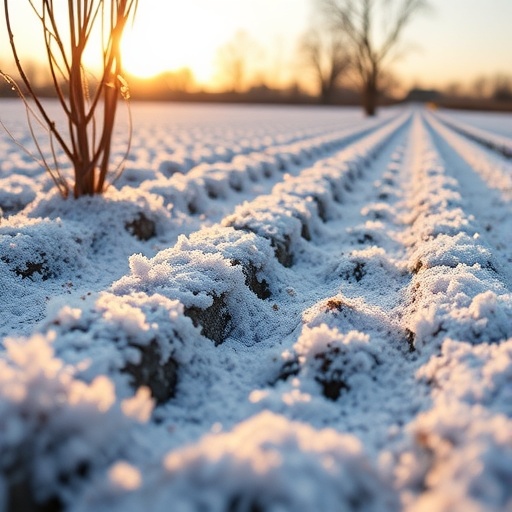
In the intricate dance of life on Earth, the timing of spring’s arrival plays a critical role in shaping ecosystems, agricultural yields, and even the global climate. A groundbreaking study by Yan, Chen, Liu, and colleagues, recently published in Nature Communications, delves into an age-old dilemma that has perplexed ecologists and evolutionary biologists alike: balancing the onset of spring phenology with the ever-present threat of lethal frost. Through an expansive meta-analysis, this research quantifies the trade-offs plants face between emerging early to optimize growth and reproduction, and delaying leaf-out or flowering to avoid frost damage. The findings illuminate fundamental biological strategies and offer vital insights for managing ecosystems in an era of unprecedented climatic uncertainty.
Spring phenology—the timing of naturally occurring biological events such as budburst and flowering—is governed by a complex interplay of environmental cues, primarily temperature and photoperiod. Plants have evolved intricate mechanisms that cue growth to coincide with favorable climatic windows. However, climate variability injects considerable risk, particularly from late-season frosts that can decimate young tissues. The authors’ analysis synthesizes data from decades of phenological observations and frost impact assessments across varied biomes, species, and latitudinal gradients, uncovering patterns that underscore the evolutionary calculus plants perform to thrive.
One of the core revelations is the quantifiable relationship between advancing spring phenology and the increasing probability of lethal frost events. Early emergence enables plants to maximize photosynthetic activity, lengthen growing seasons, and secure reproductive success, but it simultaneously exposes tender buds and leaves to damaging cold snaps. Conversely, conservative phenologies mitigate frost risk but potentially sacrifice valuable time needed for growth and reproduction. This trade-off is not static; it dynamically shifts in response to changing climate regimes, species-specific sensitivities, and local environmental contexts.
From a mechanistic perspective, the study highlights how temperature thresholds modulate bud dormancy release, with species exhibiting nuanced thermal requirements that delay or hasten spring activity. These physiological underpinnings explain differential frost vulnerability observed among taxa. For instance, species with obligate chilling requirements experience a delayed phenological onset, effectively evading early frosts but risking a condensed growing period. Meanwhile, species relying heavily on cumulative temperature cues may spring forward prematurely during warm spells, risking extensive frost damage when cold snaps follow.
Geographical patterns bring further complexity to this ecological balancing act. High-latitude and high-altitude environments, where frost events linger later into the season, force a more cautious phenological strategy. Plants in these regions tend to delay leaf-out relative to lowland populations, despite shorter growing seasons. The meta-analysis consolidates evidence that this latitude-dependent frost risk shapes distinct adaptive phenologies, which in turn influence community composition and ecosystem function. Moreover, these patterns are projected to shift as global warming alters frost frequencies and seasonal temperature norms.
Ecologically, the consequences of frost damage extend beyond immediate tissue mortality. Frost events can disrupt flowering phenology, impair reproductive success, and cascade through trophic interactions—including pollinator availability and herbivore feeding patterns. The study elucidates how negative impacts on vulnerable developmental stages propagate through plant populations, altering competitive dynamics and potentially driving evolutionary pressures towards phenological plasticity or genetic adaptation.
Crucially, this research transcends ecological theory, offering practical implications for agriculture and forestry sectors. As spring frost events become more erratic under climate change, understanding phenological responses enables better crop management, frost protection strategies, and selection of resilient cultivars. The authors argue that integrating this meta-quantitative understanding into predictive models can enhance forecasting accuracy of frost risks, thereby assisting stakeholders in mitigating damage and safeguarding food security.
The interplay between advancing spring phenology and frost risk is emblematic of broader biological trade-offs emerging under rapid environmental change. This study’s synthesis reinforces the notion that phenological timing represents an evolutionary compromise shaped by multifaceted selective pressures. Plants cannot simultaneously optimize for all environmental variables; instead, they navigate a landscape of risk and opportunity, with frost frequency acting as a powerful arbiter.
Importantly, the meta-analysis emphasizes the role of interspecific variation and phenotypic plasticity. Not all species—or even populations within a species—respond identically to thermal cues or frost risk. This heterogeneity introduces complexity in predicting community-level responses to climate change but also suggests reservoirs of adaptive potential. Some species might shift phenologies adaptively, while others may face elevated mortality and reduced fitness, potentially altering species distributions and ecosystem resilience.
Further technical insights arise from methodological advancements showcased in the study. Leveraging meta-analytic techniques allowed the authors to integrate data sets ranging from long-term field observations to controlled frost exposure experiments. This approach enabled statistically robust quantification of trade-offs across diverse taxa and spatial scales, a feat difficult to achieve through singular field studies. The integration of phenological modeling with frost risk metrics represents a powerful framework for future eco-climatic research.
The study also calls attention to the inadequacies of current climate models in representing frost risk at phenological time scales. Despite improvements in temperature projections, the stochastic nature of frost events—driven by complex atmospheric processes—poses challenges for predictive ecology. The authors advocate for interdisciplinary collaborations that combine high-resolution meteorological data with biological models, aiming to refine risk assessments integral to conservation and land management policies.
Looking ahead, the findings prompt urgent questions about how continued warming trends will reshape these phenological-frost trade-offs globally. While general warming might reduce frost frequency, paradoxically, increased climate variability could heighten frost event unpredictability. The interplay of these factors will dictate whether plants can maintain or recalibrate phenological timing without compromising survival. This makes longitudinal monitoring and mechanistic research imperative for anticipating ecosystem trajectories.
A profound takeaway is the vulnerability of temperate and boreal forests, which comprise species finely tuned to narrow frost-free windows. Disruptions in phenological synchrony may lead to increased mortality, reduced carbon sequestration, and perturbations in forest structure, with cascading effects on biodiversity and climate feedbacks. Strategies that foster genetic diversity and promote phenological resilience emerge as critical conservation priorities.
In synthesizing decades of research, Yan and colleagues have illuminated a central axis of plant life history strategy, quantifying how the race to embrace spring’s warmth is counterbalanced by the shadow of frost. This elegant quantification of a biological paradox deepens our understanding of plant ecology and fortifies our capacity to predict and manage ecological futures amid climatic upheaval. As the planet continues to warm unevenly and unpredictably, comprehending these trade-offs will be indispensable to safeguarding ecosystems, agriculture, and biodiversity.
The study stands as a testament to the power of meta-analytical science in resolving complex ecological questions, revealing that in the natural world, timing truly is everything. For plants, the choice to awaken heralds both opportunity and peril, a delicate synchronization composed over evolutionary time and now challenged by a rapidly shifting climate orchestra.
Cite Scienmag News
Gavin Prescott. (March 6, 2026). Balancing Spring Growth and Frost Risk: A Meta-Analysis. Scienmag. https://scienmag.com/balancing-spring-growth-and-frost-risk-a-meta-analysis/
Gavin Prescott. "Balancing Spring Growth and Frost Risk: A Meta-Analysis." Scienmag, 6 March 2026, https://scienmag.com/balancing-spring-growth-and-frost-risk-a-meta-analysis/. Accessed 3 September 2026.
Gavin Prescott. "Balancing Spring Growth and Frost Risk: A Meta-Analysis." Scienmag. March 6, 2026. https://scienmag.com/balancing-spring-growth-and-frost-risk-a-meta-analysis/


