


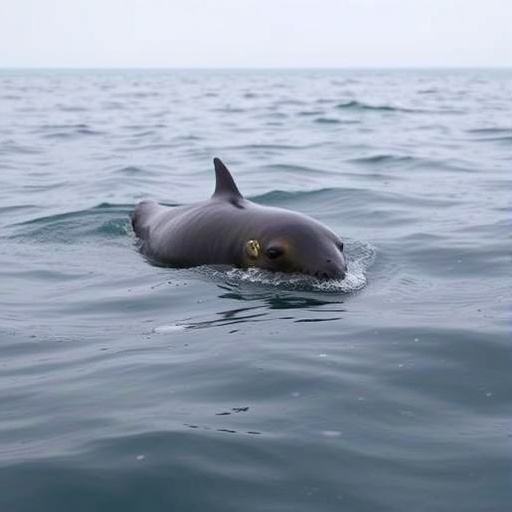
In the remote waters surrounding Shetland, a remarkable breakthrough in marine biology has been achieved through the use of drone technology. Researchers have captured unprecedented footage of harbour porpoises, revealing previously unseen social behaviors and mating dynamics within unusually large groups. This study, spanning from 2019 to 2023, offers the most comprehensive documentation of harbour porpoise mating behavior recorded in UK waters to date, potentially reshaping our understanding of this elusive cetacean species.
Harbour porpoises, commonly inhabiting Scottish coastal waters, are notoriously difficult to study due to their small size, rapid movements, and brief surfacing intervals. Traditional observation methods, such as boat or land-based watching, often fail to capture their full behavioral repertoire. The advent of drone technology has provided researchers with a novel aerial perspective, enabling continuous and detailed observation while minimizing disturbance to the animals. This vantage point has unveiled complex social interactions that had eluded scientists for decades.
The research was spearheaded by Sophie Ariadne Francine Smith from UHI Shetland as part of her doctoral studies, during which she also became a licensed drone pilot. The project was catalyzed by an observation from Karen Hall of NatureScot, Sophie’s PhD supervisor, who noted unusual surface splashing that hinted at mating activity. Recognizing the limitations of existing monitoring methods, the team deployed drones to capture this ephemeral behavior, which typically lasts only a few seconds per surfacing event.
Analyzing over 79 minutes of high-quality footage from diverse coastal locations including Gulberwick Bay, South Nesting Bay, Mousa Sound, and Quendale Bay, the scientists identified gatherings of harbour porpoises in numbers far exceeding prior expectations. While previous reports tended to record porpoises in pairs or triplets, the drones documented assemblies of up to 26 individuals simultaneously. This finding suggests that harbour porpoise social structures are considerably more complex and dynamic than previously understood.
The researchers observed two distinct types of sexual behaviors. The first involved males swiftly approaching females in what appeared to be copulation attempts. These vigorous interactions often culminated in individual porpoises breaking the surface amidst conspicuous splashing—a phenomenon initially captured by onshore observers. The second behavior comprised a specific form of display where males would roll to reveal their undersides to females, presumably as part of a courtship ritual or sexual signaling mechanism.
This detailed characterization of porpoise mating behavior is significant not only for ethologists but also for conservationists aiming to protect these marine mammals. Harbour porpoises, despite their relative abundance locally, remain vulnerable due to their elusive nature and the increasing anthropogenic pressures in their habitats. By understanding when and where they congregate, and the social contexts driving these gatherings, conservation management can be finely tuned to mitigate risks such as bycatch, noise pollution, and habitat disruption.
The contributions of this study extend beyond mere behavioral cataloging; they emphasize the intersection of ecology, technology, and community involvement. Collaborating closely with Shetland residents and incorporating local ecological knowledge allowed the research team to optimize their data collection within the narrow and often challenging weather windows characteristic of the region. This synergy between science and community exemplifies how participatory approaches can enhance the effectiveness of marine spatial planning and species conservation.
Dr. Lauren McWhinnie from Heriot-Watt University, a co-supervisor of the research, highlighted the broader implications of these findings. Although North Sea harbour porpoise populations are considered relatively stable, fine-scale regional data such as this are critical for assessing local threats and guiding strategic interventions. These efforts align with the designation of Shetland and Fair Isle as an Important Marine Mammal Area (IMMA) in 2024, underscoring the international commitment to safeguard key cetacean habitats.
Moreover, Dr. Rachel Shucksmith of UHI Shetland emphasized the innovative aspect of drone deployment in marine mammal research. Despite the logistical constraints posed by Shetland’s often inclement weather, the technological advancements utilized in this project allow for unprecedented behavioral observation. This methodological innovation paves the way for future studies across other challenging marine environments, promising richer insights into cetacean ecology and behavior globally.
The funding for this research was provided by the NERC Scottish Universities Partnership for Environmental Research (SUPER) Doctoral Training Partnership and supplemented by the National Lottery Heritage Fund. Such support underscores the growing recognition of marine mammal research as a vital component of environmental stewardship. The diverse expertise involved, including supervisors from the Scottish Association for Marine Science (SAMS) and NatureScot, as well as collaborative input from multiple scientists, reflects the interdisciplinary nature required to advance our understanding of these enigmatic creatures.
In essence, this research not only documents the social and reproductive behaviors of harbour porpoises in unprecedented detail but also demonstrates the transformative potential of integrating emerging technologies with traditional ecological inquiry. As climate change and human activity continue to alter marine ecosystems, such detailed baseline studies become ever more crucial. This work sets a new standard for marine mammal behavioral research and conservation strategy, offering hope that we can protect these vital species through informed, adaptive management.
The culmination of this study was published in the Journal of the Marine Biological Association of the United Kingdom on March 5, 2026, under the title “Sexual interactions and unexpected group sizes in harbour porpoises.” This seminal article invites further research and discussion, driving a paradigm shift in how scientists and policymakers approach the study and safeguarding of harbour porpoises and similar marine mammals worldwide.
Cite Scienmag News
Margaret Porter. (March 5, 2026). Rare Mating Behavior of Harbour Porpoises Documented by Drones off Shetland. Scienmag. https://scienmag.com/rare-mating-behavior-of-harbour-porpoises-documented-by-drones-off-shetland/
Margaret Porter. "Rare Mating Behavior of Harbour Porpoises Documented by Drones off Shetland." Scienmag, 5 March 2026, https://scienmag.com/rare-mating-behavior-of-harbour-porpoises-documented-by-drones-off-shetland/. Accessed 3 September 2026.
Margaret Porter. "Rare Mating Behavior of Harbour Porpoises Documented by Drones off Shetland." Scienmag. March 5, 2026. https://scienmag.com/rare-mating-behavior-of-harbour-porpoises-documented-by-drones-off-shetland/


