


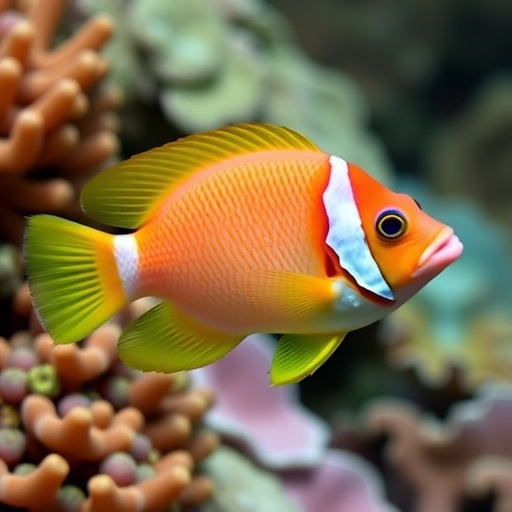
The vibrant and intricate color patterns adorning coral reef fishes have long fascinated marine biologists and casual observers alike. From the dazzling stripes of the Caribbean angelfish to the complex labyrinthine motifs characteristic of Indo-Pacific species, the dazzling diversity of reef fish pigmentation raises deep evolutionary questions. Why do some fish species from vastly different oceans exhibit strikingly similar designs despite never having shared the same biogeographic space? A recent comprehensive study by researchers at the University of Liège offers a groundbreaking glimpse into the evolutionary forces shaping these remarkable visual traits, unraveling a tale of rapid speciation, convergent evolution, and intrinsic biological constraints.
Coral reef ecosystems are globally renowned for their staggering biodiversity, and this is vividly reflected in the wide palette and patterns of reef fish. Researchers Bruno Frédérich and colleagues set out to understand whether this diversification in pigmentation patterns is primarily driven by localized ecological factors such as environmental pressures or predation, or if it follows more universal developmental and evolutionary principles. To address this, the team assembled an extensive dataset encompassing 918 species spanning six major fish families — surgeonfish (Acanthuridae), butterflyfish (Chaetodontidae), snappers (Lutjanidae), mullets (Mullidae), angelfish (Pomacanthidae), and damselfish (Pomacentridae). Each species’ distinct pattern type was meticulously cataloged across five key biogeographic regions: the Atlantic, Western Indian Ocean, Central Indo-Pacific, Central Pacific, and Tropical Eastern Pacific.
A salient discovery from this vast survey is the positive correlation between species richness and motif diversity within coral reef fish communities. According to Frédérich, the increase in pattern variety corresponds directly with the number of fish species inhabiting a given region. This suggests that the process of speciation — the emergence of new species — inherently fosters diversification in color patterns. Visual cues play a crucial role in species recognition and social interactions among reef fishes; thus, pigmentation patterns evolve not randomly but under selective pressures favoring traits that mitigate interspecies mating confusion and facilitate intra-species communication. Hence, the data imply that species richness acts as a driver for pattern complexity more than local environmental nuances alone.
Beyond mere correlation, the investigation delves into the evolutionary tempo and constraints dictating pigmentation diversification. Remarkably, the researchers found that pattern evolution in reef fishes occurs at a rapid pace, with new motifs emerging swiftly through evolutionary time. However, this acceleration is bounded within a finite range of possible pattern configurations. The biological mechanisms—cellular and developmental pathways—that orchestrate pigment cell differentiation and spatial arrangement impose intrinsic constraints. These limiting factors generate a “design space” within which phenotypic variations can unfold, thereby explaining why unrelated species in disparate oceans sometimes convergently evolve similar motifs. This convergence is not incidental; rather, it signals the presence of deeply conserved developmental rules shaping visual appearance in reef fishes.
The evolutionary convergence phenomenon emphasizes that external ecological factors alone do not dictate pigment pattern evolution. Instead, internal biological rules, governed by genetic, cellular, and morphogenetic processes, channel these traits towards specific visual solutions. Pigmentation arises from complex interactions among chromatophores—specialized pigment cells such as melanophores and iridophores—which follow reaction-diffusion dynamics, molecular gradients, and gene regulatory networks established early in fish development. Consequently, evolutionary innovations in patterning are shaped by modifications within this constrained framework, giving rise to repeated, analogous ornamental designs across phylogenetically distant taxa.
This study’s insights challenge a classical view of pigment diversity as a purely adaptive trait shaped by environmental selective pressures such as predation or habitat. Instead, the dual forces of rapid speciation and strict developmental constraints collaboratively influence the patterns expressed. Fish populations diverge visually as new species emerge, but their visual traits rapidly saturate the spectrum of feasible motifs allowed by their pigmentation biology. Thus, pattern evolution exhibits a pulsed dynamic: fast adaptive radiation followed by stasis constrained by physiological limits.
The researchers’ database, unprecedented in scope and detail, provides a global-scale quantification of pigmentation diversity in coral reef fishes, offering new avenues to explore the molecular underpinnings of these patterns. Understanding the genetic and cellular bases responsible for the observed evolutionary constraints may illuminate the fundamental developmental principles governing vertebrate pigmentation beyond marine fishes. Moreover, this knowledge could have implications for deciphering evolutionary trajectories in other visually diverse animal clades.
This work builds on the foundational research conducted by ULiège’s Laboratory of Evolutionary Ecology, where investigations into clownfish adaptive radiation revealed complex relationships between coloration and ecological specialization. Extending such approaches to broader fish families and global regions enables a more unified view of how phenotypic traits evolve under the combined influences of speciation, ecological interactions, and developmental biology.
Ultimately, the study affirms that the breathtaking visual complexity of coral reef fish is neither random nor solely environmentally dictated. Instead, it emerges from an evolutionary narrative intertwining rapid species diversification with the imperatives of genetically and physiologically constrained developmental mechanics. By decoding this interplay, scientists move closer to comprehending the evolutionary language inscribed in the stunning tapestries of reef fish color and pattern.
In summary, the University of Liège’s research presents a compelling synthesis that links ecological and evolutionary theory with developmental biology. It substantiates that reef fish pigmentation patterns evolve through rapid speciation processes within a limited morphospace shaped by biologically inherited constraints. This duality fosters evolutionary convergence that produces strikingly similar patterns in disparate lineages, reflecting common developmental pathways rather than shared environmental histories. Such revelations enrich our understanding of biodiversity and evolution, highlighting the elegant complexity underlying nature’s colorful marine mosaics.
The broader significance of these findings resonates beyond marine biology, encourages interdisciplinary approaches that integrate ecology, evolution, and developmental genetics, and highlights the adaptive and constrained nature of phenotypic diversity. As future research identifies the specific genes and molecular circuits orchestrating pigment patterning, it may become possible to predict evolutionary trajectories or even bioengineer ornamental traits—opening exciting frontiers in evolutionary developmental biology.
The study, published in BMC Biology, sets a benchmark for combining global-scale comparative data with mechanistic evolutionary analyses, and establishes a vital foundation for unraveling the intricate patterns of life’s colorful wonders.
Cite Scienmag News
Gavin Prescott. (March 5, 2026). How Evolution Drives Color Diversity in Coral Reef Fish. Scienmag. https://scienmag.com/how-evolution-drives-color-diversity-in-coral-reef-fish/
Gavin Prescott. "How Evolution Drives Color Diversity in Coral Reef Fish." Scienmag, 5 March 2026, https://scienmag.com/how-evolution-drives-color-diversity-in-coral-reef-fish/. Accessed 5 September 2026.
Gavin Prescott. "How Evolution Drives Color Diversity in Coral Reef Fish." Scienmag. March 5, 2026. https://scienmag.com/how-evolution-drives-color-diversity-in-coral-reef-fish/


