


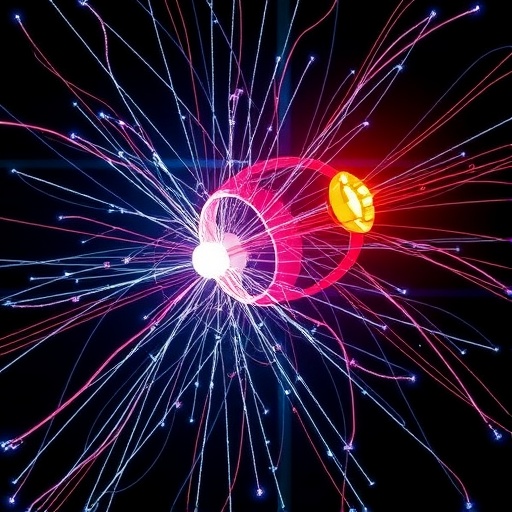
In a groundbreaking discovery poised to reshape our understanding of solar energy conversion, scientists at the University of Cambridge have observed electrons being transferred across solar materials at velocities that challenge traditional theoretical limits. This revelation disrupts well-established principles of ultrafast charge transfer in organic solar systems and opens exciting avenues for the design of next-generation solar harvesting technologies. Their findings reveal that molecular vibrations—once seen as merely incidental to electron movement—play a critical role, actively accelerating charge separation within a timeframe that aligns precisely with the natural oscillations of atoms.
The experiments employed ultrafast laser spectroscopy techniques capable of capturing phenomena occurring in an astonishing 18 femtoseconds—an interval so brief that light itself barely traverses a fraction of its wavelength in that span. This temporal resolution allowed the researchers to witness electronic charge migration unfolding almost synchronously with atomic vibrations inside the molecules involved. The observed coherence between vibrational motion and electronic transfer defies conventional wisdom which implied that such rapid, efficient transfer required substantial energy differences and strong electronic coupling between donor and acceptor materials.
Leading the study, Dr. Pratyush Ghosh, a Research Fellow at St John’s College, Cambridge, explained that they intentionally engineered a ‘weak’ heterojunction between a polymer donor and a non-fullerene acceptor with minimal energetic offset and interaction. According to long-standing design rules, this system should have exhibited sluggish charge transfer dynamics due to the lack of driving energy gradient. Contrary to expectations, however, electrons were propelled across the interface at ultrafast speeds within a single vibrational cycle, revealing a mechanism that leverages vibrational energy to effectively ‘catapult’ charges.
This vibrationally assisted charge transfer mechanism signifies a paradigm shift in our understanding of how solar materials function at the molecular level. Instead of electrons meandering diffusively and incoherently, as traditionally envisioned, the electron wavefunction evolves ballistically, driven by coupling with specific high-frequency vibrational modes intrinsic to the polymer. These coherent vibrations dynamically modulate electronic states, enabling directional charge migration with minimal recombination losses—a hallmark of efficiency crucial for viable photovoltaic devices.
The study meticulously elucidates how the vibrations do not merely coincide temporally with the charge transfer event but act as an active participant, fostering the ultrafast separation of electron-hole pairs (excitons) into free charges capable of generating electrical current. This insight overturns the almost half-century belief that molecular vibrations hinder charge mobility and instead positions them as functional elements that can be harnessed to design better materials.
Furthermore, upon arrival at the acceptor site, the electron instigates a new coherent vibrational mode, essentially imprinting a dynamic fingerprint indicative of the rapid and clean nature of the transfer. This coherent vibrational signature is rarely documented in organic heterojunctions and provides compelling experimental validation alongside computational simulations confirming the intimate interplay of electronic and vibrational degrees of freedom during charge transport.
Such ultrafast and efficient charge separation is vitally important for organic solar cells, photodetectors, and photocatalytic systems that depend on transforming incident photons into usable electrical or chemical energy with minimal dissipation. The research uncovers a strategy to circumvent traditional trade-offs where accelerating charge transfer often necessitates energy-level offsets that sacrifice voltage and overall device performance.
Professor Akshay Rao, a co-author and physicist at the Cavendish Laboratory, articulated the broader implications of the findings by emphasizing the shift from trying to suppress molecular motion towards actively exploiting it as a design principle. By understanding and tuning vibrational modes, material scientists can potentially manipulate charge transfer pathways at the quantum level, boosting efficiency beyond what static electronic structures alone would permit.
The international collaborative effort behind this research combined precise experimental ultrafast spectroscopy with state-of-the-art computational modeling to map the subtle interplay of vibronic coupling at an unprecedented resolution. Their integrative approach not only demonstrated the phenomenon in operationally relevant systems but also laid the foundation for predictive design models where molecular vibrations are integral design parameters rather than noise sources to be minimized.
Looking forward, these insights hold promise for innovating more efficient, cost-effective, and sustainable solar energy solutions. The fundamental understanding that vibrational coherence and quantum dynamics govern charge transport could extend beyond artificial solar devices to natural photosynthetic complexes, potentially informing biomimetic strategies that replicate nature’s precision and efficiency in light harvesting.
In conclusion, by observing charge separation occurring on the same ultrafast timescale as atomic vibrations and uncovering the role of vibrational modes as facilitators rather than impediments of electron motion, this research offers a transformative perspective. It invites scientists to rethink the fundamental mechanisms of photovoltaic operation, urging a reconsideration of long-standing design dogmas and inspiring novel material architectures optimized for vibrationally assisted charge transfer.
Cite Scienmag News
Katie Riggs. (March 5, 2026). Molecular ‘Catapult’ Launches Electrons at Physics’ Extreme Limits. Scienmag. https://scienmag.com/molecular-catapult-launches-electrons-at-physics-extreme-limits/
Katie Riggs. "Molecular ‘Catapult’ Launches Electrons at Physics’ Extreme Limits." Scienmag, 5 March 2026, https://scienmag.com/molecular-catapult-launches-electrons-at-physics-extreme-limits/. Accessed 4 September 2026.
Katie Riggs. "Molecular ‘Catapult’ Launches Electrons at Physics’ Extreme Limits." Scienmag. March 5, 2026. https://scienmag.com/molecular-catapult-launches-electrons-at-physics-extreme-limits/


