


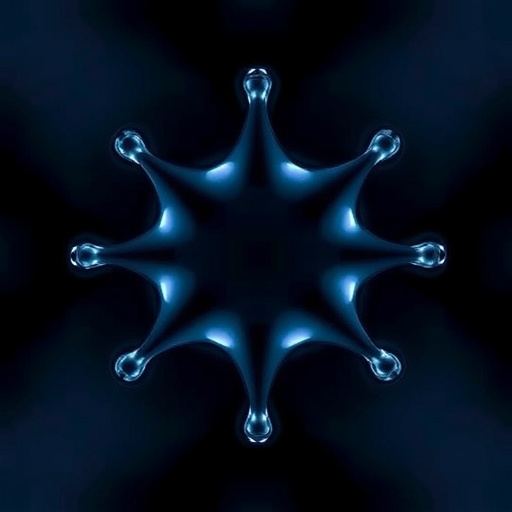
In a groundbreaking study that challenges long-held perceptions about the behavior of liquids, researchers have unveiled a phenomenon where microscopic oil droplets suspended within water can astonishingly fold themselves into intricately precise six-pointed star shapes while preserving their liquid interior. This discovery not only redefines fundamental understanding of liquid morphology but introduces a novel physical mechanism for shape transformation at microscale interfaces, marrying concepts from interfacial physics, elasticity, and topology into a cohesive framework.
Traditionally, liquid droplets have been understood to minimize surface energy by adopting smooth, spherical forms. This natural tendency is governed by surface tension, which drives the interface to become as compact and simple as possible. However, the recent work led by Prof. Eli Sloutskin of Bar-Ilan University, in collaboration with Dr. Catherine Quilliet from CNRS/Université Grenoble-Alpes, has empirically demonstrated that when subjected to precise temperature modulation, these droplets depart dramatically from the norm. Instead of maintaining rounded shapes, they spontaneously evolve into hexagonal and lenticular six-pointed star (hexagram) configurations, while the interior remains unequivocally in the liquid state.
The mechanism underpinning this phenomenon stems from a temperature-induced phase transition occurring at the droplet interface. As the droplet is cooled, its surface forms an ultra-thin crystalline shell, astonishingly only a couple of nanometers thick. This shell behaves neither like a solid shell encompassing the liquid nor a fluid membrane but as a flexible yet nearly unstretchable elastic skin. Upon subsequent gentle reheating, the shell manifests a spectacular folding behavior, reminiscent of origami, that folds the droplet’s shape into a morphologically stable, three-dimensional star-like configuration.
What fundamentally sets this process apart from previous observations in droplet shape evolution is that the transformation happens through bending and folding exclusively, without any topological alteration or rearrangement of defects in the crystalline shell. Defects — disruptions in the orderly arrangement of molecules — are commonly thought to play a crucial role in faceting and shape changes in crystalline droplets. However, Prof. Sloutskin emphasizes that the crystalline shell in their system remains completely intact, purely executing transformations via bending elasticity. This insight shatters existing paradigms focused on defect-driven morphological transitions.
This discovery also solves a longstanding enigma in the field. Faceted polygonal shapes of liquid droplets were first documented years ago, but the formation of concave hexagram shapes, often observed sporadically in experiments, eluded reproducible explanation. By engineering a highly controlled and specific temperature protocol integrated with comprehensive optical and electron microscopy investigations, the researchers mapped the precise conditions and mechanisms that reliably reproduce these star-shaped transformations. The coupling of theory and experiment revealed that the elastic shell, imbued with strategically located structural defects, folds predictably into lenticular hexagram geometries.
One of the most striking aspects of this work is that the six-pointed star configuration emerges not during cooling, as might be expected given the formation of the crystalline shell, but rather through a heating process. This reversal in the thermal activation sequence further underscores the unique nature of this folding transition and distinguishes it from previously documented droplet faceting events that relied on defect migration or creation. It appears the shell’s elastic energy landscape favors folding transformations over plastic rearrangements, signifying an emergent physical pathway for shape change at liquid interfaces.
Beyond the purely physical novelty, the spontaneous appearance of a shape as culturally pervasive as the six-pointed star lends an intriguing aesthetic dimension to the physics. Such symmetry emerging from the simple interplay of temperature, elasticity, and interfacial crystallization demonstrates how elemental physical principles can produce complex, meaningful geometries. This observation may inspire further inquiry into the universality and activation pathways of shape transformations across condensed matter systems.
The broader implications of this discovery stretch well beyond academic curiosity. An improved understanding of how thin elastic shells self-assemble and dynamically transform around fluid cores could drive innovations in engineered nano-materials. Potential applications include the design of nanoparticle carriers with tunable shapes for drug delivery, where shape influences circulation time and cellular uptake, or in the development of responsive soft materials that alter mechanical properties on demand. Such controlled shape shifting is also relevant to biomimetic systems, where thin membranes frequently undergo shape transitions critical for biological function.
Moreover, the interdisciplinary approach integrating elasticity theory, interfacial physics, and topology points to new horizons in material science, especially in manipulating interfaces at the nanoscale. The fact that the shell remains topologically intact throughout the transition means that these foldings could be reversible, opening pathways for repeatable, dynamic morphological control in soft matter systems. Additionally, this research might illuminate natural processes, providing a model for shape changes observed in cellular membranes and viral capsids where thin elastic layers interface with fluid interiors.
This research, spearheaded by a collaboration between Bar-Ilan University and CNRS/Université Grenoble-Alpes, demonstrates the value of coupling precise experimental control with multifaceted theoretical modeling. Their finding of a purely folding-driven shape transformation in liquid droplets marks a paradigm shift that will invite reevaluation of both liquid crystal interfaces and morphogenetic processes in biological and synthetic systems alike.
Published in Physical Review Letters amidst support from the Israel Science Foundation, this pioneering work not only challenges conventional wisdom but also offers an elegant, physically transparent account of how complexity and symmetry can arise spontaneously from minimalistic, yet rich, interfacial physics. As the scientific community digests these findings, future research may well explore how such nano-origami principles extend to larger scale phenomena or alternative materials, potentially unlocking a new class of shape-programmable liquids.
In sum, this study unveils a heretofore hidden dimension of liquid behavior by revealing how microscopic droplets can fold themselves into exquisite, stable, six-pointed star shapes solely through bending of a crystalline elastic shell. The convergence of interdisciplinary methods and insights reveals a fundamentally original morphological transformation pathway that promises to influence future explorations in soft matter physics, materials science, and beyond.
News Publication Date:
27-Feb-2026
Web References:
https://doi.org/10.1103/13ld-vr3l
Keywords
Liquid droplets, shape transformation, nanoscale folding, crystalline shell, elasticity, interfacial physics, topology, nano-origami, hexagram droplets, soft matter physics, phase transition, microscopic morphology
Cite Scienmag News
Bethany Barker. (March 5, 2026). Microscopic Six-Pointed Stars Crafted from Tiny Droplets: The Art of Liquid Origami. Scienmag. https://scienmag.com/microscopic-six-pointed-stars-crafted-from-tiny-droplets-the-art-of-liquid-origami/
Bethany Barker. "Microscopic Six-Pointed Stars Crafted from Tiny Droplets: The Art of Liquid Origami." Scienmag, 5 March 2026, https://scienmag.com/microscopic-six-pointed-stars-crafted-from-tiny-droplets-the-art-of-liquid-origami/. Accessed 4 September 2026.
Bethany Barker. "Microscopic Six-Pointed Stars Crafted from Tiny Droplets: The Art of Liquid Origami." Scienmag. March 5, 2026. https://scienmag.com/microscopic-six-pointed-stars-crafted-from-tiny-droplets-the-art-of-liquid-origami/


