


The study of processes occurring at attosecond timescales utilizing extreme ultraviolet (XUV) pulses is at the forefront of ultrafast science. These XUV pulses, produced via high-harmonic generation (HHG) from intense laser–matter interaction, demonstrate unprecedented temporal resolution in observing and influencing electron dynamics. Such pulses enable the exploration of coherent control of wave packets, ultrafast spectroscopy of quantum materials, and real-time probing of molecular systems, charge transfer dynamics in chemical and biologically relevant systems and even investigation of the fastest processes in relativistic plasmas. These studies demand energetic pulses at high-repetition rates to enhance signal-to-noise ratio and provide adequate statistics.

Credit: Ultrafast Science
The study of processes occurring at attosecond timescales utilizing extreme ultraviolet (XUV) pulses is at the forefront of ultrafast science. These XUV pulses, produced via high-harmonic generation (HHG) from intense laser–matter interaction, demonstrate unprecedented temporal resolution in observing and influencing electron dynamics. Such pulses enable the exploration of coherent control of wave packets, ultrafast spectroscopy of quantum materials, and real-time probing of molecular systems, charge transfer dynamics in chemical and biologically relevant systems and even investigation of the fastest processes in relativistic plasmas. These studies demand energetic pulses at high-repetition rates to enhance signal-to-noise ratio and provide adequate statistics.
The Extreme Light Infrastructure, Attosecond Light Pulse Source (ELI ALPS) facility is at the forefront of providing state-of-the-art tools for research in these domains. Designing high repetition rate attosecond XUV beamlines has its inherent challenges. This work presents the design rationale, capabilities, and applications of the plasma and gas-based high-repetition-rate (1 kHz – 100 kHz) attosecond extreme ultraviolet (XUV) beamlines developed at ELI ALPS, emphasizing their potential to advance multidisciplinary research in ultrafast phenomenon.
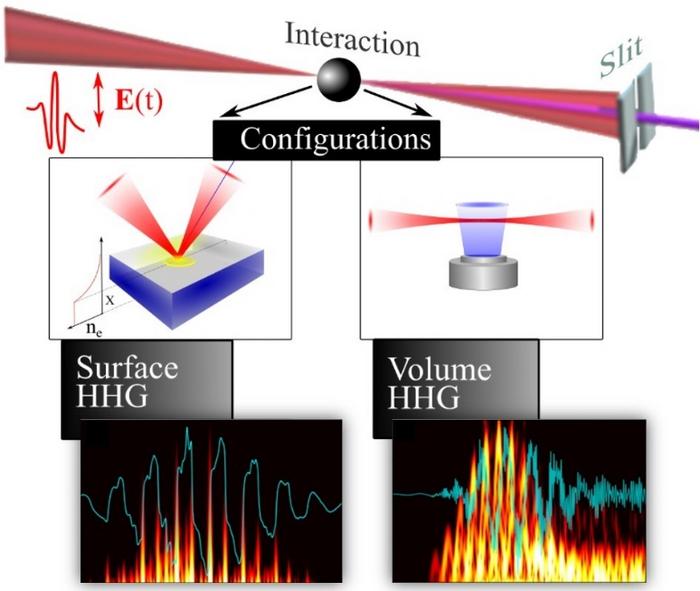
The XUV pulse generation at ELI ALPS utilizes ultrashort pulses from multiple laser systems interacting with various states of matter. The XUV generation process can be broadly classified into two categories, viz., volume and surface. In volume HHG, the laser interaction occurs with gases in the strong field regime (intensity ~ 1012-14 W/cm2) resulting in tunnel ionization and subsequent phase matched recombination of the ionized electron with the parent atom, leading to the generation of attosecond pulse train (APT). In surface HHG, relativistic (intensity > 1018 W/cm2) laser interaction occurs with thin, dense plasma layer formed on the surface of solid and liquid targets via pre-ionization, leading to sub-cycle electron dynamics resulting in the emission of APT in the specular direction. Both the schemes are capable of generating XUV with up to 100’s of eV photon energies. While the harmonic generation efficiency of these two schemes can be similar (~ 10-4), the scaling of volume HHG is limited by the laser saturation intensity in gas. The gas based XUV sources can continuously operate at very-high repetition rates (100 kHz), and are ideal for studies requiring large statistics. The surface HHG sources are often limited in repetition rate and operation time, but offer higher XUV pulse intensities. However, recent advances in liquid targetry is expected to alleviate these limitations. The Gas High Harmonic Generation (GHHG) and Surface High Harmonic Generation (SHHG) beamlines at ELI ALPS cater to these two schemes of XUV generation, offering a broad choice of XUV pulse parameters to the researchers.
Journal
Ultrafast Science
Method of Research
Experimental study
Subject of Research
Not applicable
Article Title
High-repetition-rate attosecond XUV beamlines at ELI ALPS for studying ultrafast phenomena
Article Publication Date
21-Jun-2024
Cite Scienmag News
Bethany Barker. (July 15, 2024). High-repetition-rate attosecond XUV beamlines at ELI ALPS for studying ultrafast phenomena. Scienmag. https://scienmag.com/high-repetition-rate-attosecond-xuv-beamlines-at-eli-alps-for-studying-ultrafast-phenomena/
Bethany Barker. "High-repetition-rate attosecond XUV beamlines at ELI ALPS for studying ultrafast phenomena." Scienmag, 15 July 2024, https://scienmag.com/high-repetition-rate-attosecond-xuv-beamlines-at-eli-alps-for-studying-ultrafast-phenomena/. Accessed 9 September 2026.
Bethany Barker. "High-repetition-rate attosecond XUV beamlines at ELI ALPS for studying ultrafast phenomena." Scienmag. July 15, 2024. https://scienmag.com/high-repetition-rate-attosecond-xuv-beamlines-at-eli-alps-for-studying-ultrafast-phenomena/

