


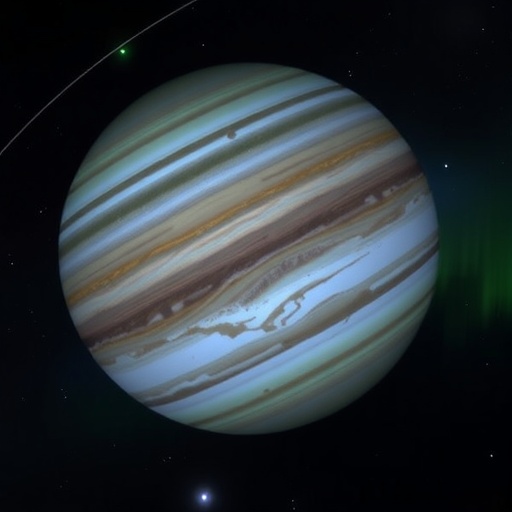
A groundbreaking international study led by a PhD researcher at Northumbria University has unveiled unprecedented insights into Jupiter’s northern lights, specifically focusing on the auroral footprints created by its Galilean moons, Io and Europa. Utilizing the exceptional capabilities of the James Webb Space Telescope (JWST), the team has, for the first time, mapped the intricate temperature structures and dramatic density fluctuations in the upper atmosphere of the gas giant, reshaping our understanding of planetary magnetospheric interactions on a scale never before recorded.
Jupiter’s auroras have long fascinated scientists due to their sheer power and persistent intensity, surpassing those found anywhere else in our solar system. Unlike Earth’s auroras, which primarily result from charged particles emitted by the solar wind, Jupiter’s northern lights receive an additional energetic boost from the dynamic interplay with its four large moons: Io, Europa, Ganymede, and Callisto. This celestial dance creates distinct, bright “footprints” in the planet’s atmosphere, corresponding directly to the orbital positions of these satellites within Jupiter’s vast magnetic field.
Traditional observations of Jupiter’s auroras focused on their glow intensity through ultraviolet and infrared wavelengths. However, the new research led by Katie Knowles, a PhD candidate in Planetary Physics, breaks new ground by revealing not only the brightness but also the physical atmospheric parameters such as temperature profiles and ion density variations within the auroral footprints. These spectral measurements, made possible by JWST’s unique infrared capabilities, offer a comprehensive look at the planetary atmosphere’s chemistry and plasma behavior under the influence of intense magnetic interactions.
The James Webb Space Telescope, a collaboration between NASA, the European Space Agency (ESA), and the Canadian Space Agency, harnesses infrared radiation to penetrate cosmic phenomena that are hidden in visible light. In September 2023, during a crucial 22-hour observation window, the JWST was pointed towards Jupiter’s northern atmospheric limb, capturing exquisite images and spectral data that traced the auroral footprints as they rotated into view. These observations coincided with the detection of previously unobserved temperature anomalies and dense plasma structures within Io’s footprint.
One of the most startling findings was the identification of a “cold spot” embedded within Io’s auroral footprint, exhibiting temperatures significantly lower than those in the surrounding aurora. While Jupiter’s main auroral regions commonly reach temperatures around 766 Kelvin (approximately 493°C), this distinct cold spot recorded temperatures as low as 538 Kelvin (265°C). Intriguingly, this cooler atmospheric pocket also displayed ion densities three times greater than Jupiter’s typical auroral plasma, suggesting highly localized and intense energy deposition driven by magnetosphere-ionosphere coupling processes.
Io, known as the solar system’s most volcanically active moon, continuously ejects vast quantities of materials into space, fueling the dense Io plasma torus that encircles Jupiter. This torus is a doughnut-shaped ring of ionized particles generated by the moon’s massive volcanic output, which becomes trapped and energized by Jupiter’s rotating magnetic field. The interaction between Io’s movement through this plasma environment and Jupiter’s magnetosphere generates complex electrical currents, which in turn create the vivid auroral spots that directly correlate with Io’s orbit.
Spectroscopic analysis revealed the auroral footprints are abundant in trihydrogen cations (H₃⁺), a fundamental ion that emits strongly in the infrared and serves as a key diagnostic tool for understanding planetary ionospheres. In certain regions within Io’s footprint, H₃⁺ densities were found to be up to 45 times more concentrated than adjacent areas, emphasizing the extreme spatial variability in ion production and energy influx. This fine-scale variability occurs on timescales of mere minutes, underscoring a highly dynamic upper atmospheric environment influenced by rapidly changing electron precipitation patterns.
The energy cascade leading to these auroral features involves high-energy electrons spiraling along Jupiter’s magnetic field lines and colliding with the upper atmosphere. Such collisions ionize and excite atmospheric particles, producing not only the visible and infrared emissions characteristic of auroras but also driving localized heating and chemical reactions. The discovery of these spatial and temporal fluctuations deepens the understanding of magnetosphere-ionosphere coupling mechanisms, reflecting how the giant planet’s magnetic field shapes its atmospheric structure and behavior in real time.
Beyond Jupiter, these findings bear significant implications for other planetary systems. Saturn’s moon Enceladus, for example, similarly imprints its own auroral footprint on Saturn’s magnetic environment. The knowledge gained from Jupiter’s aurora, therefore, serves as a blueprint, offering potential avenues to investigate moon-planet interactions and magnetospheric variations across diverse gas giants, both within our solar system and potentially around exoplanets orbiting distant stars.
The cutting-edge study, titled Short-Term Variability of Jupiter’s Satellite Footprints as Spotted by JWST and published in Geophysical Research Letters in March 2026, opens numerous questions about the frequency and drivers of these extreme variations. Katie Knowles’ research will continue with follow-up observational campaigns using NASA’s Infrared Telescope Facility (IRTF) in Hawaii in early 2026. These observations aim to capture longer time sequences, probing whether the cold spot phenomenon is episodic or sustained, and how geomagnetic and plasma conditions influence the auroral dynamics.
Presenting these pioneering results on global stages—such as the EPSC-DPS Joint Meeting 2025 in Helsinki and invited sessions of the International Space Science Institute in Bern—Katie has positioned herself as a prominent voice in planetary auroral physics. Her work exemplifies how new-generation telescopes, like JWST, revolutionize remote sensing of giant planet atmospheres by enabling the extraction of detailed physical and chemical parameters rather than solely observational brightness.
This study signifies more than just a revelation about Jupiter’s auroras; it articulates a transformative perspective on the mutable nature of magnetospheric phenomena and their ability to reshape upper atmospheric environments on small spatial scales. As JWST and other observational platforms continue to refine our vision, the magnetic ballet between giant planets and their moons will undoubtedly be traced with even greater precision, enhancing comprehension of fundamental plasma physics in planetary contexts.
In sum, the innovative exploitation of JWST’s infrared spectral imaging has revealed an extraordinary microcosm of plasma activity in Jupiter’s upper atmosphere. The variations in temperature and ion density within Io’s auroral footprint underline the intricate and volatile character of magnetospheric interactions. These discoveries not only augment our understanding of Jupiter’s atmospheric dynamics but also set a new benchmark for studying planetary auroras, motivating the scientific community to explore other celestial plasma environments with fresh eyes and deeper investigation.
News Publication Date: 3 March 2026
Web References:
- Geophysical Research Letters
- James Webb Space Telescope mission
- Northumbria University Research Portal
References:
Knowles, K.L., et al. (2026). Short-Term Variability of Jupiter’s Satellite Footprints as Spotted by JWST. Geophysical Research Letters. DOI: 10.1029/2025GL118553
Keywords
Jupiter aurora, Galilean moons, Io plasma torus, James Webb Space Telescope, infrared spectroscopy, planetary magnetosphere, trihydrogen cation, auroral footprint, upper atmosphere, plasma density variations, electron precipitation, magnetosphere-ionosphere coupling
Cite Scienmag News
Grant Pearson. (March 4, 2026). New Telescope Uncovers Unexpected Mysteries in Jupiter’s Northern Lights. Scienmag. https://scienmag.com/new-telescope-uncovers-unexpected-mysteries-in-jupiters-northern-lights/
Grant Pearson. "New Telescope Uncovers Unexpected Mysteries in Jupiter’s Northern Lights." Scienmag, 4 March 2026, https://scienmag.com/new-telescope-uncovers-unexpected-mysteries-in-jupiters-northern-lights/. Accessed 5 September 2026.
Grant Pearson. "New Telescope Uncovers Unexpected Mysteries in Jupiter’s Northern Lights." Scienmag. March 4, 2026. https://scienmag.com/new-telescope-uncovers-unexpected-mysteries-in-jupiters-northern-lights/


