


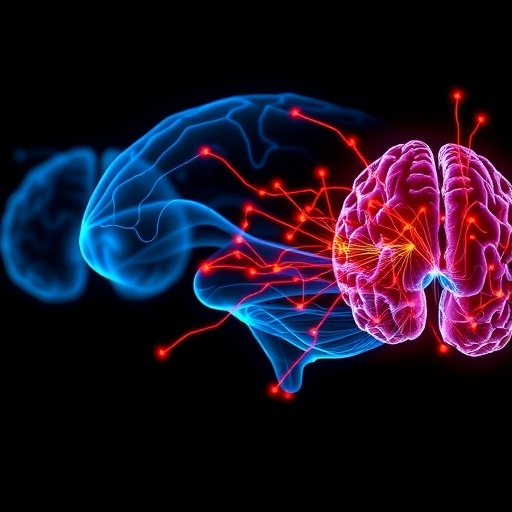
In a groundbreaking study set to reshape the landscape of Parkinson’s disease treatment, researchers have unveiled critical insights into how different deep brain stimulation (DBS) targets influence brain connectivity. The study, conducted by Lin, Zeng, Duan, and colleagues and published in the prestigious npj Parkinson’s Disease journal, harnesses the power of advanced 3.0T resting-state functional magnetic resonance imaging (fMRI) to dissect the nuanced impacts of stimulating two distinct subcortical regions: the posterior subthalamic area (PSA) and the subthalamic nucleus (STN). This investigation offers a new window into the neural mechanisms underlying DBS efficacy, charting a course for more refined and personalized therapeutic strategies for those battling Parkinson’s disease.
Parkinson’s disease, a neurodegenerative disorder marked by motor symptoms including tremor, rigidity, and bradykinesia, often requires intervention beyond pharmacological management. Deep brain stimulation has emerged as a transformative technology that delivers electrical impulses via implanted electrodes to specific brain regions, modulating circuits implicated in the disease’s motor and non-motor symptoms. However, substantial variability exists in patient outcomes depending on the chosen target within the basal ganglia-thalamocortical network. The current study addresses this clinical variability by interrogating how PSA-DBS and STN-DBS differentially modulate effective connectivity within the motor and associative neural networks.
Using state-of-the-art 3.0T resting-state fMRI, the investigators captured spontaneous brain activity patterns from a cohort of Parkinson’s patients undergoing either PSA- or STN-targeted DBS. Resting-state fMRI measures fluctuations in blood oxygen level-dependent (BOLD) signals when the brain is not engaged in explicit tasks, providing a robust proxy for the intrinsic synchronization and communication between brain regions. By applying sophisticated network analysis and dynamic causal modeling, the study quantified the directionality and strength of neural interactions, revealing how each stimulation target distinctly perturbs the brain’s functional architecture.
One of the landmark findings is that PSA-DBS selectively enhances connectivity within sensorimotor circuits, potentially explaining why this approach can yield marked improvements in tremor control. The posterior subthalamic area, with its proximity to cerebellothalamic pathways, appears uniquely positioned to modulate these tremor-related oscillations. Conversely, STN-DBS exerts a broader influence, affecting both motor and associative circuits, which might account for its more comprehensive symptomatic relief but also for a profile of cognitive side effects reported in some patients.
The implications of these findings extend beyond mechanistic neuroscience. Clinicians can leverage this connectivity data to tailor DBS programming in a precision medicine framework, optimizing symptom control while mitigating adverse effects. Moreover, the differential modulation identified between PSA and STN stimulation sets the stage for developing adaptive DBS systems that dynamically adjust parameters based on real-time neural feedback, potentially revolutionizing long-term disease management.
Importantly, the study’s methodological rigor and innovative use of resting-state fMRI address longstanding challenges in Parkinson’s disease research. Traditional clinical assessments and imaging have struggled to elucidate the complex interactions between localized electrical stimulation and whole-brain network dynamics. By disentangling these effects with advanced neuroimaging and computational modeling, the investigators offer a more holistic understanding of DBS mechanisms, merging clinical neurophysiology with systems neuroscience.
The researchers emphasize that the heterogeneity observed among patients underscores the need for individualized target selection, moving beyond a one-size-fits-all approach. Some patients, particularly those with predominant tremor symptoms, may derive greater benefit from PSA-DBS, while others exhibiting a more diffuse motor and cognitive symptomatology might be better candidates for STN-DBS. Future clinical guidelines could integrate connectivity profiles as biomarkers to guide initial target choice and post-operative programming.
Furthermore, the study catalyzes further inquiry into the neural substrates of Parkinson’s disease, particularly how pathological oscillatory activity in the basal ganglia-thalamocortical loops contributes to motor deficits. The differentiation of therapeutic effects based on stimulation site offers clues about the hierarchical organization of motor control and its disruption in disease. It invites a deeper exploration of how extrinsic modulation via DBS can recalibrate aberrant network dynamics at multiple scales.
In parallel, these findings may influence emerging neuromodulation technologies such as focused ultrasound and optogenetics, where targeting precision and circuit-level understanding are paramount. The insights from PSA versus STN stimulation enrich the conceptual framework necessary for designing interventions that restore network homeostasis without inducing unwanted side effects.
As Parkinson’s disease continues to impose a growing burden on an aging global population, advances like this represent a beacon of hope. The combination of cutting-edge imaging, computational neuroscience, and clinical expertise promises to improve quality of life by refining how therapeutic electrical stimulation is applied. This study marks a significant step towards fully harnessing the brain’s complex networks to alleviate the debilitating symptoms that define Parkinson’s disease.
Looking ahead, the integration of multi-modal imaging, including diffusion tensor imaging and magnetoencephalography, with fMRI could further delineate structural-functional connectivity changes induced by DBS. Longitudinal studies tracking patients before and after DBS implantation will be crucial to map the evolution of network plasticity and its correlation with clinical trajectories. The synergy between evolving imaging modalities and neuromodulation technologies heralds a new era of precision neurology in movement disorders.
In essence, Lin, Zeng, Duan, and colleagues’ work illuminates the subtle yet profound ways that DBS targeting PSAs or STNs differentially reconfigures the Parkinsonian brain. Their research does not merely catalog changes but provides a framework for interpreting how therapeutic stimulation resonates through interconnected brain circuits. It challenges the field to rethink DBS not just as a blunt electrical intervention, but as a nuanced tool capable of sculpting brain network dynamics to restore function.
Such insights reinforce the urgency for continued multidisciplinary collaboration bridging neurology, neuroimaging, engineering, and computational modeling. The quest to optimize DBS efficacy while minimizing risks hinges on understanding this intricate neural orchestration. Ultimately, the hope is that this research will spur the translation of connectivity-guided neuromodulation protocols from bench to bedside, dramatically enhancing the breadth and durability of symptom relief for Parkinson’s patients worldwide.
This pioneering 3.0T resting-state fMRI study offers a vivid illustration of how advanced neuroimaging can serve as both a microscope and a compass—revealing hidden mechanisms while guiding therapeutic innovation. As the field moves forward, the vision of personalized, connectivity-informed DBS may become a reality, transforming the therapeutic paradigm for Parkinson’s disease and other neurological disorders characterized by network dysfunction.
Cite Scienmag News
Cassandra Pierce. (March 3, 2026). PSA vs. STN-DBS: Connectivity in Parkinson’s Revealed. Scienmag. https://scienmag.com/psa-vs-stn-dbs-connectivity-in-parkinsons-revealed/
Cassandra Pierce. "PSA vs. STN-DBS: Connectivity in Parkinson’s Revealed." Scienmag, 3 March 2026, https://scienmag.com/psa-vs-stn-dbs-connectivity-in-parkinsons-revealed/. Accessed 4 September 2026.
Cassandra Pierce. "PSA vs. STN-DBS: Connectivity in Parkinson’s Revealed." Scienmag. March 3, 2026. https://scienmag.com/psa-vs-stn-dbs-connectivity-in-parkinsons-revealed/


