


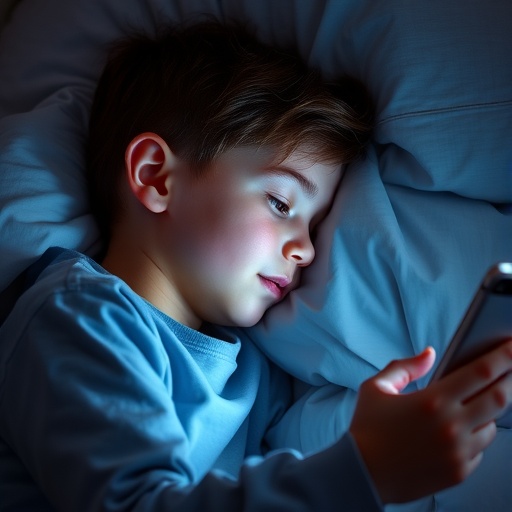
In a groundbreaking systematic review and meta-analysis published in JAMA Pediatrics, researchers have illuminated the nuanced relationship between daily screen time and sleep patterns among youth. Contradicting prior between-person studies that suggested strong negative impacts of screen exposure on sleep health, this comprehensive investigation reveals that while increased screen time may slightly delay sleep onset, its influence on other critical sleep parameters such as duration, efficiency, and quality remains minimal. These findings challenge prevailing assumptions in both clinical and public health spheres regarding screen exposure and youth sleep deprivation.
This meta-analytic study meticulously synthesized data across multiple cohorts, employing advanced statistical modeling to parse within-person fluctuations of screen time against subsequent night’s sleep characteristics. The researchers focused on acute, day-to-day variability rather than long-term averaged exposures, which distinguishes their approach from earlier cross-sectional or between-person analyses. Such a design enabled an unprecedented precision in assessing how individual screen time variations correlate temporally with sleep metrics, thereby providing deeper mechanistic insights.
Scientific understanding of sleep regulation underscores the importance of circadian rhythms, homeostatic sleep drive, and environmental cues. Blue light emitted from screens has been historically implicated in melatonin suppression, leading to delayed sleep phase and insomnia symptoms, especially in adolescents. However, the current study’s evidence indicates that, on a daily basis, short-term deviations in screen use produce only a modest effect on sleep onset timing, with negligible repercussions for total sleep duration or quality. This raises compelling questions about the overall weight of screen exposure in youth sleep health relative to other behavioral or environmental factors.
Moreover, the investigation’s findings point to a decoupling between bedtime procrastination induced by screen time and the overall efficacy of sleep architecture. Sleep efficiency—a measure of actual sleep time compared to time in bed—and subjective quality ratings do not appear to degrade in direct response to increased screen exposure on any given day. This suggests that while screens might postpone the initiation of sleep, the subsequent consolidation of sleep and restorative processes might remain intact, a result that merits further physiological exploration.
In light of these nuanced results, the research team postulates that public health messages targeting youth sleep hygiene may benefit from recalibration. Blanket discouragement of screen time for the sole purpose of improving sleep quality may be overly simplistic. Instead, tailored strategies focusing on timing, content, and individual susceptibilities could achieve better outcomes. For instance, controlling screen use closer to bedtime rather than outright reduction might be sufficient to mitigate the delay in sleep onset without imposing excessive restrictions.
From a methodological perspective, this study exemplifies the strength of within-person analytic frameworks in disentangling temporal dynamics from confounding individual differences. Prior between-person studies often conflated trait-like screen habits with sleep outcomes, potentially inflating associations due to stable behavioral or psychosocial factors. By contrast, the current meta-analysis captures the variability intrinsic to daily life, thus revealing the modest magnitude of screen time’s immediate impact on sleep regulation.
In developmental terms, adolescence constitutes a sensitive period marked by biological shifts in circadian preference, where delayed sleep phase is normative. The study’s focus on youth encompasses this critical window, highlighting that screen use, while influential, is one of many environmental inputs shaping sleep timing. Psychosocial stress, academic pressures, and lifestyle factors may exert more pronounced effects on sleep continuity and sufficiency than ephemeral screen exposure fluctuations.
Furthermore, the investigation encourages a reconsideration of assumed sleep deprivation mechanisms in youth digital behavior. The minimal impact on sleep efficiency and quality reported contradicts the notion of pervasive sleep fragmentation induced by screen use. This has implications for future research prioritizing direct physiological assessments—such as polysomnography or actigraphy—to validate these findings and disentangle potential differential effects across device types, content engagement, and individual susceptibility.
This comprehensive study, led by Matthew Bourke, PhD, reflects an evolution in sleep research methodology and interpretation. The nuanced understanding of screen time’s role in delaying sleep onset without substantially undermining other aspects of sleep health could inform clinicians, educators, and parents aiming to promote optimal youth well-being. As digital media continues to proliferate, evidence-based guidelines that balance technological engagement with sleep needs remain a public health imperative.
In summary, this work provides a sophisticated, evidence-driven perspective on youth screen time, emphasizing that its immediate influence chiefly involves a modest delay in sleep onset rather than broad degradation of sleep quality or duration. This insight challenges prevailing narratives and underscores a more differentiated approach to addressing youth sleep health in the digital age. Future longitudinal and experimental studies are warranted to further map the complex interplay of behavioral, environmental, and physiological determinants in adolescent sleep regulation.
News Publication Date: (Not provided in the content.)
Web References: (Not provided in the content.)
References: (doi:10.1001/jamapediatrics.2025.6490)
Cite Scienmag News
Reid Dalton. (March 2, 2026). Daily Screen Time and Sleep Patterns Linked Within Individuals in Youth, Study Finds. Scienmag. https://scienmag.com/daily-screen-time-and-sleep-patterns-linked-within-individuals-in-youth-study-finds/
Reid Dalton. "Daily Screen Time and Sleep Patterns Linked Within Individuals in Youth, Study Finds." Scienmag, 2 March 2026, https://scienmag.com/daily-screen-time-and-sleep-patterns-linked-within-individuals-in-youth-study-finds/. Accessed 3 September 2026.
Reid Dalton. "Daily Screen Time and Sleep Patterns Linked Within Individuals in Youth, Study Finds." Scienmag. March 2, 2026. https://scienmag.com/daily-screen-time-and-sleep-patterns-linked-within-individuals-in-youth-study-finds/


