


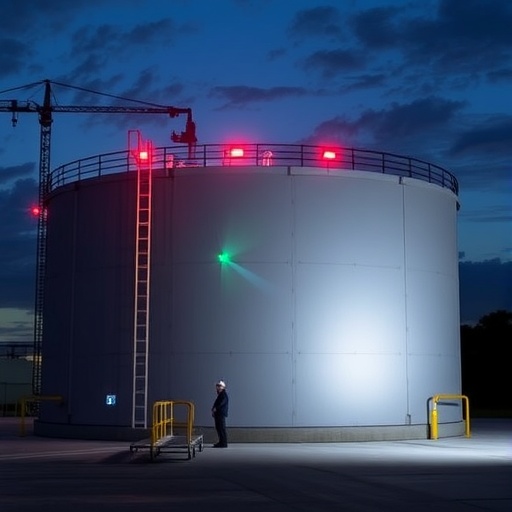
In a significant advancement for industrial safety and maintenance, Southwest Research Institute (SwRI) has unveiled a cutting-edge magnetostrictive transducer (MST) probe that leverages ultrasonic guided wave technology to revolutionize corrosion detection in storage tanks. This innovation addresses longstanding challenges faced by industries that rely heavily on storage tanks, offering a highly precise, non-invasive, and cost-effective solution that eliminates the need for tank emptying and manual inspections.
Traditional inspection methods for corrosion in storage tanks demand the complete draining and cleaning of the tanks, followed by manual evaluation—a process riddled with time consumption, high operational costs, and safety hazards due to confined space entries. SwRI’s MST probe ushers in a paradigm shift by enabling inspections from the tank’s exterior surface, thereby minimizing downtime and enhancing worker safety.
At the core of this groundbreaking technology is the SwRI MST 8×8, an array comprising eight ultrasonic sensors embedded within a flexible strip. These sensors emit shear horizontal guided waves—an ultrasonic wave mode highly sensitive to defects—along the tank’s structural surface. When these waves encounter anomalies such as corrosion pits, wall thinning, or cracks, they reflect back to the sensors, generating data indicative of the location and severity of the damage.
The unique advantage of employing shear horizontal guided waves lies in their propagation characteristics. Unlike other wave modes, shear horizontal waves exhibit reduced attenuation and heightened sensitivity to planar defects, making them ideal for comprehensive screening of extensive tank surfaces, including curved and complex geometries where conventional ultrasonic methods often falter.
The MST probe’s design facilitates full matrix capture (FMC), an advanced data acquisition technique that records wave interactions from multiple angles across the sensor array. This rich dataset serves as input for sophisticated imaging algorithms—most notably the total focusing method (TFM)—which reconstruct a high-resolution, two-dimensional map of the tank’s internal condition. This capability surpasses simple defect detection by providing an in-depth visualization of corrosion patterns, allowing maintenance teams to quantify damage extent and prioritize repairs effectively.
Rigorous field tests conducted on a variety of storage tanks have demonstrated the MST 8×8’s efficacy and resolution in real-world operational conditions. Notably, the probe’s adaptability extends beyond storage tanks, with promising applications in inspecting critical structures such as ship hulls, wind turbine blades, rocket bodies, and pipelines. This versatility paves the way for a unified inspection methodology that can be standardized across diverse industrial sectors.
SwRI’s multidisciplinary expertise in magnetostrictive sensing and nondestructive evaluation has been pivotal in refining the MST probe. The principle underlying magnetostriction—where certain materials deform in response to magnetic fields—enables efficient generation and detection of guided waves without requiring direct contact or surface modifications, thus preserving the structural integrity of inspected components.
Operational ease is further enhanced by the probe’s flexible architecture, allowing it to conform to irregular surfaces and attachments typically found on storage tanks. This ensures comprehensive coverage and reliability, where traditional ultrasonic transducers might fail due to geometric limitations or require complex coupling agents.
Economic benefits are substantial. By eliminating the need for tank emptying, the MST probe drastically reduces downtime—translating into significant cost savings and productivity gains. Moreover, the technology enhances safety protocols by negating the need for personnel to enter hazardous environments, mitigating exposure to toxic gases, confined spaces, and other risks.
The inspection process is streamlined and data-rich. The high-fidelity maps produced not only delineate corrosion presence but offer insights into corrosion progression trends, facilitating predictive maintenance and optimized scheduling of repairs. This proactive monitoring approach aligns with industry shifts towards digital twins and Industry 4.0 paradigms, integrating sensor data analytics into asset management systems.
SwRI plans to commercialize the MST technology through a combination of equipment sales, licensing agreements, and technology transfer to inspection service providers globally. This strategy aims to accelerate adoption and foster a new standard for corrosion assessment across the oil and gas, aerospace, manufacturing, marine, water utility, and municipal sectors.
The underpinning research, “Screening of Corrosion in Storage Tank Walls and Bottoms Using an Array of Guided Wave Magnetostrictive Transducers,” has been peer-reviewed and published in the journal Sensors. The publication elaborates on the theoretical framework, sensor design, data processing techniques, and field validation results, offering a comprehensive resource for professionals and researchers interested in advanced nondestructive evaluation methods.
Through this pioneering effort, Southwest Research Institute not only addresses a critical industrial challenge but also exemplifies how innovative sensor technologies can transform traditional maintenance practices, bridging the gap between safety, efficiency, and cost-effectiveness in structural health monitoring.
Keywords
Magnetostrictive transducer, ultrasonic guided waves, corrosion detection, storage tanks, nondestructive evaluation, shear horizontal waves, total focusing method, full matrix capture, industrial inspection, structural health monitoring
Cite Scienmag News
Bethany Barker. (March 2, 2026). SwRI Creates Advanced Magnetostrictive Probe to Enhance Safety and Reduce Costs in Storage Tank Inspections. Scienmag. https://scienmag.com/swri-creates-advanced-magnetostrictive-probe-to-enhance-safety-and-reduce-costs-in-storage-tank-inspections/
Bethany Barker. "SwRI Creates Advanced Magnetostrictive Probe to Enhance Safety and Reduce Costs in Storage Tank Inspections." Scienmag, 2 March 2026, https://scienmag.com/swri-creates-advanced-magnetostrictive-probe-to-enhance-safety-and-reduce-costs-in-storage-tank-inspections/. Accessed 4 September 2026.
Bethany Barker. "SwRI Creates Advanced Magnetostrictive Probe to Enhance Safety and Reduce Costs in Storage Tank Inspections." Scienmag. March 2, 2026. https://scienmag.com/swri-creates-advanced-magnetostrictive-probe-to-enhance-safety-and-reduce-costs-in-storage-tank-inspections/


