


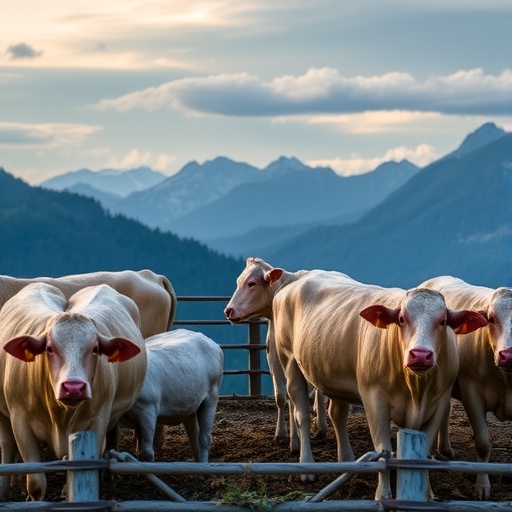
In the evolving landscape of sustainable food production, the meat industry in the United States faces a complex interplay of environmental, economic, and social challenges. A groundbreaking study published in Nature Food in February 2026 provides new insights into how meat producers navigate these competing sustainability demands. According to research led by Collier, Janzing, Fudge, and colleagues, the decisions and strategies employed by meat producers cannot be understood merely through economic or technological lenses; rather, they are deeply shaped by distinct worldviews that fundamentally influence how sustainability is prioritized and operationalized.
The study systematically explores the heterogeneity among U.S. meat producers, revealing that their approaches to sustainability are not monolithic but instead vary significantly depending on underlying philosophies and core beliefs about the role of agriculture, the environment, and society. This research employs a multidisciplinary framework combining qualitative interviews, ethnographic observation, and quantitative analysis to map out these divergent perspectives. By doing so, the authors offer a nuanced understanding of how industry actors reconcile conflicting priorities such as reducing greenhouse gas emissions, ensuring animal welfare, maintaining economic viability, and addressing social equity.
One of the striking findings of the study is the identification of three dominant worldview categories that delineate how producers conceptualize sustainability. The first worldview venerates traditional production methods emphasizing stewardship of the land and incremental improvements in environmental impact without drastically altering the production paradigm. This group tends to prioritize maintaining economic stability for rural communities and preserving cultural practices linked to meat production. They often view technological innovation with cautious optimism, balancing it against potential disruptions to established ecosystems and social fabrics.
The second worldview is characterized by a more interventionist stance. Producers aligned with this perspective actively pursue technological advancements such as precision agriculture, enhanced feed efficiency, and novel biotechnologies aimed at transformative reductions in the environmental footprint of meat production. They frame sustainability largely in terms of measurable environmental metrics—greenhouse gas reductions, water usage minimization, and energy conservation—and often advocate for industry-wide regulatory frameworks to incentivize rapid change.
Conversely, the third worldview adopts a systemic socio-ecological lens. Producers with this orientation emphasize interconnectedness between environmental outcomes, community wellbeing, and social justice. They critique both traditional and purely technocratic approaches for insufficiently addressing power imbalances, rural depopulation, and labor conditions in the meat industry. Sustainability here entails a holistic transformation of supply chains, equitable stakeholder engagement, and regenerative agricultural practices that restore ecological integrity while fostering social resilience.
This tripartite framework underscores the complexities faced by policymakers and stakeholders attempting to harmonize sustainability goals in the meat production sector. The study illuminates why blanket policies or one-size-fits-all sustainability initiatives frequently encounter resistance or yield suboptimal results. Instead, nuanced interventions that recognize and engage the plurality of producer worldviews are imperative for meaningful progress.
Technically, the research employs robust mixed methods analyses to deepen understanding of these worldviews. Qualitative data was collected through in-depth interviews spanning small family-run farms to large-scale industrial operations, enabling the researchers to capture a broad spectrum of production contexts and motivations. The ethnographic component provided contextual richness, revealing how daily decision-making processes and local social dynamics shape sustainability practices. Quantitative analyses then synthesized these insights into typologies, validated through clustering algorithms and comparative statistical testing.
Importantly, these findings challenge dominant narratives that depict meat producers as homogenous stakeholders either uniformly resistant to sustainability reforms or uniformly progressive innovators. The revealed diversity suggests that efforts to foster sustainable meat production must be tailored, culturally sensitive, and capable of addressing not only technical challenges but also deeply held values and identities. For instance, engagement strategies for traditional producers might focus on demonstrating incremental environmental benefits and economic incentives aligned with heritage preservation, while interventionist producers may be receptive to support for research and development.
Moreover, the systemic socio-ecological group’s emphasis on justice and community invites broader participatory governance models and collaborative frameworks. This could involve co-designing sustainability initiatives with producers, labor representatives, environmental NGOs, and consumers to balance interests and generate legitimacy. It also spotlights the necessity of re-evaluating supply chain structures to incorporate ethical considerations alongside environmental metrics.
This research arrives at a pivotal moment, as global climate and biodiversity crises intensify calls for radical food system transformations. The meat sector, recognized for its outsized environmental footprint, is a central arena for innovation and contestation. By foregrounding producer worldviews, the study enriches the academic discourse and policy dialogue by revealing underlying drivers and barriers that standard techno-economic analyses might overlook. It provides a roadmap for more empathetic and effective sustainability interventions.
Beyond academic circles, these insights have practical implications for industry leadership and advocacy organizations seeking to mobilize support for environmental stewardship in livestock production. Understanding worldview differences can enhance communication strategies, helping to craft messages that resonate with diverse producer identities. This may accelerate adoption of best practices and foster coalitions capable of confronting entrenched environmental and social challenges.
In sum, Collier and colleagues’ work represents a paradigm shift in how sustainable meat production is conceptualized. It moves beyond simplistic categorizations and demonstrates that navigating competing sustainability priorities is as much a question of values and worldviews as it is of technology or economics. This layered perspective equips decision-makers with deeper empathy and strategic tools to engage a heterogeneous producer community enmeshed in a high-stakes balancing act between tradition, innovation, and transformation.
As pressures mount—from consumer demand for ethical products to regulatory tightening and environmental advocacy—the ability to recognize and integrate diverse producer perspectives will determine the viability of sustainable meat production pathways. Furthermore, the study emphasizes that sustainability efforts divorced from social and cultural contexts risk alienating key stakeholders and undermining long-term success. Hence, integrative frameworks that unite environmental goals with economic stability and social justice offer the most promising avenues forward.
Ultimately, the study’s contribution extends a critical reminder that meat producers are not passive recipients of external mandates but active agents whose worldviews sculpt their relationships with land, animals, communities, and markets. Appreciating this agency is essential for crafting policies and innovations that are not only environmentally sound but socially equitable and economically resilient. As global food systems strive to meet the dual imperatives of sustainability and nourishment, this research offers indispensable guidance for aligning divergent interests in pursuit of shared futures.
Cite Scienmag News
Sloane Callahan. (February 28, 2026). Meat Producers Navigate U.S. Sustainability with Diverse Views. Scienmag. https://scienmag.com/meat-producers-navigate-u-s-sustainability-with-diverse-views/
Sloane Callahan. "Meat Producers Navigate U.S. Sustainability with Diverse Views." Scienmag, 28 February 2026, https://scienmag.com/meat-producers-navigate-u-s-sustainability-with-diverse-views/. Accessed 4 September 2026.
Sloane Callahan. "Meat Producers Navigate U.S. Sustainability with Diverse Views." Scienmag. February 28, 2026. https://scienmag.com/meat-producers-navigate-u-s-sustainability-with-diverse-views/


