


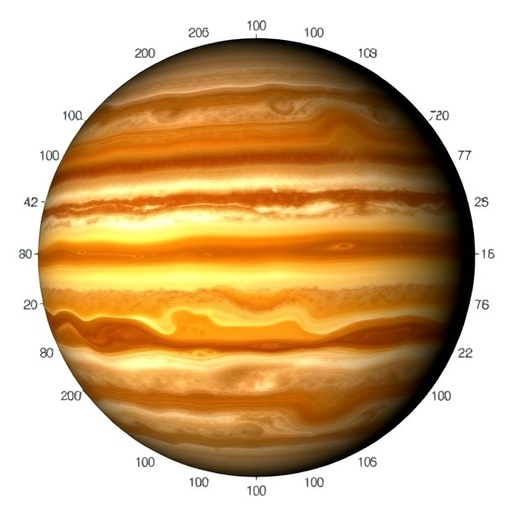
The formation of gas-giant planets has long intrigued astronomers, yet the detailed processes that govern their development—particularly the accretion of icy and rocky solids—remain shrouded in uncertainty. While gas giants are predominantly composed of hydrogen and helium, the role of heavier elements, often referred to as “metals” in astronomical parlance, is crucial in unraveling the complex history embedded within these massive worlds. In a groundbreaking study enabled by the unparalleled capabilities of NASA’s James Webb Space Telescope (JWST), scientists have taken a quantum leap forward in understanding the chemical composition of giant exoplanets, shedding light on their formative environments and the mechanisms that seeded them with heavy elements.
At the heart of this research lies the HR 8799 system, a fascinating stellar neighborhood that boasts several directly imaged gas giants, providing an extraordinary laboratory for planetary formation studies beyond our Solar System. These planets orbit a young, sun-like star and present a unique opportunity to probe the elemental abundances in giant planet atmospheres with exquisite precision. The key innovation in this study was the ability of JWST’s state-of-the-art instruments to detect multiple molecular species simultaneously, including both volatile compounds—such as water vapor (H₂O), carbon monoxide (CO), methane (CH₄), and carbon dioxide (CO₂)—and refractory molecules like hydrogen sulfide (H₂S), along with isotopologues such as ^13CO and C^18O. This comprehensive chemical census opens a fresh window into the accretion processes that govern giant planet assembly.
The fundamental question addressed by the researchers centers on how these planets acquired their heavy elements. It is well-established that certain elemental species—especially refractory ones like sulfur—are locked almost exclusively in solid form in the protoplanetary disk where planets coalesce. Thus, the abundance of sulfur and similar elements in a planetary atmosphere directly traces the amount and nature of accreted solids during formation. Prior to this investigation, the measurements of these species were limited or indirect, clouding interpretations about whether heavy elements were mainly incorporated through gaseous or solid accretion. The exquisite sensitivity of JWST has finally shifted the paradigm by providing unambiguous detection of multiple key species indicative of solid accretion.
Analyses revealed that all three massive gas giants orbiting HR 8799 exhibit a striking and uniform enhancement in metallicity compared to their host star. This enrichment spans both volatile elements—typically found in gas phase—and refractory elements, confirming that the heavy-element budget stems largely from solid material acquisition rather than gas alone. Interestingly, the degree of metallicity enrichment mirrors what we observe in Jupiter and Saturn, suggesting a common thread that links our Solar System’s giants with these far-flung exoworlds. This discovery effectively extends the framework of planetary formation theories, indicating that efficient solid accretion is not a localized phenomenon but rather a universal mechanism operating across diverse planetary systems.
The interplay of chemical signatures detected in the HR 8799 planets paints a dynamic picture of planet formation pathways. For instance, the presence of isotopically distinct carbon monoxide variants (^13CO and C^18O) offers a precision tool for probing the chemical history of the protoplanetary disk and the feeding zones of these planets. Such isotopic ratios carry fingerprints of the disk’s initial composition, radial mixing, and thermal processing before planet accretion occurred. These measurements are essential in constraining disk models and differentiating between competing theories that address where and how different planetary building blocks congregate.
Moreover, the observed uniformity of metal enrichment across multiple planets in the same system defies simple models that predict significant compositional gradients in gas giants depending on their distance from the star or position within the disk. Instead, the data imply that the accretion of solids—icy and rocky—is efficient all along the protoplanetary disk regions inhabited by these planets. This homogeneity hints at a shared evolutionary pathway and may reflect robust mixing processes in young planetary systems that ensure solid materials are delivered consistently across a range of orbital radii.
This new window into giant planet formation has profound implications for our understanding of planetary system architectures. By demonstrating that significant heavy-element enrichment occurs in multiple gas giants around a single star, astronomers can refine models for planetesimal migration, core accretion efficiency, and disk dynamics. It suggests that the formation environment of giant planets may be more chemically rich and dynamically active than previously thought, fostering conditions that yield planets with compositions similar to, or even more enhanced than, those within our own cosmic backyard.
In addition to refining formation models, the findings provide a tangible chemical link between exoplanetary giants and our Solar System’s gas giants. This parallel supports the concept that elemental enrichment is a pervasive hallmark of giant planet formation regardless of stellar or planetary system parameters. It may also imply that the processes leading to the accumulation of heavy elements—whether via pebble accretion, planetesimal capture, or disk chemical evolution—operate under shared physical principles that transcend local disk conditions.
The role of JWST in this study cannot be overstated. Its unprecedented spectral resolution and sensitivity in the infrared allows researchers to disentangle complex molecular signatures in exoplanet atmospheres with clarity never before achieved. These capabilities mark a new era in exoplanet characterization, where detailed chemical inventories can be constructed for a growing sample of planets. Such analyses will inevitably refine our understanding of planetary atmospheres, internal structures, and their formation histories.
While this research primarily targets giant planets, it also opens avenues for exploring smaller and more diverse exoplanets using similar techniques. By expanding detailed chemical analyses to a variety of planetary types, astronomers hope to uncover universal trends and anomalies in planet formation and evolution. This, in turn, strengthens the empirical footing upon which theoretical frameworks rest, allowing for iterative improvements in models that resonate with observed realities.
Furthermore, the detection of heavy refractory elements like sulfur provides an essential benchmark for studies of planetary atmospheres, where processes like photochemistry, atmospheric escape, and cloud formation can obscure abundance measurements. Robust chemical detections reinforce confidence in atmospheric retrievals and help distinguish primordial compositions from later evolutionary alterations. Thus, this research also enhances the fidelity of atmospheric modeling across the exoplanet field.
The findings beg new questions about the timelines over which metal enrichment occurs and the subsequent evolution of planetary atmospheres. Understanding how heavy element delivery shapes atmospheric chemistry and structure over millions of years may reveal critical insights into planetary climate regimes and potential habitability of moons orbiting such giants. Future JWST observations combined with direct imaging and high-resolution spectroscopy will be pivotal in tracing these temporal evolutions.
In conclusion, this landmark study utilizing JWST’s capabilities ushers in a transformative understanding of gas giant formation by revealing Jupiter-like uniform metal enrichment among multiple giant exoplanets orbiting HR 8799. The clear chemical linkage between these distant worlds and the gas giants in our own Solar System underscores universal processes shaping planetary formation across the Galaxy. By probing the fundamental building blocks and assembly pathways of giant planets, researchers now have a powerful blueprint to test and refine planet formation theories on an unprecedented scale.
As new generations of telescopes and instruments come online, the foundations laid by this research will guide explorations into the rich diversity of planetary systems. Unlocking the secrets of heavy-element accumulation in gas giants not only illuminates their pasts but also sets the stage for understanding planetary system evolution, architecture, and ultimately, the potential for environments conducive to life elsewhere in the Universe.
Ruffio, JB., Xuan, J.W., Chachan, Y. et al. Jupiter-like uniform metal enrichment in a system of multiple giant exoplanets.
Nat Astron (2026). https://doi.org/10.1038/s41550-026-02783-z
Cite Scienmag News
Grant Pearson. (February 27, 2026). Uniform Metal Enrichment in Jupiter-Like Giant Exoplanets. Scienmag. https://scienmag.com/uniform-metal-enrichment-in-jupiter-like-giant-exoplanets/
Grant Pearson. "Uniform Metal Enrichment in Jupiter-Like Giant Exoplanets." Scienmag, 27 February 2026, https://scienmag.com/uniform-metal-enrichment-in-jupiter-like-giant-exoplanets/. Accessed 1 September 2026.
Grant Pearson. "Uniform Metal Enrichment in Jupiter-Like Giant Exoplanets." Scienmag. February 27, 2026. https://scienmag.com/uniform-metal-enrichment-in-jupiter-like-giant-exoplanets/


