


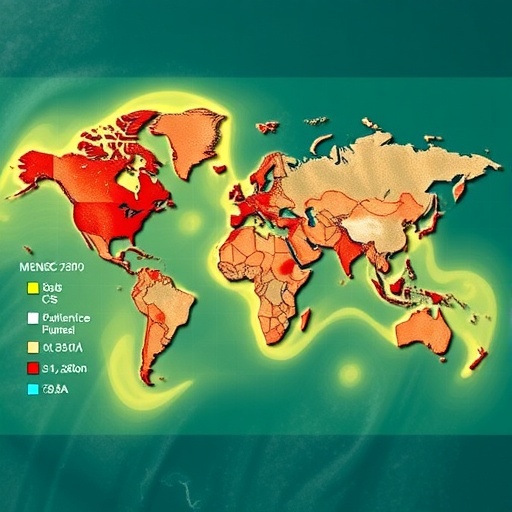
In a remarkable intersection of global public health measures and environmental science, a recent study has unveiled how the COVID-19 pandemic’s containment efforts led to a pronounced reduction in lake turbidity worldwide. This groundbreaking research, published in Communications Earth & Environment, reveals the unprecedented environmental effects of reduced human activity during lockdowns, shedding new light on the dynamic interplay between anthropogenic pressures and aquatic ecosystems. The findings carry profound implications for future environmental management and policy decisions as the world emerges from the pandemic era.
Lake turbidity, a key indicator of water quality, measures the cloudiness or haziness caused by suspended particles such as sediments, organic matter, and pollutants. Turbidity influences critical ecological aspects such as light penetration, photosynthesis rates, and habitat suitability for aquatic life. Elevated turbidity levels often point to disturbed watersheds and increased human impacts, including agriculture runoff, urban stormwater, and industrial discharges. Therefore, understanding the drivers of turbidity fluctuations has long been a priority for ecologists and environmental managers striving to safeguard freshwater resources.
This comprehensive study leverages a vast, global-scale dataset, employing satellite remote sensing technologies to quantify lake turbidity trends spanning the pandemic years of 2020 and 2021. Sophisticated algorithms processed multispectral imagery from Earth observation satellites, enabling researchers to detect subtle yet widespread shifts in turbidity patterns. By comparing these recent observations against historical baselines, the researchers identified a striking global reduction of lake turbidity coinciding with the strictest COVID-19 containment periods—a phenomenon previously undocumented at this scale.
The analytical framework integrated massive datasets, harmonizing remote sensing insights with meteorological records and localized human activity indices such as mobility reduction metrics from mobile phone data. This coupling allowed for the disentanglement of complex drivers influencing water quality, affirming that diminished human mobility and industrial shutdowns were the primary catalysts behind the clearer water observed. Importantly, this natural experiment underscored how human activities are tightly coupled to environmental degradation, and conversely, their reduction can yield rapid ecological recovery.
Lakes across diverse geographic and climatic zones demonstrated variable responses, but the overall pattern was remarkably coherent. Turbidity declined most noticeably in regions with dense urban populations and intensive agricultural activities, where lockdowns drastically curtailed pollution sources like vehicular emissions and nutrient runoff. For instance, lakes in rapidly urbanizing zones of Asia, Europe, and North America exhibited turbidity reductions ranging from 15 to 30%. This consistency across continents attests to the ubiquitous role of human interference in shaping water quality.
Crucially, these turbidity improvements were transient but insightful, emphasizing the resilience and vulnerability of lake ecosystems. As human activities gradually resumed post-lockdown, many lakes reverted to pre-pandemic turbidity levels. This reversion illustrates the persistent pressures exerted by anthropogenic inputs but also highlights how environmental conditions can quickly improve if these pressures are alleviated. The study’s findings thus advocate for targeted, sustained intervention strategies capable of maintaining water clarity through improved land use practices and pollution control.
Another important aspect explored is the potential feedback mechanisms involving reduced turbidity and local climate effects. Enhanced water clarity allows greater penetration of sunlight, potentially altering thermal stratification patterns within lakes and influencing biological productivity. While the study primarily focused on turbidity itself, the authors suggest that ancillary climatic and biogeochemical dynamics merit deeper investigation to fully comprehend the cascading effects triggered by abrupt human behavior changes.
From a methodological perspective, this study showcases the transformative power of integrating cutting-edge satellite technology with innovative data analysis paradigms. By applying machine learning techniques to vast image databases, researchers rapidly synthesized insights across spatial and temporal scales unattainable by traditional ground-based observations alone. This approach exemplifies how remote sensing can play a pivotal role in monitoring and managing freshwater ecosystems globally, offering near-real-time environmental intelligence for decision-makers.
The COVID-19 pandemic, despite its tragic human toll, inadvertently provided a rare global-scale experimental platform for environmental scientists. This study capitalizes on that unique moment, furnishing clear evidence that rapid environmental responses occur when humans enact behavioral changes, even if involuntarily. Such lessons are invaluable in the context of escalating threats like climate change, where human activities remain the dominant influence on ecosystem health but targeted interventions hold promise for mitigation.
Policy implications emerging from this research are profound. The demonstration that large-scale reductions in turbidity are achievable within short timescales highlights the efficacy of stringent controls on pollutant sources. It reinforces the need for holistic water management frameworks that integrate urban planning, industrial regulation, and agricultural best practices. Moreover, real-time remote sensing monitoring can enhance regulatory compliance and public awareness, fostering more sustainable interactions with aquatic environments.
Public engagement and awareness also gain relevance through this study’s revelations. Visualizing cleaner, clearer lakes during lockdown periods created a palpable connection between everyday activities and environmental quality for many people. This experiential understanding could catalyze broader public support for environmental stewardship programs and sustainable behavioral models moving forward, underscoring the power of informed communities in shaping resilient ecosystems.
Furthermore, this unprecedented global reduction in lake turbidity opens new avenues for interdisciplinary research. Hydrologists, ecologists, climatologists, and social scientists can collaboratively explore the multifaceted consequences of reduced anthropogenic momentum. For example, investigating how aquatic biodiversity responds to rapid water quality improvements could yield critical insights into ecosystem recovery potentials and limits under stress scenarios.
In conclusion, the study by Wu, Liu, Makowski, and colleagues marks a seminal contribution to our understanding of freshwater ecosystem dynamics amidst human perturbations. It illustrates nature’s capacity for swift recuperation when pressures diminish, while simultaneously spotlighting the fragility embedded in current environmental paradigms. As humanity steps into a post-pandemic world, harnessing these lessons could drive transformative changes toward healthier, more sustainable freshwater environments into the future.
The research not only enriches environmental science with robust empirical evidence but also acts as a call to reimagine the relationship between society and its natural water systems. The clear waters glimpsed during pandemic lockdowns stand as a testament to what is possible—a cleaner, brighter future that beckons actionable commitment from all sectors to balance human needs with ecological preservation.
Cite Scienmag News
Violet Maxwell. (February 27, 2026). COVID-19 Restrictions Globally Lower Lake Turbidity Levels. Scienmag. https://scienmag.com/covid-19-restrictions-globally-lower-lake-turbidity-levels/
Violet Maxwell. "COVID-19 Restrictions Globally Lower Lake Turbidity Levels." Scienmag, 27 February 2026, https://scienmag.com/covid-19-restrictions-globally-lower-lake-turbidity-levels/. Accessed 1 September 2026.
Violet Maxwell. "COVID-19 Restrictions Globally Lower Lake Turbidity Levels." Scienmag. February 27, 2026. https://scienmag.com/covid-19-restrictions-globally-lower-lake-turbidity-levels/


