


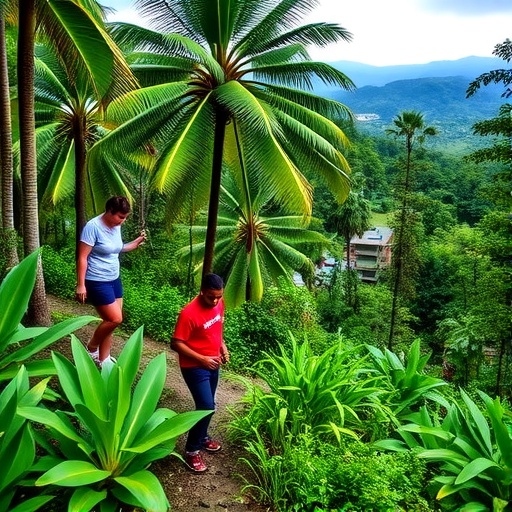
In the heart of Central America lies Costa Rica, a country celebrated for its staggering biodiversity, encompassing an extraordinary array of fungi, plants, and animal species intricately interwoven into complex ecosystems. Despite its global recognition as a conservation success story, this biodiverse nation faces the relentless pressure of habitat loss and environmental change. In a pioneering scientific endeavor, the newly funded GeCoBio project emerges as a collaborative German-Costa Rican initiative poised to deepen the understanding of Costa Rica’s fungal diversity and broader biodiversity, thereby laying a robust foundation for more effective conservation strategies.
This ambitious project, led by Professor Meike Piepenbring from Goethe University Frankfurt’s Institute of Ecology, Evolution and Diversity, has secured €450,000 in federal funding from the German government. The funding aims to establish a durable partnership between Goethe University and the Universidad de Costa Rica (UCR), characterized by formal agreements alongside extensive research exchanges. These measures aim to cultivate a transnational scientific network designed to jointly initiate and execute research programs addressing pressing conservation and biodiversity challenges.
Costa Rica continues to be a haven for myriad species, yet its ecological wealth remains inadequately documented, especially concerning fungi—a critical but often overlooked component of ecosystem functioning. Fungi contribute indispensably to nutrient cycling, symbiotic partnerships with plants, and the degradation of organic matter, playing a vital role in sustaining forest resilience. As Piepenbring emphasizes, despite protection status on 25 percent of the country’s land, primary forest cover is inexorably diminishing due to agricultural expansion and human settlements. Such losses underscore the urgency of enhancing scientific knowledge to safeguard these ecosystems effectively.
The GeCoBio project intends to tackle these knowledge gaps through interdisciplinary collaboration involving biologists, ecologists, and conservationists from both Costa Rica and Germany. Central to this collaboration is the strategic harnessing of UCR’s advanced research infrastructure and expert academic community, which provides an excellent springboard for conducting in-depth biodiversity assessments and experimental studies. One pivotal element of the project is the planned initial expedition into Costa Rica’s rainforests, designed to facilitate in situ observations and specimen collections. This hands-on scientific experience is not only crucial for data acquisition but also serves to strengthen long-term international research ties.
A key scientific thrust within GeCoBio is the exploration of fungal diversity in Costa Rican forests. Fungi represent a vastly understudied kingdom whose species richness and ecological roles in tropical ecosystems are far from fully characterized. To support this, the project will establish a culture collection comprising living strains of fungi and other microorganisms isolated from regional habitats. The establishment of such a biorepository is instrumentally important for adhering to international biodiversity regulations, specifically the Convention on Biological Diversity, by ensuring that biological material remains within the country of origin and is accessible for ongoing research without infringing on sovereign rights.
Navigating the complex regulatory landscape of permitting for collection and export of biological specimens forms another critical project component. The GeCoBio initiative will provide capacity-building and guidance to researchers, facilitating smooth compliance with national and international frameworks that govern biodiversity research and bioprospecting. This effort reinforces ethical scientific conduct while fostering equitable research cooperation between institutions and countries.
Professor Piepenbring’s longstanding connection to Costa Rica—stretching back to her tenure as a doctoral student in the early 1990s—imbues the project with valuable experiential insight and cultural sensitivity. Collaborating closely with her Costa Rican counterpart, Professor Melissa Mardones, whose academic roots are similarly tied to Goethe University Frankfurt, the partnership combines complementary expertise and a shared commitment to advancing biodiversity science. Their joint leadership exemplifies how academic networks can transcend geographic borders to address global environmental challenges.
From the German perspective, this project aligns strategically with federal government objectives to internationalize research and education, specifically by fostering collaborations in Latin America and the Caribbean. The initiative underscores Germany’s investment in tackling global challenges such as biodiversity loss and climate change through cooperative, interdisciplinary approaches. Out of more than 100 proposals submitted in response to a competitive call, the selection of GeCoBio as one of the twelve funded projects highlights its scientific rigor and relevance.
At Goethe University Frankfurt, the project benefits from a robust institutional framework supporting biodiversity research, integrating faculties of Biosciences and Geosciences with external entities such as the Senckenberg Society for Nature Research. It is embedded within the university’s cross-disciplinary profile on “Biodiversity and Sustainability,” amplifying its potential to generate impactful knowledge. Regional partnerships like BioFrankfurt e.V. and international platforms including the Frankfurt Conservation Center further extend the reach and influence of this research endeavor.
By advancing scientific understanding of fungal species and broader biodiversity in Costa Rica, the GeCoBio project promises more than academic outputs. It aims to inform policy, guide conservation planning, and develop capacity among researchers and stakeholders, ultimately contributing to the preservation of ecologically invaluable habitats amid growing anthropogenic threats. This type of collaborative biodiversity research is imperative in steering sustainable futures and safeguarding the intricate web of life that sustains planetary health.
As this transatlantic partnership unfolds, the scientific community awaits insights from its first rainforest expedition and subsequent research phases. The anticipated discoveries and generated data will no doubt enrich biological collections, fill critical biological knowledge gaps, and potentially identify novel species or bioactive compounds. Moreover, the project sets a precedent for future bilateral initiatives that leverage complementary strengths and shared conservation commitments to address global biodiversity crises.
In sum, GeCoBio represents a vital scientific response to the dual challenges of biodiversity loss and insufficient taxonomic documentation, particularly of fungi, in one of the world’s richest ecosystems. By fostering sustained international collaboration, leveraging institutional strengths, and aligning with global conservation priorities, the project exemplifies how science can serve as a cornerstone for conservation innovation and education in the 21st century.
News Publication Date: Not specified in the source material.
Web References: https://mediasvc.eurekalert.org/Api/v1/Multimedia/9ab26842-d80d-439a-a0d8-3cc49748a942/Rendition/low-res/Content/Public
Keywords
Costa Rica, biodiversity, fungi, GeCoBio project, Goethe University Frankfurt, Universidad de Costa Rica, fungal diversity, conservation, ecosystem stability, international collaboration, biological collection, rainforest expedition.
Cite Scienmag News
Margaret Porter. (February 27, 2026). Collaborative Initiative Advances Biodiversity Research in Costa Rica. Scienmag. https://scienmag.com/collaborative-initiative-advances-biodiversity-research-in-costa-rica/
Margaret Porter. "Collaborative Initiative Advances Biodiversity Research in Costa Rica." Scienmag, 27 February 2026, https://scienmag.com/collaborative-initiative-advances-biodiversity-research-in-costa-rica/. Accessed 1 September 2026.
Margaret Porter. "Collaborative Initiative Advances Biodiversity Research in Costa Rica." Scienmag. February 27, 2026. https://scienmag.com/collaborative-initiative-advances-biodiversity-research-in-costa-rica/


