


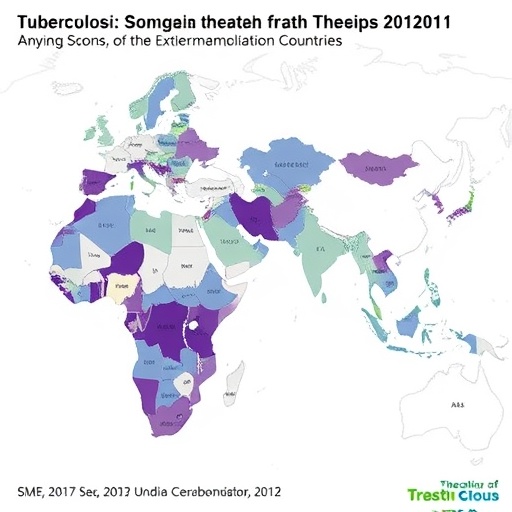
A recent computational modeling study published in PLOS Medicine sheds new light on the potentially devastating economic consequences of diminished international donor funding for tuberculosis (TB) programs in low- and middle-income countries. As TB continues to pose significant public health challenges worldwide, the research emphasizes how funding reductions could exacerbate household financial burdens, pushing thousands more families into catastrophic costs associated with TB care.
Tuberculosis remains one of the world’s deadliest infectious diseases, disproportionately affecting vulnerable populations in resource-constrained settings. Although international donor funding has been a cornerstone in scaling up TB prevention, diagnosis, and treatment services, uncertainty surrounding future financial commitments threatens to reverse hard-won gains. This study utilized advanced computational simulation models to project the economic impact of decreased donor funding on households affected by TB.
The authors’ computational approach integrated epidemiological data with economic metrics to estimate the number of households that would face catastrophic TB-related costs under different funding scenarios. Catastrophic costs, in this context, are defined as TB-related expenses that exceed a critical threshold of household income, often precipitating impoverishment and reduced adherence to therapy. The model stratified these impacts across within-country income quintiles, revealing sharp disparities in economic vulnerability.
One of the study’s striking findings is the disproportionate increase in catastrophic costs borne by the poorest income quintiles. Reduced donor funding would not only lead to greater overall economic hardship but would deepen existing inequalities, as low-income families are less resilient to the financial shocks posed by prolonged illness. This underscores the necessity for sustained, and ideally increased, international investment to safeguard equitable access to TB care.
Technically, the simulation accounted for variables such as treatment costs, income loss due to inability to work, and ancillary expenses like transportation and nutritional support. By modeling these factors over a range of scenarios—from maintaining current funding levels to significant reductions—the research provides a granular forecast of the cascading socioeconomic effects that might ensue.
Beyond direct household impact, the study highlights systemic risks. As economic burdens mount, patients might delay or discontinue treatment, fueling higher transmission rates and undermining public health efforts. The feedback loop between funding adequacy, treatment adherence, and disease control accentuates the critical role of donor resources in the global TB response framework.
Importantly, the modeling study was conducted without new funding support, reflecting an independent academic endeavor by researchers affiliated with institutions in the United States and United Kingdom. This adds an extra layer of credibility and objectivity to the findings, which are crucial for policy deliberations.
The researchers advocate for policy-makers and global health stakeholders to carefully consider these projections in light of ongoing debates around donor funding priorities. As countries grapple with competing demands and fiscal constraints, the evidence presented urges caution against scaling back TB investments prematurely, as the consequences extend well beyond clinical outcomes.
This study is also notable for introducing a novel, comprehensive modeling framework that other infectious disease programs could adapt. By integrating epidemiological data with microeconomic parameters at the household level, the approach sets a new standard for assessing the indirect consequences of funding decisions on vulnerable populations.
Ultimately, the publication stresses that TB eradication is not solely a biomedical challenge but deeply entwined with socioeconomic factors. Ensuring sustainable funding streams is pivotal not only for health systems but for protecting households from catastrophic financial distress, thus promoting broader societal resilience against infectious diseases.
The research encapsulates a broader cautionary tale for global health financing: that cuts in international aid, while sometimes considered necessary or unavoidable, risk undermining decades of progress made against infectious diseases and could have irreversible ripple effects on both health and economic well-being in vulnerable communities.
As the global health community anticipates the next round of funding commitments for TB and other priority diseases, findings like these serve as vital reminders about the hidden yet profound consequences that shifts in financial support can portend. They call for an integrated approach that balances epidemiological control with economic protection of affected households.
This modeling study’s publication in PLOS Medicine contributes significantly to the conversation on sustainable health funding strategies. It provides an evidence base that can inform donor agencies, governments, and advocacy groups aiming to align resources with measurable impact and equity in TB care delivery.
Cite Scienmag News
Courtney Benton. (February 27, 2026). Modeling Study Reveals Lower International Donor Funding Increases Household Economic Burden of Tuberculosis in Low- and Middle-Income Countries. Scienmag. https://scienmag.com/modeling-study-reveals-lower-international-donor-funding-increases-household-economic-burden-of-tuberculosis-in-low-and-middle-income-countries/
Courtney Benton. "Modeling Study Reveals Lower International Donor Funding Increases Household Economic Burden of Tuberculosis in Low- and Middle-Income Countries." Scienmag, 27 February 2026, https://scienmag.com/modeling-study-reveals-lower-international-donor-funding-increases-household-economic-burden-of-tuberculosis-in-low-and-middle-income-countries/. Accessed 1 September 2026.
Courtney Benton. "Modeling Study Reveals Lower International Donor Funding Increases Household Economic Burden of Tuberculosis in Low- and Middle-Income Countries." Scienmag. February 27, 2026. https://scienmag.com/modeling-study-reveals-lower-international-donor-funding-increases-household-economic-burden-of-tuberculosis-in-low-and-middle-income-countries/


