


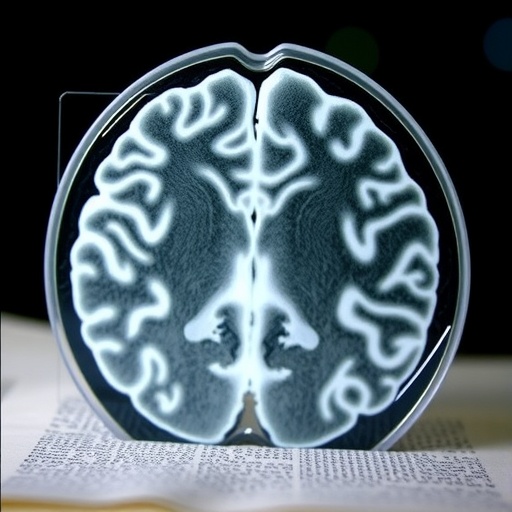
In a groundbreaking advancement at the intersection of physics, imaging technology, and literary preservation, researchers have unveiled a novel proof-of-concept for visualizing text inscribed on bowed sheets within closed books. This pioneering method employs high-resolution 3D-Magnetic Resonance Micro-imaging (3D-MR Micro-imaging) to peer through the physical constraints of book pages without necessitating mechanical separation or physical damage. The implications of this innovative technique herald a transformative leap for archival science, book conservation, and digitization efforts, offering a non-invasive avenue for accessing textual information previously locked away in fragile or uniquely bound volumes.
The crux of this technological breakthrough lies in the sophisticated application of Magnetic Resonance Imaging (MRI), traditionally a staple in medical diagnostics, recalibrated and intensified to function at a micro-scale resolution that is sensitive enough to discern the minute contrasts between ink and substrate on paper. Unlike conventional imaging techniques that rely on visible light, the 3D-MR Micro-imaging system harnesses magnetic resonance signals from the molecular structure of paper fibers and ink constituents, enabling it to generate high-fidelity spatial maps of text morphology beneath multiple overlapping pages.
One of the most exacting challenges addressed by this research is the inherent curvature or bowing of paper sheets in closed books. Book pages rarely lie perfectly flat, especially in older tomes or manuscripts where binding stress and environmental factors cause warping. This curvature poses significant distortions when attempting to image and reconstruct text accurately. The research team developed computational algorithms that integrate with the imaging data to correct the geometric distortions introduced by bowed sheets, effectively “flattening” the data in digital space to reveal legible characters.
Moreover, this approach surpasses previously attempted non-destructive text recovery methods, such as X-ray tomography or multispectral imaging, by offering markedly enhanced depth resolution and contrast specificity. Whereas X-ray based modalities struggle with differentiating organic inks from the cellulose matrix due to similar absorption properties, magnetic resonance exploits differences in proton environments, yielding clearer delineation between written text and the underlying paper. This spectral sensitivity is instrumental in isolating ink patterns that might otherwise remain obscured by paper’s complex microstructure.
Additionally, the volumetric dimension of this imaging allows for three-dimensional reconstructions of page stacks, presenting an unprecedented opportunity to visualize and digitally “turn” pages without physical interaction. This characteristic is of particular importance for illuminating fragile or historically significant manuscripts where physical handling incurs unacceptable risk. Libraries, museums, and archives stand to gain immensely from this technology’s capacity to preserve delicate literary heritage while facilitating scholarly access through digital surrogate texts.
The proof-of-concept demonstration detailed by the researchers involved imaging closed-book samples containing handwritten or printed text, successfully resolving individual letters and words beneath several overlying sheets. The scanning protocols were optimized to balance signal acquisition time with resolution demands, leveraging custom coil designs tailored for high-sensitivity detection at micro-scale depths. Through iterative imaging and computational refinement, the final outputs displayed remarkable clarity, surpassing expectations for resolution limits in such a complex scanning geometry.
Potential extensions of this technology envisage automated text extraction pipelines powered by advanced machine learning algorithms capable of transcribing the reconstructed imagery into editable digital formats. Such integration would hold the promise of rapid digitization workflows, dramatically accelerating efforts to convert vast repositories of unscannable books into searchable digital libraries. This could democratize access to rare manuscripts traditionally available only to a few specialists or physical visitors.
Beyond the humanities, the implications of this technique ripple outward into scientific disciplines that employ layered organic materials. For instance, conservationists working with layered paintings or delicate biological samples could harness similar high-resolution magnetic resonance imaging methodologies to explore internal structures without sample disruption. This cross-disciplinary utility underscores the profound versatility and adaptability of magnetic resonance micro-imaging technology.
Energy and time efficiency remain practical considerations as the methodology advances towards broader deployment. Presently, high-resolution 3D-MR imaging requires careful calibration and extended acquisition periods, which could limit rapid large-scale application. However, ongoing innovations in hardware sensitivity, signal processing speed, and algorithmic reconstruction promise to mitigate these constraints, fostering near real-time imaging capabilities in future iterations.
Furthermore, the researchers emphasize the importance of ink composition and paper type as parameters influencing imaging efficacy. Variations in ink metallic content or paper density can affect the magnetic resonance response, suggesting a need for tailored imaging protocols customized to specific book materials. This nuanced understanding will inform guidelines for scanning different genres and historical periods of documents.
Intriguingly, this technology also opens avenues for forensic examinations of books suspected to contain altered or concealed texts, enabling scholars to detect palimpsests or erased marginalia digitally reconstructed from beneath surface layers. This could yield new insights into the provenance, evolution, and historical context of literary works, enriching cultural and academic narratives with previously inaccessible information.
Looking ahead, collaborative efforts integrating this high-resolution magnetic resonance imaging with other non-destructive imaging modalities, such as hyperspectral or terahertz imaging, could produce multi-modal datasets that reveal complementary information about materials and inks. Such integrative imaging frameworks promise to greatly enhance our capacity to interrogate historical artifacts comprehensively without inflicting harm.
The potential societal impact of this work is noteworthy as well. Preserving the physical integrity of heritage documents while unlocking their contents can contribute to cultural continuity amidst threats posed by environmental degradation, war, or neglect. Furthermore, it facilitates educational outreach by enabling digital facsimiles that retain visual fidelity to their originals, thus inspiring broader public engagement with history and literature.
In summary, the advent of high-resolution 3D-Magnetic Resonance Micro-imaging as demonstrated by Berg and Seewald represents a seminal milestone in non-destructive text visualization technology. By overcoming challenges posed by bowed sheets and physical page barriers, this approach unlocks a reservoir of knowledge encapsulated within closed books, hitherto inaccessible through conventional means. As this technology matures, it promises to revolutionize not only the preservation and dissemination of textual heritage but also expand cross-disciplinary frontiers where imaging delicate layered materials is paramount.
This proof-of-concept experiment thus marks the genesis of a new paradigm in document analysis, where advanced physics meets the preservation of humanity’s intellectual legacy. It invites future research and innovation aimed at refining, scaling, and integrating this promising imaging modality into standard conservation and digitization workflows worldwide, heralding an exciting era of exploration into the hidden labyrinths of written history.
Berg, A.G., Seewald, A.K. Visualization of text on bowed sheets via High-resolution 3D-Magnetic Resonance Micro-imaging for potential reading of closed books: the proof-of-concept. Commun Eng (2026). https://doi.org/10.1038/s44172-026-00614-7
Cite Scienmag News
Denise Maddox. (February 27, 2026). 3D MRI Uncovers Text Hidden in Closed Books. Scienmag. https://scienmag.com/3d-mri-uncovers-text-hidden-in-closed-books/
Denise Maddox. "3D MRI Uncovers Text Hidden in Closed Books." Scienmag, 27 February 2026, https://scienmag.com/3d-mri-uncovers-text-hidden-in-closed-books/. Accessed 1 September 2026.
Denise Maddox. "3D MRI Uncovers Text Hidden in Closed Books." Scienmag. February 27, 2026. https://scienmag.com/3d-mri-uncovers-text-hidden-in-closed-books/


