


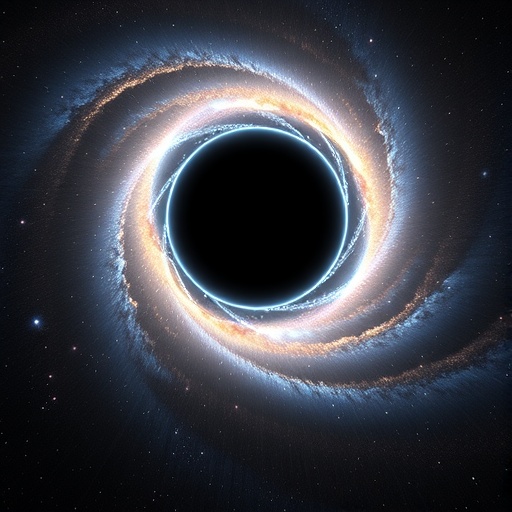
In the quest to unravel the complexities of galaxy formation and evolution, the intricate dance between star formation and the environment in which galaxies reside remains a fundamental enigma. At the heart of this enigma lies a critical gap in our understanding: the role of supermassive black holes and their active galactic nuclei (AGN) in regulating star formation across different cosmic neighborhoods. Despite decades of progress in astrophysical simulations and observational campaigns, the precise influence of black hole feedback on galaxy evolution, modulated by environmental factors such as halo mass and local density, has remained elusive. A groundbreaking study by Yesuf and Bottrell now confronts these challenges head-on, offering a comprehensive empirical benchmark drawn from an unprecedented dataset of nearly 60,000 nearby AGNs and half a million galaxy hosts, both active and quiescent.
This extensive analysis leverages new environmental and halo mass measurements that allow for an incisive comparison between observations and the predictions of three leading cosmological simulation suites: SIMBA, TNG (IllustrisTNG), and EAGLE. Together, these simulations have been heralded for their advanced modeling of galaxy formation physics, including star formation, black hole growth, and various feedback mechanisms. Yet, when placed under the microscope of rigorous data, significant and revealing discrepancies emerge that underscore a critical need to rethink key astrophysical processes within these models.
One of the most compelling revelations from this study is the failure of current simulations to reproduce observed correlations between star-forming activity, quiescent fractions, AGN luminosity, stellar mass, and the mass of their host dark matter halos. Empirically, it is well-documented that AGNs tend to thrive in lower mass halos more so than in the densest clusters or rich groups. However, the simulations, despite approximating these broad trends, diverge markedly when scrutinizing the detailed demographics of host galaxies. This indicates fundamental gaps in how black hole feedback and environmental context are encoded in the simulations’ physical prescriptions.
These discrepancies are especially pronounced in the modeling of satellite galaxies within massive halos. Observations indicate a complex interplay where low-mass satellite galaxies exhibit a diverse range of star formation states, but the simulations consistently overproduce quenched (i.e., non-star-forming) low-mass satellites in these dense environments. This overquenching hints at an overly aggressive feedback implementation or shortcomings in modeling the balance of gas accretion, cooling, and stripping processes within cluster environments. Such an imbalance critically distorts our understanding of galaxy evolution pathways in rich cosmic environments.
Conversely, massive central galaxies and those residing in low-density environments reveal another facet of complexity that current simulations struggle to capture. The fraction of quiescent massive central galaxies is misrepresented, as are the star-forming properties of galaxies isolated in underdense regions. These discrepancies are sensitive indicators of how black hole feedback physics—particularly the mechanisms governing multi-phase gas cooling and outflows—are currently implemented. The simulations’ inability to replicate these trends suggests a missing piece in the physics or resolution of gas microphysics that regulate how gas heats, cools, and fuels star formation or black hole accretion.
The implications of these findings extend far beyond the technical details of simulations. They challenge some of the foundational assumptions about how black holes interact with their larger-scale environments to influence galaxy growth. A more nuanced physical model that incorporates multi-phase gas dynamics—the coexistence of hot, warm, and cold gas phases—is likely essential to fully capture the observed diversity of galaxy states. This includes more realistic treatments of radiative cooling, feedback-driven winds, and environmental gas stripping processes that act differently across halo mass scales.
This study’s unique strength lies in its vast, meticulously calibrated observational dataset. By focusing on nearby AGNs (with redshifts below 0.15), it circumvents some of the uncertainties inherent at higher redshifts where galaxy properties are more challenging to measure reliably. Moreover, complementing AGN hosts with a large control sample of non-AGN galaxies provides the crucial context needed to isolate the distinctive imprints of black hole activity from broader environmental trends.
Comparisons across the three simulation frameworks reveal shared weaknesses despite their diverse modelling philosophies. SIMBA, known for its implementation of kinetic AGN feedback, TNG, with its dual-mode black hole feedback, and EAGLE, emphasizing thermal feedback channels, all fall short in matching the observed coupling of galaxy properties to halo environment and AGN luminosity. This convergence in failure points towards a common missing ingredient or an oversimplified parameterization in current subgrid physics treatments.
The broader astrophysical community stands to benefit immensely from these insights. By identifying where simulations depart most notably from reality, this work lays a critical roadmap for the next generation of theoretical models. Improved modeling of multi-phase gas and refined AGN feedback prescriptions—possibly incorporating cosmic ray physics, magnetic fields, or more realistic jet-driven outflows—may hold the key to resolving these discrepancies and unveiling a more predictive theory of galaxy evolution.
Importantly, this study underscores the need for going beyond global galaxy parameters such as stellar mass and star formation rates. Instead, a more holistic approach must be embraced—one that synergizes observationally accessible quantities like AGN luminosities, detailed halo mass distributions, and large-scale environmental metrics with the underlying physics of gas dynamics. Such integrative analyses not only sharpen our theoretical interpretations but also guide targeted observations with next-generation telescopes and surveys.
Looking ahead, addressing these challenges may also require pushing simulations to higher spatial and temporal resolutions, enabling more faithful representations of physical processes occurring at the interface of galaxies and their surrounding environments. Resolving cold gas clouds, turbulent mixing layers, and unresolved small-scale feedback mechanisms could drastically improve the fidelity of predictions and their match to observations.
Moreover, as multi-wavelength observational campaigns deepen our understanding of AGN properties across cosmic time, these refined datasets will provide ever more stringent benchmarks for simulation calibration and validation. The synergy between observation and simulation is thus poised for a transformative phase, driven by results such as those presented by Yesuf and Bottrell.
Their study not only calls attention to existing modeling limitations but also stimulates innovation in astrophysical theory. It suggests that galaxy and black hole co-evolution must be understood within the intricate networks of dark matter halos varying over mass and cosmic structure scales—a perspective that demands fresh modeling paradigms integrating environment, feedback, and gas physics in unprecedented detail.
In summary, the co-evolution of galaxies and their central black holes, particularly in the context of surrounding dark matter halos, remains an outstanding frontier in astrophysics. Despite substantial advances, current cosmological simulations fall short of replicating key observed relations across environment, star formation, and AGN activity. Bridging this gap will require enhanced physical modeling of black hole feedback and gas heating/cooling processes, coupled with continued comprehensive observational campaigns. The quest to decode this cosmic interplay promises to profoundly sharpen our cosmic narrative of galaxy formation and evolution in the era of precision astrophysics.
Cite Scienmag News
Grant Pearson. (February 27, 2026). Hidden Galaxy-Black Hole Growth in Dark Matter Halos. Scienmag. https://scienmag.com/hidden-galaxy-black-hole-growth-in-dark-matter-halos/
Grant Pearson. "Hidden Galaxy-Black Hole Growth in Dark Matter Halos." Scienmag, 27 February 2026, https://scienmag.com/hidden-galaxy-black-hole-growth-in-dark-matter-halos/. Accessed 2 September 2026.
Grant Pearson. "Hidden Galaxy-Black Hole Growth in Dark Matter Halos." Scienmag. February 27, 2026. https://scienmag.com/hidden-galaxy-black-hole-growth-in-dark-matter-halos/


