


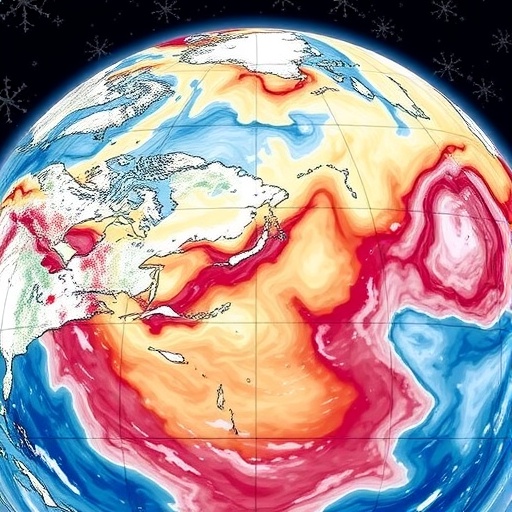
In a groundbreaking study recently published in Nature Communications, researchers Zhang, Yin, Tian, and their colleagues have unveiled a striking phenomenon that challenges established paradigms in winter climate variability across the Northern Hemisphere. Their research identifies a stratospheric precursor that acts as a catalyst for a wintertime phase reversal of the prominent “warm Arctic-cold Eurasia” (WACE) pattern, an atmospheric anomaly that fundamentally influences regional weather extremes and long-term climate trends.
The WACE pattern, widely recognized in climate science, typically manifests as a seesaw in temperature anomalies during winter, where the Arctic experiences anomalous warming while Eurasia endures persistent cold spells. This pattern significantly affects energy demand, agricultural productivity, and ecosystem dynamics across large swathes of Eurasia. Historically, the WACE phase has been a relatively stable mode, with its underlying mechanics attributable primarily to troposphere-stratosphere interactions and sea ice variability. However, this new research disrupts this understanding by demonstrating that stratospheric dynamics, often overshadowed by surface-level drivers, initiate an abrupt phase reversal, effectively flipping the conventional WACE signature.
Using a synthesis of observational data and advanced climate simulations, the researchers pinpoint a specific stratospheric precursor event characterized by perturbations in the polar vortex’s strength and stability. The polar vortex, a large area of low pressure and cold air surrounding the poles, plays a critical role in modulating the exchange of air masses between the Arctic and mid-latitudes. Disturbances in this vortex, as Zhang et al. suggest, can propagate downward, altering surface pressure patterns and temperature distributions across Eurasia. This mechanistic insight underscores the role of high-altitude stratospheric processes as forerunners to major hemispheric climate shifts.
The study further elucidates that this stratospheric precursor acts in the early winter months, setting the stage for a wintertime WACE phase reversal later in the season. This timing is crucial because it provides a potentially valuable predictive window for weather forecasters and climate modelers. The researchers emphasize that recognizing and monitoring these stratospheric signals could improve seasonal weather prediction accuracy, particularly for regions vulnerable to cold outbreaks and heat anomalies induced by WACE variability.
In terms of methodology, the team employed state-of-the-art climate models incorporating coupled stratosphere-troposphere dynamics. These models allowed them to simulate the onset and evolution of the stratospheric precursor with unprecedented spatial and temporal resolution. Through rigorous sensitivity experiments, they established a causal link between the precursor event and the subsequent phase reversal. Notably, the phase reversal was not merely a statistical anomaly but a consistent response across multiple model runs, highlighting the robustness and reproducibility of their findings.
Moreover, the research addresses an ongoing debate concerning the drivers of mid-latitude wintertime climate anomalies. Conventional wisdom has focused on surface factors such as snow cover, sea ice extent, and ocean circulation patterns. By integrating stratospheric processes, Zhang and colleagues provide a more comprehensive framework for understanding atmospheric teleconnections that govern cold Eurasian winters. Their work resonates with prior studies suggesting that the stratosphere can significantly influence tropospheric weather patterns but goes further by identifying a previously unreported dynamical precursor responsible for abrupt circulation changes.
The implications of this discovery are profound. Climate models traditionally struggle to capture the full intricacy of stratosphere-troposphere coupling, leading to uncertainties in predicting extreme weather events. By highlighting the stratospheric precursor’s pivotal role, this study charts a path for refining climate projections and enhancing early warning systems. Policy makers, urban planners, and agricultural stakeholders stand to benefit from this improved forecasting capability, enabling adaptive strategies in the face of rapidly evolving winter climate risks.
Furthermore, this research invites a reevaluation of feedback mechanisms involving Arctic warming and Eurasian cold spells. It is well-documented that decreased sea ice cover and rising Arctic temperatures can influence mid-latitude weather. Yet, the newfound phase reversal mechanism mediated by the stratosphere reveals a complex interplay that may counteract or modulate these surface-driven effects. Such insights are critical in contextualizing ongoing Arctic amplification and its broader climatological consequences.
In addition to advancing theoretical understanding, the study showcases the potential of integrating multi-level atmospheric observations, including satellite data and high-altitude balloon measurements, with sophisticated numerical simulations. This integrative approach sets a new standard for climate research, emphasizing the necessity of capturing vertical atmospheric dynamics to unravel the full spectrum of weather variability.
The authors also discuss the potential influence of anthropogenic climate change on the frequency and intensity of the stratospheric precursor events. While their analysis is preliminary, initial evidence suggests that changing greenhouse gas concentrations and altered hemispheric temperature gradients could modulate the stratospheric vortex’s behavior, thereby affecting the likelihood of WACE phase reversals. This finding accentuates the importance of monitoring stratospheric conditions within the broader context of systemic climate change.
On a practical level, the identification of a stratospheric precursor provides a physical signal that can be incorporated into operational seasonal forecast models. These models, currently limited by an incomplete representation of stratospheric processes, could see substantial improvements in skill at predicting extreme wintertime temperature anomalies over Eurasia. For sectors ranging from energy supply management to public health, these advances hold promise for mitigating adverse impacts associated with harsh winters.
The discovery also offers fertile ground for future research. Untangling the specific atmospheric wave patterns and energy transfers involved in triggering the stratospheric precursor remains a priority. Additionally, understanding how this precursor interacts with other atmospheric phenomena, such as the North Atlantic Oscillation and El Niño-Southern Oscillation, could yield a more integrated picture of global climate variability.
In essence, Zhang et al.’s work marks a milestone in atmospheric science by bridging a crucial knowledge gap concerning winter climate fluctuations in the Northern Hemisphere. Through meticulous analysis and innovative modeling techniques, they illuminate the importance of stratospheric influences, reshaping how scientists conceptualize the drivers of severe winter weather events. Their study not only enriches theoretical discourse but also lays foundational insights to bolster climate resilience in Eurasia and beyond.
As climate extremes become increasingly pronounced, understanding the full gamut of atmospheric drivers becomes indispensable. This research sets a compelling precedent for integrating stratospheric precursors into climate variability frameworks and challenges the scientific community to look beyond traditional surface-based explanations. The multifaceted approach pioneered here heralds a new era of climate predictability, with tangible benefits for societies exposed to the vagaries of winter climate.
Overall, the revelation that stratospheric precursors can instigate a phase reversal in the WACE pattern underscores a nuanced and dynamic climate system, wherein upper atmospheric processes exert a commanding influence on regional weather outcomes. This paradigm shift enhances predictive models and offers a pathway towards more adaptive and proactive management of winter climate risks in Eurasia.
Cite Scienmag News
Violet Maxwell. (February 27, 2026). Stratospheric Trigger Flips Winter “Warm Arctic-Cold Eurasia”. Scienmag. https://scienmag.com/stratospheric-trigger-flips-winter-warm-arctic-cold-eurasia/
Violet Maxwell. "Stratospheric Trigger Flips Winter “Warm Arctic-Cold Eurasia”." Scienmag, 27 February 2026, https://scienmag.com/stratospheric-trigger-flips-winter-warm-arctic-cold-eurasia/. Accessed 1 September 2026.
Violet Maxwell. "Stratospheric Trigger Flips Winter “Warm Arctic-Cold Eurasia”." Scienmag. February 27, 2026. https://scienmag.com/stratospheric-trigger-flips-winter-warm-arctic-cold-eurasia/


