


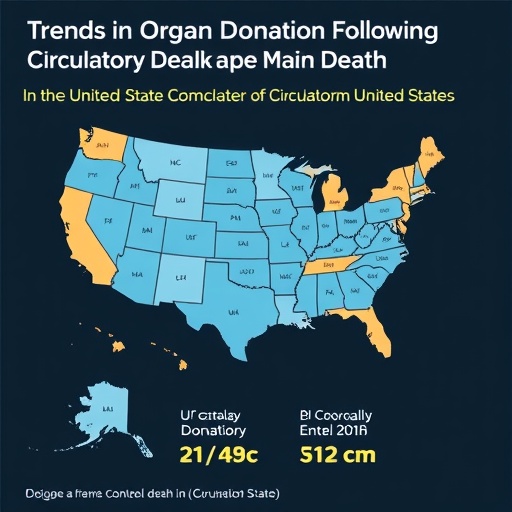
In a groundbreaking shift within the field of organ transplantation, recent research reveals that donors who have undergone circulatory death now constitute nearly half of all deceased donors across the United States, reshaping the landscape of organ procurement. This paradigm shift highlights the critical role of donation after circulatory death (DCD) in sustaining transplant accessibility nationwide, particularly as these donors now represent the majority within most organ procurement organizations (OPOs). The implications of this finding resonate profoundly with transplant medicine, necessitating an evolution of protocols and best practices to optimize outcomes.
The study underscores that contemporary DCD donors embody a significantly higher degree of medical complexity compared to those from previous decades. This complexity stems from evolving clinical criteria and demographic changes, including advanced age and increased comorbidities among donors. These intricacies pose new challenges for transplant teams in selecting, preserving, and allocating organs procured through DCD, as medical risk factors influence graft viability and recipient survival.
Historically, organ donation predominantly relied on donors who sustained brain death, offering a predictable physiological environment for organ retrieval. However, with brain-dead donor availability plateauing and increasing demand for transplants, DCD has emerged as an indispensable alternative donor pool. Circulatory death donors provide organs following the cessation of cardiac activity, introducing a time-sensitive window for organ procurement before irreversible ischemic injury occurs, thereby demanding meticulous coordination.
The growing reliance on DCD organs illustrates an urgent need to establish refined, evidence-based standards in organ selection criteria. Precise assessment of donor viability must balance the urgency for available organs with the necessity to ensure transplant success. Innovations in perfusion technologies and preservation methodologies are pivotal in mitigating ischemia-related damage and extending organ durability during the procurement-to-transplantation interval.
Notably, variation exists across OPOs regarding the proportion of DCD donors utilized, reflecting disparate institutional capacities and regional practices. Approximately 44% of OPOs currently source most of their deceased donors via DCD pathways, signifying a widespread, yet uneven adoption of this method. This heterogeneity highlights areas where targeted improvements and standardization could augment the efficiency and equity of organ allocation nationwide.
Clinicians and transplant surgeons face a complex matrix of clinical considerations when evaluating DCD donors, including donor age, comorbidities, and cause of death, all of which can impact organ function. Moreover, the physiologic changes accompanying circulatory arrest—such as warm ischemic time—contribute significantly to potential organ injury. Therefore, nuanced understanding and management of these variables are imperative for enhancing graft outcomes in recipients.
The logistical intricacies intrinsic to DCD donation are multifaceted. The withdrawal of life-sustaining treatment must occur under strict ethical and legal frameworks, balancing donor dignity with procedural efficacy. Organ retrieval teams must be adept at rapid mobilization to minimize ischemic delays, necessitating synchronized efforts between critical care, surgical, and transplant units.
In parallel with clinical advancements, allocation policies must evolve to incorporate the unique characteristics of DCD organs. Allocation algorithms should integrate donor risk profiles and recipient urgency, promoting optimal matching and post-transplant survival. Transparency in reporting and data sharing across OPOs could foster best practice dissemination and facilitate national consensus-building.
Technological innovations hold promise in revolutionizing DCD organ preservation. Ex vivo machine perfusion systems, which maintain organ viability outside the human body, offer opportunities to assess organ function before transplantation and potentially rehabilitate marginal organs. Such technologies could expand the pool of transplantable organs by salvaging DCD grafts previously deemed unsuitable.
Future research trajectories must focus on longitudinal outcomes of DCD transplantation, investigating graft and patient survival, immunologic response, and quality of life metrics. Integration of advanced biomarkers and real-time monitoring tools may refine donor assessment and post-transplant management. Collaborative registries and multicenter trials will be crucial in generating robust data to inform clinical guidelines.
This transformative study, authored by leading transplant experts and led by Dorry L. Segev, MD, PhD, provides invaluable insights into the evolving dynamics of organ donation. Their work calls attention to the pressing need for continued innovation, interdisciplinary coordination, and policy reform to harness the full potential of DCD donors in addressing the persistent organ shortage crisis.
As transplantation medicine navigates this critical juncture, the medical community and stakeholders must convene to establish consensus-driven protocols that reconcile increased donor complexity with the imperative to maximize transplant success. Embracing the challenges inherent in donation after circulatory death offers a pathway to save countless lives and redefine the future of organ transplantation.
Cite Scienmag News
Ophelia Keating. (February 27, 2026). Trends in Organ Donation Following Circulatory Death in the United States. Scienmag. https://scienmag.com/trends-in-organ-donation-following-circulatory-death-in-the-united-states/
Ophelia Keating. "Trends in Organ Donation Following Circulatory Death in the United States." Scienmag, 27 February 2026, https://scienmag.com/trends-in-organ-donation-following-circulatory-death-in-the-united-states/. Accessed 31 August 2026.
Ophelia Keating. "Trends in Organ Donation Following Circulatory Death in the United States." Scienmag. February 27, 2026. https://scienmag.com/trends-in-organ-donation-following-circulatory-death-in-the-united-states/


