


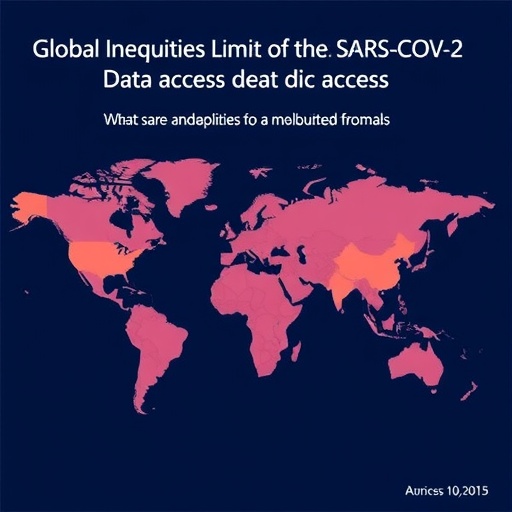
In the relentless battle against the COVID-19 pandemic, the global scientific community has fiercely relied on genomic surveillance of the SARS-CoV-2 virus, decoding its genetic makeup to track evolution, monitor emerging variants, and guide public health responses. However, a groundbreaking study recently published in npj Viruses starkly reveals that inequities and a sharp decline in genomic data availability worldwide pose critical obstacles that could undermine efforts to swiftly identify and contain new viral variants. This research underscores an urgent need for equitable, comprehensive, and sustained genomic data sharing to arm humanity’s defenses against the continuing threat of the pandemic.
The study, performed by scientists including Smith, Fleming, and Lackritz, exposes the uneven global landscape of SARS-CoV-2 sequencing data contribution, revealing striking disparities between wealthy and resource-limited regions. While high-income countries have generated and shared extensive viral genome sequences, many low- and middle-income nations lag drastically behind. Such imbalances, the authors argue, compromise global variant detection efficacy and public health interventions, allowing potentially dangerous viral lineages to proliferate unnoticed for extended periods.
The authors systematically analyzed worldwide genomic data submissions to major public repositories, such as GISAID, over recent years. Their comprehensive assessment traced temporal trends, geographic distribution, and the volume of sequencing efforts during different pandemic phases. The findings uncovered a worrying decline in the overall rate of SARS-CoV-2 sequencing post-2022, coinciding with shifts in pandemic dynamics and waning political and financial focus on surveillance programs. This ebb in data flow further exacerbates existing geographic data gaps.
Of particular concern is the revelation that regions historically underrepresented in genomic contributions have seen their sequencing outputs stagnate or even regress. Given these areas often bear disproportionate infectious disease burdens and have lower healthcare infrastructure, the lack of robust viral genetic data risks blinding health authorities to emergent variants with enhanced transmissibility or immune escape properties. This blind spot could delay critical adjustments to vaccines, diagnostics, and therapeutics.
The research team highlights how factors such as inadequate funding, limited laboratory capacity, logistical constraints, and geopolitical challenges converge to stifle equitable participation in global genomic surveillance efforts. Many resource-limited countries face technical hurdles in sample collection, sequencing technology access, and data sharing frameworks. Furthermore, political sensitivities may disincentivize open sharing of pathogen genetic data, complicating efforts to build a unified global picture.
Through detailed comparisons, the study juxtaposes the quantity and timeliness of SARS-CoV-2 genome sequences from various continents and income groups. It points out that while North America and Europe have pioneered high-throughput sequencing at unprecedented scales, large swathes of Africa, Southeast Asia, and Latin America remain underrepresented, producing fewer sequences relative to their case numbers. This disparity not only skews global variant frequency estimates but undermines efforts to pinpoint regional variant origins and transmission pathways.
The ramifications of these inequities are far-reaching. Emerging viral variants with altered spike protein mutations can evade pre-existing immunity conferred by vaccines or prior infection, compromise monoclonal antibody therapies, and trigger fresh waves of infection. Without timely and representative genomic data, public health officials risk lagging behind viral evolution. As such, the study insists that combating COVID-19 variants mandates not only maintaining but dramatically enhancing equitable genomic surveillance infrastructure worldwide.
Crucially, the research underscores the importance of sustainable investments in sequencing technology democratization. Strengthening local laboratory capacity empowers on-site rapid viral genome characterization, enabling real-time surveillance and localized outbreak responses. Additionally, fostering international collaborations and transparent data sharing policies can break down geopolitical barriers and promote collective health security.
The authors also discuss the potential of emerging innovations, such as portable sequencing devices and automated analytical pipelines, to transform genomic surveillance accessibility. Coupled with training initiatives and resource allocation, these tools could help bridge the divide, ensuring data from all affected populations flow promptly into global databases, thereby refining epidemiological models and vaccine strain updates.
This study serves as a wake-up call amid the pandemic’s evolving challenge, illustrating that the fight against SARS-CoV-2 and future pathogens demands a truly global, inclusive, and sustained genomic data ecosystem. Without addressing systemic inequities and reinvigorating sequencing efforts worldwide, humanity risks walking blind against viral evolution, jeopardizing progress achieved with enormous scientific and social sacrifice.
In essence, while the SARS-CoV-2 virus continues to rewrite its genetic script at an alarming pace, the infrastructure to read and respond to this viral language is fraying. Policymakers, funders, and the scientific community must heed the study’s warning and commit to reversing declining trends in genomic data availability. Only through a coordinated global effort can we hope to outpace viral adaptation, safeguard public health, and mitigate the ongoing threat of COVID-19 variants.
The research calls for urgent international leadership to mobilize resources, facilitate equitable technology transfer, and harmonize data governance frameworks. In doing so, the world can harness the full power of genomic epidemiology, transforming raw sequence data into actionable knowledge that saves lives. The COVID-19 pandemic has illuminated the paramount importance of genomic surveillance; our collective resilience depends on nurturing this capability universally.
In conclusion, the study by Smith et al. lays bare a critical vulnerability in global pandemic response infrastructure: the inequitable and declining availability of SARS-CoV-2 genomic data. It highlights the need for sustained, inclusive sequencing efforts to detect and respond rapidly to evolving variants. The lessons extend beyond the current crisis, providing a blueprint for pathogen surveillance systems resilient to future public health emergencies. The path forward demands cooperation, innovation, and unwavering commitment to scientific diplomacy and equity.
As we stand at a crossroads in the ongoing pandemic journey, this research reminds us that viruses know no borders. A fragmented genomic surveillance landscape invites variants to emerge from the shadows. To turn the tide, the world must unite in building a robust, global viral genome database—comprehensive, timely, and accessible—that serves as our frontline early warning system for the public health challenges yet to come.
Cite Scienmag News
Kristina Jarvis. (February 26, 2026). Global Inequities Limit SARS-CoV-2 Variant Data Access. Scienmag. https://scienmag.com/global-inequities-limit-sars-cov-2-variant-data-access/
Kristina Jarvis. "Global Inequities Limit SARS-CoV-2 Variant Data Access." Scienmag, 26 February 2026, https://scienmag.com/global-inequities-limit-sars-cov-2-variant-data-access/. Accessed 2 September 2026.
Kristina Jarvis. "Global Inequities Limit SARS-CoV-2 Variant Data Access." Scienmag. February 26, 2026. https://scienmag.com/global-inequities-limit-sars-cov-2-variant-data-access/


