


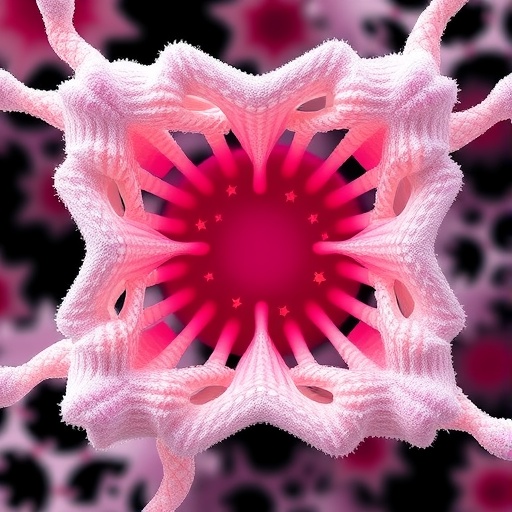
In an era where regenerative medicine is rapidly evolving, the development of innovative scaffolding technologies holds immense promise for advancing tissue repair and healing. Researchers have now introduced a groundbreaking protocol for fabricating three-dimensional (3D) hierarchically aligned nanofiber scaffolds that significantly enhance cellular migration, thereby accelerating tissue regeneration. This novel approach addresses a critical bottleneck in tissue engineering: the failure of cells to properly migrate and populate large, morphologically complex defect sites, which often results in dysfunctional repair.
The challenge with conventional tissue regeneration methods lies in their inability to recapitulate the native architecture of damaged tissue, especially when the injury site exceeds a certain size or complexity. Cells from the surrounding environment typically migrate in an uncoordinated manner, which hampers the restoration of healthy tissue morphology and function. The introduction of bioscaffolds offers a promising solution by providing a structural framework that guides cell migration and organization. However, existing scaffold fabrication techniques have struggled with scalability, porosity control, and alignment precision—limitations that constrain their practical application.
The newly developed protocol integrates a series of advanced material engineering techniques—namely electrospinning, weaving, thermal fixation, and modified gas-foaming—to fabricate 3D nanofiber scaffolds with finely tuned hierarchical organization. Electrospinning produces nanometer-scale fibers that mimic the extracellular matrix, creating an ideal substrate for cell attachment and migration. Weaving allows the assembly of fibers into complex configurations, while thermal fixation stabilizes the scaffold structure. The modified gas-foaming process introduces high porosity, crucial for nutrient diffusion and cellular infiltration.
One of the standout features of these scaffolds is their versatility in fiber alignment. Researchers have achieved uniaxial, bidirectional, radial, and even gradient alignments within the scaffold architecture. This hierarchical arrangement mimics the directional cues found in natural tissue, essentially creating “cell highways” that encourage collective and guided cell movement toward the defect sites. Such directional migration is key to restoring functional tissue morphology as it enables coordinated cell behavior, a prerequisite for effective regeneration.
The porosity of the scaffolds is another crucial parameter that distinguishes this technology. High porosity not only facilitates nutrient and oxygen exchange but also permits deeper infiltration of reparative cells. This is a considerable advancement over traditional dense scaffolds, which often impede cell migration and tissue integration. The optimized porosity in these 3D nanofiber scaffolds ensures that the implanted constructs do not become barriers but rather active participants in tissue regeneration.
Crucially, the synthesis of these scaffolds can be completed within 24 hours, a significant step towards making this technology accessible and scalable. The protocol is designed with the expertise of biomaterials scientists and regenerative medicine specialists in mind, aiming to bridge laboratory development and clinical application. This rapid fabrication method removes a typical bottleneck in scaffold production, facilitating broader adoption and enabling faster transition to preclinical and clinical studies.
The implications of this technology extend across a broad spectrum of medical applications. From wound healing to bone repair, the 3D hierarchically aligned nanofiber scaffolds can be tailored to various tissue types due to their customizable architecture. Hemostatic materials benefit from rapid cellular coverage to control bleeding, while complex structures involved in hernia repair demand precise scaffold alignment to restore strength and function. The application of these scaffolds in biomedical swabs also suggests potential for improving sample collection and diagnostic accuracy.
In vitro studies have demonstrated that these aligned nanofiber scaffolds significantly boost cell migration rates compared to non-aligned or 2D substrates. Cells cultured on the scaffolds exhibit enhanced collective movement, a crucial behavior absent in most traditional scaffold designs. This phenomenon not only accelerates tissue coverage but also promotes the formation of tissue architectures akin to native morphology, marking an important milestone in tissue engineering.
In vivo models further validate the efficacy of these scaffolds. Implantation into defect sites results in a marked acceleration of tissue reconstruction, as cells rapidly navigate the scaffold’s directional cues to populate the injury area. The regeneration achieved is not merely volumetric but also functionally relevant, addressing the morphology and mechanical properties essential for tissue restoration. This highlights the scaffolds’ ability to translate cellular activity into meaningful anatomical and functional outcomes.
The protocol’s integration of multiple fabrication techniques is a testament to interdisciplinary innovation. Electrospinning provides nanometer-scale precision, weaving confers mechanical robustness, thermal fixation stabilizes the architecture, and gas-foaming tailors porosity at a microscale. This synergy creates a biomimetic environment that was previously unattainable with single-method approaches, ushering in a new standard for scaffold fabrication.
Furthermore, the controlled fiber alignment opens possibilities for designing gradient properties within a single scaffold, enabling spatially specific cellular responses. For example, gradient alignment can guide different cell types or behaviors in various scaffold regions, allowing for complex tissue interfaces and zonal architecture that resemble native tissues such as osteochondral units or skin appendages.
The translation of this technology is bolstered by the protocol’s focus on reproducibility and scalability. Unlike many novel biomaterial methods restricted to proof-of-concept demonstrations, this approach equips researchers and clinicians with a straightforward, reliable means to create functionally advanced scaffolds. This capability is poised to accelerate the bench-to-bedside transition and may soon revolutionize multiple facets of regenerative medicine.
Looking forward, the potential synergy between these nanofiber scaffolds and emerging biotechnologies like cellular therapies, gene editing, and advanced imaging could further enhance outcomes. The scaffolds might be engineered to serve as delivery platforms for bioactive molecules, facilitating controlled release of growth factors that amplify regenerative signals or modulate immune responses.
This scientific breakthrough underscores the critical role of scaffold microarchitecture in regenerative success. Aligning and structuring fibers at multiple hierarchical levels offers cells precise navigational cues, reflecting a biomimetic strategy that leverages nature’s own principles. As tissue engineering continues to evolve, such innovations will be central to overcoming current clinical challenges, improving patient outcomes, and transforming regenerative therapies from theoretical potential into everyday medical reality.
In summary, the development of 3D hierarchically aligned nanofiber scaffolds represents a significant advancement in the field of tissue regeneration. By combining multiple sophisticated fabrication methods, this protocol delivers customizable, highly porous, and directionally tuned scaffolds that dramatically enhance cell migration and tissue reconstruction. With broad clinical application potential and a scalable production process, these scaffolds are set to redefine how damaged tissues are repaired and regenerated.
Cite Scienmag News
Ophelia Keating. (February 26, 2026). 3D Nanofiber Scaffolds Boost Cell Migration. Scienmag. https://scienmag.com/3d-nanofiber-scaffolds-boost-cell-migration/
Ophelia Keating. "3D Nanofiber Scaffolds Boost Cell Migration." Scienmag, 26 February 2026, https://scienmag.com/3d-nanofiber-scaffolds-boost-cell-migration/. Accessed 1 September 2026.
Ophelia Keating. "3D Nanofiber Scaffolds Boost Cell Migration." Scienmag. February 26, 2026. https://scienmag.com/3d-nanofiber-scaffolds-boost-cell-migration/


