


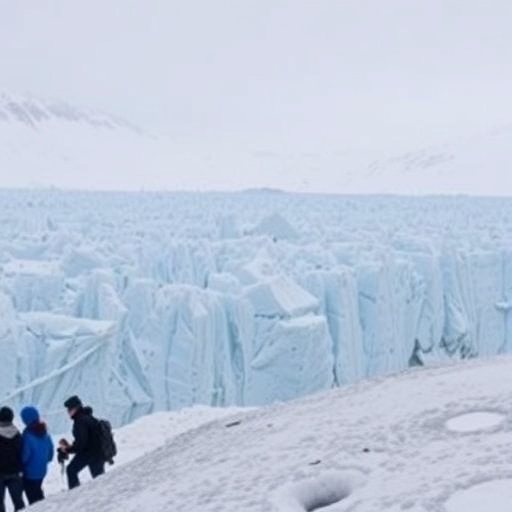
Scientists have long theorized that as the Antarctic glaciers melt, they release iron trapped within the ice, thereby fertilizing the Southern Ocean and stimulating phytoplankton blooms. These microscopic algae, thriving on the iron, subsequently sequester atmospheric carbon dioxide through photosynthesis, offering a natural braking mechanism against climate change. However, groundbreaking new research from Rutgers University-New Brunswick challenges this foundational assumption, revealing that iron contributions from glacier meltwater are markedly less than previously believed.
The Southern Ocean surrounding Antarctica is a crucial carbon sink, absorbing vast quantities of the greenhouse gas CO2. Prior models posited that melting ice shelves, driven by warming oceans, would act as natural iron fertilization sources, fueling phytoplankton growth. This process was thought to partially offset the atmospheric accumulation of carbon, an optimistic scenario amid dire climate projections. But the reality uncovered through meticulous measurements paints a different, more nuanced picture.
In an unprecedented expedition aboard the decommissioned U.S. research vessel Nathaniel B. Palmer, Rutgers scientists sampled meltwater directly from beneath the expanses of the Dotson Ice Shelf in the Amundsen Sea region. This area is pivotal due to its outsized contribution to global sea level rise, fueled by one of the fastest-melting sectors of the Antarctic ice sheet. By collecting water at precise entry and exit points within the ice shelf cavity, the team sought to measure iron concentrations with unparalleled resolution.
Analyses conducted back in the lab revealed that meltwater contributes only about 10% of the dissolved iron flowing from the ice shelf cavity into surrounding waters. Far more iron originates from deep ocean waters – comprising approximately 62% of the total – and from sedimentary sources on the continental shelf, which contribute nearly 28%. This overturns decades of assumptions that placed glacial meltwater at the center of iron supply in this marine ecosystem.
Isotopic fingerprinting of the iron helped uncover the distinct origins, highlighting a significant role for subglacial liquid meltwater layers devoid of dissolved oxygen. Such anoxic environments facilitate the dissolution of iron oxides from bedrock beneath the glaciers, producing bioavailable iron that ultimately reaches the ocean waters. In contrast, the ice shelf meltwater itself carries surprisingly little iron, implicating bedrock interactions beneath the glacier rather than the melting ice mass as the primary iron source.
These findings have profound implications for how scientists model future carbon cycles and climate feedbacks in polar regions. If meltwater contributes less iron than expected, the anticipated natural fertilization effect in the Southern Ocean might be far less robust. This calls for a reassessment of the biological pump’s efficiency and urges the integration of these complex subglacial processes into climate projections.
The Southern Ocean’s phytoplankton blooms are vital for the Antarctic food web, supporting krill populations that in turn sustain iconic species including penguins, seals, and whales. Understanding the true drivers of nutrient supply can inform conservation priorities and enhance predictive models for ecosystem responses to warming. This study demonstrates the necessity of direct, high-precision measurement campaigns rather than reliance on simulations or computational predictions alone.
The interdisciplinary collaboration, spanning institutions from Rutgers University to Texas A&M and the University of South Florida, leveraged cutting-edge chemical oceanography techniques. By measuring both dissolved and particulate iron concentrations alongside iron isotope ratios, the researchers pieced together an intricate puzzle of iron sources and transformations beneath the Antarctic ice shelves. This approach marks a significant advance in polar marine biogeochemistry.
Rob Sherrell, the study’s lead investigator, emphasized that these results generate a pivotal paradigm shift. Rather than viewing glacial meltwater as a major iron vector, attention must focus on understudied subglacial hydrology and sediment interactions. Such insights could recalibrate the global understanding of nutrient cycling in polar oceans, refining how we predict biological productivity and carbon sequestration in a warming planet.
Future research is urgently needed to unravel the detailed mechanisms by which bedrock dissolution beneath glaciers produces bioavailable iron. Additionally, quantifying spatial variability across different Antarctic ice shelves and seasons remains a critical frontier. The interplay of physical oceanography, glaciology, geochemistry, and biology in these dynamic environments is complex, challenging scientists to develop sophisticated models with empirical grounding.
In sum, while the concept of iron fertilization through Antarctic glacier melting provided hopeful expectations for natural climate mitigation, this latest empirical evidence reveals a much more constrained iron supply. It highlights the intricacy of subglacial processes and the importance of sediment and deep ocean contributions. Such revelations underline the urgency of comprehensive, multidisciplinary studies to accurately forecast the Southern Ocean’s role in future climate scenarios.
This study spurs a transformative rethink in how the research community views Antarctic ice shelf melting and nutrient supply. It emphasizes that climate models must incorporate nuanced, evidence-based characterizations of iron sources to better predict the Southern Ocean’s carbon uptake capacity. This discovery serves as a powerful reminder that natural feedbacks in Earth’s climate system can be subtler and more intricate than anticipated, refining the roadmap toward understanding and mitigating global climate change.
News Publication Date: June 2024
Web References:
- https://agupubs.onlinelibrary.wiley.com/doi/10.1029/2022JC019210
- https://www.nature.com/articles/s43247-026-03264-x
- https://www.colorado.edu/today/2025/09/16/us-retire-its-only-icebreaker-stranding-polar-research
- https://thwaitesglacier.org/
- https://www.science.org/doi/10.1126/sciadv.adn5781
References:
Sherrell, R. et al. (2024). “Iron Inputs to the Southern Ocean from Antarctic Meltwater: A Reevaluation,” Communications Earth & Environment, DOI: 10.1038/s43247-026-03264-x
Cite Scienmag News
Sloane Callahan. (February 26, 2026). Do Melting Glaciers Really Slow Climate Change? New Evidence Challenges Popular Belief. Scienmag. https://scienmag.com/do-melting-glaciers-really-slow-climate-change-new-evidence-challenges-popular-belief/
Sloane Callahan. "Do Melting Glaciers Really Slow Climate Change? New Evidence Challenges Popular Belief." Scienmag, 26 February 2026, https://scienmag.com/do-melting-glaciers-really-slow-climate-change-new-evidence-challenges-popular-belief/. Accessed 4 September 2026.
Sloane Callahan. "Do Melting Glaciers Really Slow Climate Change? New Evidence Challenges Popular Belief." Scienmag. February 26, 2026. https://scienmag.com/do-melting-glaciers-really-slow-climate-change-new-evidence-challenges-popular-belief/


