


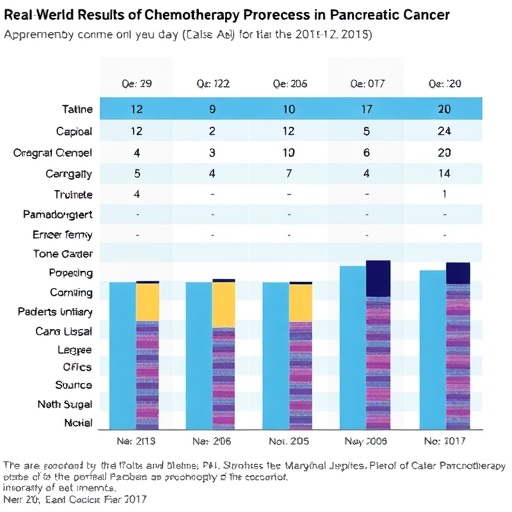
In a groundbreaking real-world study published in the British Journal of Cancer, researchers have shed new light on the outcomes of adjuvant chemotherapy for patients who have undergone surgical resection for pancreatic cancer. This investigation, conducted within a centralized oncology service, challenges previous assumptions derived largely from controlled clinical trials and offers fresh insights into the effectiveness and ultimate benefit of adjuvant chemotherapy in everyday clinical practice.
Pancreatic cancer remains one of the deadliest malignancies globally, notorious for its late presentation and poor prognosis. Surgical resection presents the only potential for cure; however, recurrence is common even after ostensibly successful removal of the tumor. For this reason, adjuvant chemotherapy—treatment given after surgery to eradicate microscopic residual disease—has become the standard of care in many oncology centers. Despite this, the actual real-world utility and impact of chemotherapy post-resection remain inadequately defined, largely due to the heterogeneous nature of patient populations outside clinical trial settings. The study by Hale et al. meticulously investigates these dynamics in a centralised healthcare framework.
Central to the investigation was a cohort of pancreatic cancer patients who underwent surgical resection followed by various adjuvant chemotherapy regimens. The researchers meticulously collected and analyzed comprehensive real-world data, capturing variables such as demographic factors, tumor biology, chemotherapy regimens administered, treatment adherence, toxicity profiles, and survival outcomes. This granularity allowed the study to mirror the complex clinical landscape physicians navigate, highlighting discrepancies between trial efficacy and real-world effectiveness.
What emerged from the data challenges the simplistic notion that adjuvant chemotherapy uniformly improves survival in all cases of resected pancreatic cancer. While chemotherapy did deliver a statistically significant overall survival benefit compared to surgery alone, the magnitude of this benefit was heterogeneous across subgroups. Patient factors such as performance status at baseline, tumor stage, and resection margin status markedly influenced outcomes. Notably, patients with favorable baseline characteristics reaped the most substantial survival advantages, whereas those with more advanced disease or compromised health derived less pronounced benefits.
The study’s innovative integration within a centralised oncology service was pivotal in ensuring consistent treatment protocols and follow-up procedures, minimizing variability often encountered in decentralized care. This allowed for high-quality, standardized data acquisition and better patient monitoring, thereby reinforcing the reliability of the observed outcomes. The findings demonstrate that a centralized model may enhance both treatment deliverability and monitoring of adverse effects, crucial components for optimizing chemotherapy benefits.
Chemotherapy-related toxicity was another critical facet explored. Adjuvant chemotherapy regimens, though potentially life-extending, carry inherent risks of side effects that can diminish quality of life or even preclude treatment continuation. The researchers meticulously documented a spectrum of toxicities, ranging from hematologic complications, such as neutropenia and thrombocytopenia, to gastrointestinal toxicities and fatigue. Importantly, treatment discontinuation rates due to adverse events were correlated with poorer survival, emphasizing the delicate balance between therapeutic benefit and tolerability.
Intriguingly, the study also underscored the impact of socioeconomic factors and healthcare access on treatment adherence and outcomes. Patients with better social support and fewer comorbidities were more likely to complete the full chemotherapy course, illuminating the critical role of holistic patient management extending beyond pharmacologic intervention. Such insights advocate for integrated care models that encompass nutritional support, psychological counseling, and social services to maximize patient compliance and outcomes.
Molecular and pathological analyses performed in conjunction with clinical data offered insights into tumor biology influencing responsiveness to adjuvant chemotherapy. Specific genetic mutations and biomarkers associated with chemoresistance or sensitivity were preliminarily identified, suggesting future potential for personalized therapy. This aspect of the research aligns with the broader move towards precision oncology, where treatments are tailored based on individual tumor profiles rather than a one-size-fits-all approach.
The implications of this study are far-reaching for clinical practice. Firstly, it provides a more nuanced understanding that can guide oncologists in patient selection for adjuvant chemotherapy, potentially sparing those unlikely to benefit from exposure to toxic regimens. Secondly, the research reaffirms the necessity of centralized healthcare delivery models that can standardize treatment and improve comprehensive patient management. Thirdly, it calls attention to the need for supportive care infrastructure to ensure treatment adherence and mitigate side effects.
In addition to clinical insights, this study encourages revisiting current clinical guidelines and protocols to incorporate real-world evidence into decision-making algorithms. While randomized controlled trials will remain the gold standard for establishing efficacy, augmenting them with population-wide data reflective of routine practice may yield more pragmatic and applicable recommendations. This is especially crucial in malignancies like pancreatic cancer with narrow therapeutic windows and high morbidity.
The research also paves avenues for subsequent investigations focusing on optimizing chemotherapy protocols, such as dosing schedules or combining chemotherapy with novel targeted agents or immunotherapies. It sets a precedent for ongoing prospective registries and databases that continuously capture outcome data from real-world clinical settings, enabling dynamic refinement of treatment strategies.
In an era where data-driven medicine is transforming oncology, studies like that of Hale and colleagues exemplify how systematically collected real-world evidence can complement and enrich randomized trials, creating a more comprehensive landscape of cancer care. For patients battling pancreatic cancer, these findings offer cautious hope—not only for extended survival through adjuvant chemotherapy—but also for personalized, nuanced approaches that respect the complexity of their disease and individual circumstances.
Centralization of care, coupled with a commitment to thoroughly understanding patient diversity and therapeutic risk-benefit ratios, promises to shape the future of pancreatic cancer management. In a word, this study embodies the joining of cutting-edge clinical oncology with practical healthcare delivery insights, illuminating a path forward in a challenging therapeutic frontier.
The challenge remains immense, but so too does the promise of evolving oncologic care that better matches treatments to those who stand to gain most, mitigates unnecessary toxicity, and ultimately improves both survival and quality of life for patients with this devastating disease.
Cite Scienmag News
Nathaniel Bowman. (February 25, 2026). Real-World Results of Chemotherapy in Pancreatic Cancer. Scienmag. https://scienmag.com/real-world-results-of-chemotherapy-in-pancreatic-cancer/
Nathaniel Bowman. "Real-World Results of Chemotherapy in Pancreatic Cancer." Scienmag, 25 February 2026, https://scienmag.com/real-world-results-of-chemotherapy-in-pancreatic-cancer/. Accessed 1 September 2026.
Nathaniel Bowman. "Real-World Results of Chemotherapy in Pancreatic Cancer." Scienmag. February 25, 2026. https://scienmag.com/real-world-results-of-chemotherapy-in-pancreatic-cancer/


