


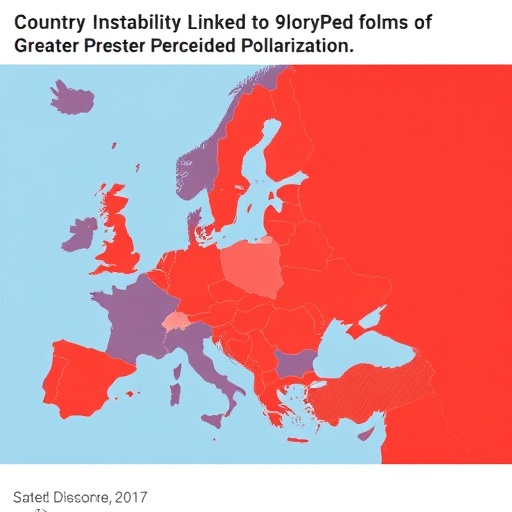
In an era marked by mounting political and social division, researchers have embarked on a comprehensive investigation to understand the factors that amplify perceptions of societal polarization. A groundbreaking study conducted by Lee, Kirkland, and Bastian, published in Communications Psychology in 2026, reveals a profound connection between country-level instability and the heightened perception of polarization among populations across 44 diverse nations. This extensive cross-national analysis sheds new light on the psychological underpinnings of societal divisions and the larger implications for democratic stability worldwide.
The contemporary global landscape is characterized by rapid changes, including economic volatility, political upheaval, and social fragmentation. These dynamics have fostered an environment wherein populations perceive their societies as increasingly polarized. According to the new research, instability at the national level—encompassing political uncertainty, economic fluctuations, and social unrest—exerts a substantial influence on the collective psyche, intensifying the sense that communities are starkly divided along ideological and cultural lines.
Lee and colleagues utilized a robust methodological framework, integrating extensive survey data with country-level indices of instability to elucidate the relationship between macro-level conditions and individual perceptions. The study’s dataset comprises a representative sample of citizens from 44 countries, spanning various continents and socio-political contexts, which enhances the generalizability of its findings. By statistically correlating perceptions of polarization with quantifiable instability metrics, the research provides empirical validation of a phenomenon often discussed anecdotally but rarely scrutinized with such rigor.
One of the study’s pivotal findings is the apparent feedback loop between instability and perceived polarization. In countries experiencing heightened political turmoil or economic crisis, citizens not only encounter more real instances of division but also develop a strengthened belief that society is deeply fragmented. This perception, in turn, may perpetuate cycles of mistrust and divisiveness, further destabilizing social cohesion. The research highlights how instability acts not only as a cause but also as an amplifier of social fragmentation.
The investigation differentiates between various types of instability, including governmental turnover, civil unrest, inflation rates, and institutional trust deficits. Intriguingly, the authors demonstrate that political instability exerts the most pronounced effect on perceived polarization, suggesting that the unpredictability of leadership and governance creates fertile ground for polarizing narratives. Economic instability also plays a significant role but is more variable depending on social safety nets and economic structures in place.
Importantly, the study reveals that the psychological perception of societal division does not always correspond perfectly with objective measures of polarization. In some nations, populations report elevated senses of polarization despite relatively stable institutional frameworks, hinting at the influence of media, social networks, and elite rhetoric. This discrepancy underlines the complexity of polarization as both a sociological and psychological phenomenon, influenced by external realities and internal cognitive processes alike.
The use of psychometrically validated surveys enables a nuanced exploration of how individuals perceive ideological distance within their societies. The authors point out that perceived polarization often extends beyond political partisanship, encompassing cultural, ethnic, and even generational divides. This expanded scope calls for interdisciplinary approaches to conflict resolution and societal healing, integrating psychological insights with political science and economics.
Moreover, Lee and co-authors emphasize the role of media environments in framing instability and polarization. The proliferation of fragmented media ecosystems and algorithmically curated content heightens awareness of societal fissures and enhances perceptions of ‘us versus them’ mentalities. The study suggests that media consumption patterns might serve as both a symptom and driver of perceived polarization, linking individual cognitive biases with broader informational structures.
Another compelling aspect of the research is its demonstration of how social trust mediates the relationship between instability and polarization. In countries where trust in institutions and fellow citizens remains relatively high, the destabilizing impact on perceived polarization is attenuated. This finding provides a hopeful avenue for policy interventions, highlighting that reinforcing social trust could buffer societies against the psychological corrosiveness of instability.
The timing of this study is particularly relevant given the contemporary challenges democracies face globally, including the rise of populism, increasing misinformation, and erosion of civic norms. Understanding how macro-level instability influences the collective perception of division can inform strategies aimed at preserving democratic integrity and fostering social resilience. The authors advocate for comprehensive approaches that address not only structural reforms but also public perceptions and social narratives.
Crucially, the study also delves into the spatial distribution of perceived polarization within countries. Responses varied significantly between urban and rural respondents, with rural populations often reporting stronger senses of division, especially in politically unstable contexts. This geographic dimension suggests that targeted local interventions may be essential alongside national policies to address polarization.
The researchers caution against oversimplified diagnoses of polarization, advocating for more granular analyses that consider the heterogeneous experiences within populations. They note that subpopulations such as minorities, youth, and economically marginalized groups frequently experience polarization differently, influenced by intersecting social identities and historical grievances. Thus, inclusive policy frameworks are necessary to authentically bridge societal divides.
In synthesizing their findings, Lee, Kirkland, and Bastian conclude that managing perceptions of polarization amidst instability requires multidimensional strategies. These include bolstering political stability, fostering economic security, enhancing media literacy, and cultivating social trust. The holistic approach recognizes the psychological dimensions of societal division and the need for sustained communal efforts in healing fractured social fabrics.
Their contribution to the scientific literature is a salient reminder that perceptions shape realities—when citizens perceive their societies as polarized, the social and political consequences often become self-fulfilling. This investigation provides a crucial empirical foundation for future research and policy aimed at mitigating the pernicious effects of instability on social cohesion, ultimately contributing to more peaceful and resilient societies worldwide.
By bridging the gap between psychological science and political analysis, the study advances a transdisciplinary understanding necessary to tackle one of the most pressing challenges of our time: the growing sense of division that threatens the very foundations of democratic life. With global instability seemingly on the rise, these insights could not be more urgent or relevant.
Cite Scienmag News
Glenn Wilkins. (February 25, 2026). Country Instability Linked to Greater Perceived Polarization. Scienmag. https://scienmag.com/country-instability-linked-to-greater-perceived-polarization/
Glenn Wilkins. "Country Instability Linked to Greater Perceived Polarization." Scienmag, 25 February 2026, https://scienmag.com/country-instability-linked-to-greater-perceived-polarization/. Accessed 3 September 2026.
Glenn Wilkins. "Country Instability Linked to Greater Perceived Polarization." Scienmag. February 25, 2026. https://scienmag.com/country-instability-linked-to-greater-perceived-polarization/


