


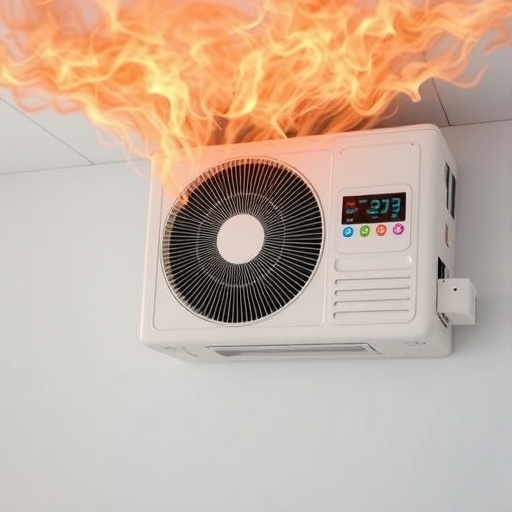
As global temperatures continue to climb, the widespread use of air-conditioning — long regarded as a safeguard against deadly heatwaves — is emerging as a formidable driver of climate change. A landmark study published in Nature Communications by an international consortium of researchers, led by the University of Birmingham, presents a stark warning: by 2050, emissions stemming from air-conditioning could surpass current annual carbon dioxide outputs of the United States, fundamentally exacerbating global warming in profound and unprecedented ways.
The research team undertook a comprehensive interdisciplinary approach, blending climate science, advanced energy modeling, and socioeconomic inequality analyses within a robust framework anchored in Shared Socioeconomic Pathways (SSP) and Representative Concentration Pathways (RCP). These globally recognized scenario frameworks enable a nuanced exploration of possible futures, from aggressive climate mitigation to business-as-usual high-emissions trajectories. Central to their findings is the projection that air-conditioning demand will more than double by mid-century, with electricity consumption for cooling soaring to an estimated 4,493 terawatt-hours (TWh) under moderate emission pathways and significantly higher levels in fossil-fuel-intensive scenarios.
This surge in energy demand translates directly into greenhouse gas emissions that could reach a staggering 8.5 gigatons of carbon dioxide equivalent (GtCO₂-eq) annually in the worst-case scenario, a figure eclipsing the entire current emissions of the United States, which stands at approximately 5.9 GtCO₂-eq per year. The implications for global temperature rise are substantial; the researchers estimate that air-conditioning alone could drive an additional warming of 0.03°C to 0.07°C by 2050, depending on the world’s emissions trajectory. This seemingly modest increase is, in fact, climatically significant, considering the already razor-thin margin to keep global warming below the critical 1.5°C threshold outlined by the Paris Agreement.
At the heart of this intensifying dilemma lies a paradoxical socioeconomic dimension. While colder regions with affluent populations like Europe and North America exhibit extensive air-conditioning adoption despite relatively moderate cooling needs, regions such as South Asia and Africa—paradoxically bearing the brunt of rising heat stress—remain starkly under-cooled due to economic constraints. This imbalance not only highlights acute global inequality but also portends a potentially massive increase in cooling-related emissions should low-income settings experience rapid uptake of air-conditioning units spurred by economic growth.
Professor Yuli Shan emphasizes the cyclical challenge: “As global temperatures rise, we risk being locked into an ‘arms race’ where defending ourselves against extreme heat causes the climate crisis to worsen further. Urgent investment in cleaner and more efficient cooling technologies is critical, alongside ensuring vulnerable populations have equitable access to cooling.” Achieving this transition necessitates harnessing innovative cooling technologies that rely on low-emission refrigerants, enhancing building energy efficiency through superior insulation and shading, and adopting behavioral interventions such as moderating temperature set points and shifting cooling demand away from peak electricity hours.
The researchers utilized GCAM, a sophisticated global energy-economy-climate model, to quantify how socioeconomic variables and climate forces will shape air-conditioning adoption, electricity consumption, and associated emissions from the present day through 2050. By integrating empirical cooling needs — calculated based on temperature, humidity, and population density — the team could dynamically simulate plausible adoption patterns across different regions and income brackets. Their econometric analyses reveal how cooling demand will escalate sharply with income increases in previously underserved areas, estimating increments of tens to hundreds of millions of new air-conditioning units depending on the pace and level of economic development.
One particularly chilling insight from the study points to the implications of equalizing air-conditioning access worldwide. Should all low-income regions reach the same saturation levels as wealthy areas—even under the most climate-friendly scenario—the increase in emissions would be substantial enough to produce an additional 0.05°C rise in global mean surface temperature. This underscores the intricate policy challenge: striving for thermal comfort equity may paradoxically intensify the very climate risks policymakers aim to mitigate.
A key technical innovation in this research was the application of MAGICC, a well-regarded climate emulator model, to translate the modelled emissions trajectories specifically attributable to air-conditioning into quantifiable temperature increments. This approach allowed the study to draw a direct connection between consumption-driven emissions and subsequent climatic impacts, offering precise estimates of incremental warming linked to the proliferation of cooling technologies.
The study’s findings resonate with broader concerns surrounding the energy and environmental costs of adapting to a warming planet. Air-conditioning, while essential for safeguarding human health and productivity amid intensifying heat extremes, is simultaneously entrenching dependency on energy systems that remain heavily reliant on fossil fuels in many regions. This feedback loop risks undermining global climate targets unless accompanied by deep decarbonization of power grids and rapid technological innovation.
Moreover, the study advocates for urgent structural change in cooling infrastructure, highlighting the need for regulatory policies encouraging adoption of environmentally benign refrigerants. These substances have historically contributed to ozone depletion and potent greenhouse gas emissions, so transitioning away from high-global-warming-potential chemicals is imperative for minimizing the climate footprint of air-conditioning.
In addition to technological and economic considerations, behavioral adaptation emerges as a crucial lever. Adjusting thermostat set points just a few degrees higher in residential and commercial buildings and employing passive cooling strategies can significantly temper rising electricity demands. Shifting peak cooling loads via demand-side management could alleviate strain on vulnerable electricity networks, further reducing reliance on carbon-intensive energy.
The comprehensive multi-institutional collaboration underlying this research—from institutions including Imperial College London, Beijing Institute of Technology, and the International Institute for Applied Systems Analysis (IIASA)—reflects a global recognition of the complex intersections between climate change, energy consumption, and social equity. The work encapsulates the urgent need for integrated approaches that balance human wellbeing, environmental sustainability, and technological advancement.
Ultimately, this study serves as a clarion call to the scientific community, policymakers, and industry stakeholders: the quest to cool the planet’s most vulnerable populations without accelerating global warming demands immediate, coordinated action. Failure to do so risks locking humanity into an ever-escalating cycle of heat exposure and fossil-fueled cooling—yielding a future increasingly defined by the very crises we seek to escape.
News Publication Date: 25-Feb-2026
Cite Scienmag News
Hazel L. (February 25, 2026). New Study Reveals Air Conditioner Heat Relief Significantly Exacerbates Climate Change. Scienmag. https://scienmag.com/new-study-reveals-air-conditioner-heat-relief-significantly-exacerbates-climate-change/
Hazel L. "New Study Reveals Air Conditioner Heat Relief Significantly Exacerbates Climate Change." Scienmag, 25 February 2026, https://scienmag.com/new-study-reveals-air-conditioner-heat-relief-significantly-exacerbates-climate-change/. Accessed 28 August 2026.
Hazel L. "New Study Reveals Air Conditioner Heat Relief Significantly Exacerbates Climate Change." Scienmag. February 25, 2026. https://scienmag.com/new-study-reveals-air-conditioner-heat-relief-significantly-exacerbates-climate-change/


