


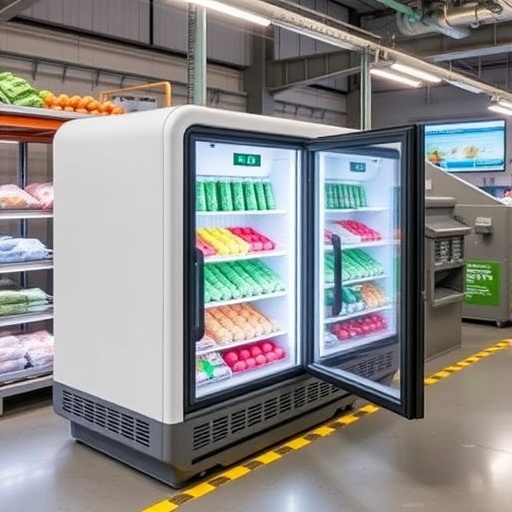
Two pioneering research teams from Spain’s Universitat Jaume I of Castelló and the Public University of Navarre have engineered a groundbreaking passive thermoelectric subcooling device aimed at revolutionizing self-contained refrigeration systems. This innovative technology dramatically improves both the energy efficiency and operational performance of refrigeration circuits widely employed in the preservation of perishable goods. As energy consumption and sustainability concerns intensify globally, such advancements offer critical potential to transform commercial refrigeration infrastructure across diverse sectors.
Central to this development is the device’s capability to integrate seamlessly within existing self-contained refrigeration units, which are standard in commercial settings such as supermarkets, convenience stores, and food storage facilities. Traditionally, these refrigeration units face efficiency challenges due to fluctuating loads and suboptimal thermal control. The novel thermoelectric subcooling mechanism effectively enhances the refrigeration cycle by enabling precise temperature regulation in the condenser, leading to reduced compressor workload and minimized energy waste.
Technically, the device capitalizes on thermoelectric effects—phenomena where temperature gradients generate electrical voltage or vice versa without reliance on moving mechanical components. The passive nature of the system means it operates silently and reliably without additional power consumption or noise, a stark contrast to traditional active cooling enhancements that often increase complexity and maintenance requirements. The new device’s silent operation and robustness result from its lack of moving parts, offering significant advantages in durability and long-term maintenance burden reduction.
The thermoelectric technology incorporated provides a fine-tuned subcooling effect, which lowers the temperature of the liquid refrigerant before it enters the expansion valve. By deepening the subcooling level, the refrigeration cycle’s coefficient of performance (COP) improves markedly, meaning the refrigeration system consumes less energy for a given cooling output. This enhanced control and efficiency are achieved through the direct modulation of temperature gradients within the condenser, leveraging solid-state materials that respond dynamically to thermal differences.
Rigorous laboratory testing has validated the device’s performance at an experimental scale, confirming substantial gains in both energy savings and operational stability. The research teams employed controlled environments to simulate real-world refrigeration scenarios, ensuring that the technology can withstand typical commercial operating conditions. These trials not only demonstrated the device’s energy efficiency enhancements but also its ability to maintain precise temperature control integral for preserving perishable products reliably.
Beyond its efficiency credentials, the compact footprint and straightforward integration process distinguish the device as a highly attractive retrofit solution. Commercial refrigeration operators can incorporate the thermoelectric subcooling unit without extensive modifications to existing systems, facilitating rapid and cost-effective deployment across various refrigeration applications. This ease of integration amplifies the device’s potential to accelerate energy performance improvements industry-wide.
The technological innovation has attracted intellectual property protection via a European patent application, signaling its significant market potential and cutting-edge nature. The research groups now seek partnerships with commercial entities to tailor the technology for specific refrigeration configurations and applications. Collaborative efforts aimed at customization and optimization will pave the way for comprehensive licensing agreements and broader industrial adoption.
This breakthrough stems from a coordinated research endeavor funded by the Spanish State Research Agency under the Knowledge Generation Projects 2021 initiative. The project, titled “Advanced multistage refrigeration systems for low-temperature applications” (HELTHA), facilitated explorations not only into thermoelectric subcooling but also into advanced refrigerant mixtures, including new natural CO₂-based blends. These efforts contribute to a more sustainable refrigeration sector by reducing reliance on synthetic refrigerants and enhancing system efficiencies through innovative cycle configurations, such as cascaded refrigeration stages.
The research teams behind this achievement bring together extensive expertise from two renowned groups: the Thermal Engineering Group (GIT) at Universitat Jaume I, led by Daniel Sánchez García-Vacas and Rodrigo Llopis Doménech, and the Thermal and Fluid Engineering Group (ITF) at the Public University of Navarre, led by Antonio Rodríguez García. Their multidisciplinary collaboration has been instrumental in addressing thermal-fluid dynamics challenges, material science integration, and system-level optimization, culminating in this efficient thermoelectric solution.
This development represents more than just an energy-saving device; it marks an essential step towards sustainable refrigeration technology that aligns with environmental imperatives to reduce carbon footprints and operational costs. As refrigeration accounts for a significant share of global electricity use and associated emissions, innovations like these are vital to the evolution of commercial refrigeration systems facing strict efficiency and environmental standards.
The Universitat Jaume I fosters the broader dissemination and technological transfer of such research innovations through its Research and Knowledge Transfer Service (SEGIT) and Vice-Rector’s Office for Transfer, Innovation, and Scientific Outreach. This institutional support underlines the commitment to translating scientific advances into practical solutions that benefit society, industries, and the environment alike by promoting cooperation between academia and the commercial sector.
Future work will focus on refining device designs, scaling production capabilities, and conducting field trials within operational refrigeration units in commercial environments. These efforts seek to not only confirm laboratory results in real-world settings but also to quantify lifecycle benefits including maintenance savings, noise reduction, and energy cost reductions. Ultimately, this promising thermoelectric subcooling technology offers a compelling pathway toward greener refrigeration that maintains product integrity and reduces operational expenditures.
In conclusion, the advent of this passive thermoelectric subcooling device stands poised to disrupt traditional refrigeration paradigms by elevating energy efficiency through smart thermal management. Its silent, maintenance-light, and compact design, combined with demonstrated performance benefits, strongly position it for widespread adoption. As the global refrigeration industry transitions to more sustainable practices, innovations such as these offer a blueprint for integrating advanced science into everyday commercial applications.
News Publication Date: Not specified
Web References:
– Universitat Jaume I Thermal Engineering Group: http://www.uji.es/serveis/ocit/base/grupsinvestigacio/detall?codi=107
– Public University of Navarre Thermal and Fluid Engineering Group: http://observatorio-investigacion.unavarra.es/grupos/32619/detalle
Keywords
Thermoelectric subcooling, refrigeration efficiency, passive cooling device, self-contained refrigeration units, commercial refrigeration, energy savings, CO₂ refrigerants, cascade refrigeration cycles, thermal engineering, sustainable cooling technology
Cite Scienmag News
Bethany Barker. (February 24, 2026). UJI and UPNA Develop Device to Boost Energy Efficiency in Autonomous Refrigeration for Perishable Goods. Scienmag. https://scienmag.com/uji-and-upna-develop-device-to-boost-energy-efficiency-in-autonomous-refrigeration-for-perishable-goods/
Bethany Barker. "UJI and UPNA Develop Device to Boost Energy Efficiency in Autonomous Refrigeration for Perishable Goods." Scienmag, 24 February 2026, https://scienmag.com/uji-and-upna-develop-device-to-boost-energy-efficiency-in-autonomous-refrigeration-for-perishable-goods/. Accessed 1 September 2026.
Bethany Barker. "UJI and UPNA Develop Device to Boost Energy Efficiency in Autonomous Refrigeration for Perishable Goods." Scienmag. February 24, 2026. https://scienmag.com/uji-and-upna-develop-device-to-boost-energy-efficiency-in-autonomous-refrigeration-for-perishable-goods/


