


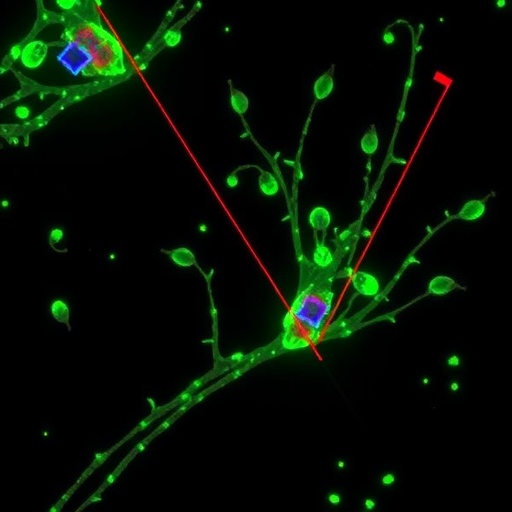
In recent advancements within the field of biophotonics, a pioneering study has illuminated the dynamic behaviors of biological tissues through the innovative use of biospeckle laser imaging. This cutting-edge technique capitalizes on the unique optical speckle patterns produced when coherent laser light interacts with the microstructures in living tissues. The resulting biospeckle patterns fluctuate over time, reflecting the inherent biological activities occurring at cellular and subcellular levels. By decoding these temporal variations, scientists are now capable of mapping intricate physiological processes with unprecedented detail.
Biospeckle laser imaging is rooted in the principle that when coherent light, such as from a laser, illuminates a biological tissue, it scatters in a complex manner, creating an interference pattern known as speckle. These speckles are not static; their temporal fluctuations correlate directly with biological motions such as cytoplasmic streaming, cellular respiration, and microcirculation within tissues. The behavior of these speckle patterns is a rich source of information, yet their analysis requires sophisticated statistical methods and temporal signal processing to extract meaningful biological signatures.
A central breakthrough presented in this study involves the modification and enhancement of the Fujii method, a well-established technique for biospeckle activity mapping. Traditionally, the Fujii method assesses activity by evaluating changes between sequential frames of speckle images, but the current enhancements have markedly increased its sensitivity and spatial resolution. This improvement enables researchers to construct highly detailed vascularization maps, particularly demonstrated in the investigation of leaf tissues, where fluid dynamics and microcirculation are critical indicators of physiological health and senescence.
The experimental protocol involved meticulous acquisition of time-series speckle frames from various vegetable tissues, providing a dynamic dataset for analysis. Through this time-resolved imaging, it became evident that biospeckle patterns carry temporal fingerprints unique to each biological sample. Researchers quantified these dynamics through the computation of a Time History of Speckle Pattern (THSP), revealing complex temporal structures that serve as distinguishing biological markers. This temporal signature offers a promising avenue for non-invasive diagnosis and monitoring of tissue vitality.
Further innovating the analysis toolkit, the researchers employed temporal contrast evaluation methods to generate spectral activity maps. These maps successfully delineate regions of immediate and latent biological disturbances. Notably, the contrasting sensitivity of this approach was instrumental in detecting subtle bruises in tissues that were invisible to conventional observation, highlighting its potential for agricultural quality control and post-harvest assessment.
An integral aspect of the study was defining an activity index, a quantitative measure derived from the speckle dynamics that encapsulates the overall biological activity within the tissue. This index proved robust across multiple samples and varying biological conditions, substantiating its reliability as a biomarker. Its development ushers in potential applications in monitoring stress responses, tissue aging, and potentially even disease progression in plant and possibly animal tissues.
The research accentuates the interdisciplinary synergy between optics, biology, and computational analysis, establishing biospeckle laser imaging as a versatile and powerful modality. By bridging high-resolution optical imaging with advanced statistical characterization, this approach opens new frontiers in both basic biological research and applied diagnostics. The ability to visualize and quantify microcirculation and cellular activity non-invasively could revolutionize fields from botany to medical diagnostics.
Moreover, the implications extend to optimizing agricultural practices by enabling real-time monitoring of plant vitality and early stress detection. This could lead to reduced crop losses, optimized irrigation strategies, and enhanced understanding of plant-pathogen interactions. The high resolution and sensitivity of biospeckle imaging positions it as a key tool in sustainable agriculture and precision farming.
In medical contexts, the potential for biospeckle laser imaging to assess tissue viability, detect bruises, or monitor wound healing is profoundly promising. Unlike traditional imaging techniques, it offers a label-free, non-contact modality capable of delivering real-time functional information about tissue dynamics. Such attributes are invaluable in clinical environments where rapid, non-invasive diagnostics are paramount.
The study also highlights the importance of comprehensive data acquisition and rigorous algorithmic development to interpret the complex speckle fluctuations accurately. Tailoring imaging parameters and refining computational models enhances the specificity and sensitivity of the biospeckle assessments, making the technique adaptable to a wide range of biological samples and conditions.
Future research directions prompted by this work include extending biospeckle imaging to animal tissues and exploring its integration with complementary imaging modalities. Combining biospeckle data with fluorescence or hyperspectral imaging could yield multimodal insights, augmenting the understanding of tissue physiology and pathology.
As biospeckle laser imaging technology matures, miniaturization of setups and real-time processing capabilities will facilitate broader adoption. Portable, user-friendly devices could enable on-site diagnostics in clinical, agricultural, and environmental settings, democratizing access to advanced biological monitoring and enhancing decision-making processes.
This thorough exploration into the dynamic interplay between coherent light and living tissues via biospeckle laser imaging marks a significant leap forward in biological imaging. By unveiling the hidden rhythms of life within the microcosm of tissue structures, this methodology promises to transform scientific inquiry and practical applications alike, heralding a new era of precision monitoring and analysis in the life sciences.
News Publication Date:
1-Feb-2026
Web References:
http://dx.doi.org/10.52601/bpr.2025.250010
Cite Scienmag News
Drew Townsend. (February 24, 2026). Assessing Biological Activity Using Biospeckle Laser Imaging. Scienmag. https://scienmag.com/assessing-biological-activity-using-biospeckle-laser-imaging/
Drew Townsend. "Assessing Biological Activity Using Biospeckle Laser Imaging." Scienmag, 24 February 2026, https://scienmag.com/assessing-biological-activity-using-biospeckle-laser-imaging/. Accessed 1 September 2026.
Drew Townsend. "Assessing Biological Activity Using Biospeckle Laser Imaging." Scienmag. February 24, 2026. https://scienmag.com/assessing-biological-activity-using-biospeckle-laser-imaging/


