


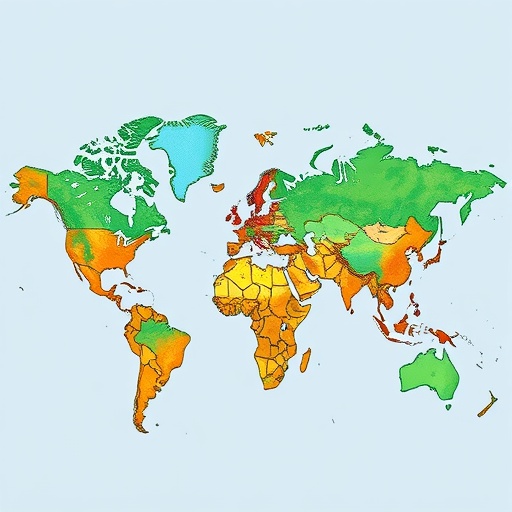
In a groundbreaking study published in Nature Communications, researchers Li, Zhong, Derudder, and colleagues unveil a transformative understanding of urban expansion patterns across the globe. Their comprehensive analysis reveals a significant global increase in built-up volume that signals a shift toward more divergent and less dispersed urban growth than previously thought. This revelation challenges long-held assumptions about how cities develop and sprawl, opening new discussions on sustainable urban planning and regional development in an era of rapid urbanization.
Urban expansion has traditionally been perceived as a sprawling phenomenon characterized by the dispersal of built-up areas into peripheries, often resulting in fragmented landscapes associated with suburbanization. However, the new research utilizes advanced satellite imagery, volumetric measurements, and sophisticated spatial analytics to quantify the three-dimensional growth of urban areas worldwide. This volumetric approach transcends traditional two-dimensional surface area assessments, providing a more nuanced, accurate picture of how urbanization reshapes landscapes vertically and horizontally over time.
The team’s method hinges on integrating remote sensing data with urban morphology models, capturing not only the horizontal spread of cities but also the vertical increase in built-up volume—essentially the emergence of denser, taller infrastructures. By applying machine learning techniques to vast datasets, they discerned urban expansion trends that are regionally heterogeneous yet globally consistent in exhibiting increasing divergence, where urban growth becomes more directionally focused rather than evenly dispersed.
This divergence implies that urbanization is becoming less about diffusing into surrounding rural areas uniformly and more about intensifying in particular directions, driven by economic, social, and infrastructural factors. For example, cities are expanding vertically with increased high-rise constructions in core areas, while simultaneously growing outward along transportation corridors or particular geographic or political boundaries. Such patterns result in urban forms that are sprawling in volume but spatially more concentrated than previously documented through surface area alone.
One of the vital technical breakthroughs in this study is the use of high-resolution LiDAR and advanced multispectral satellite data that enable precise calculations of building heights and volumes on a global scale. These data sources, coupled with novel algorithms developed for this project, allowed the researchers to map urban volume changes consistently across diverse urban typologies—from megacities in Asia to mid-sized urban centers in Europe and rapidly urbanizing regions in Africa and Latin America.
The implications of these findings are profound for urban planners and policymakers. Traditional strategies aimed at curbing urban sprawl might need reevaluation considering that urban growth is not merely spreading but diverging and focusing in volume. Infrastructure development, transportation planning, and housing policies must account for this multidimensional growth, as vertical expansion can strain utilities, increase energy demands, and impact social dynamics differently than horizontal sprawl.
Moreover, the less dispersed nature of recent urban growth trends may paradoxically offer opportunities for more efficient urban designs. By understanding where and how cities concentrate growth volumes, planners can leverage these trends to optimize public transport networks, concentrate services, and reduce ecological footprints through compaction. However, this requires detailed and up-to-date volumetric data—precisely the kind this study demonstrates is available and actionable.
The study also explores the socioeconomic drivers behind divergent urban expansion. Economic globalization, technological advancements, and changing demographic patterns create spatial incentives for cities to expand in targeted directions with increased density. For instance, proximity to major transportation hubs or economic zones catalyzes vertical growth and corridor-focused sprawl, reinforcing regional disparities and shaping the future landscape of urban agglomerations.
Furthermore, the researchers point out that increasing urban volume has critical environmental consequences. Higher buildings and denser urban cores affect microclimates, potentially exacerbating urban heat island effects. Simultaneously, divergent growth patterns complicate ecosystem conservation, as intensified development along specific axes may impact natural habitats more severely than dispersed growth, posing challenges for biodiversity preservation amid urbanization.
Technically, the team leveraged cloud computing platforms to handle petabytes of geospatial data and implemented cutting-edge convolutional neural networks capable of extracting volumetric information from raw satellite imagery with unprecedented accuracy. These methodological advancements represent a significant leap forward in urban remote sensing, enabling near-real-time monitoring of how global cities evolve structurally.
Their findings also reveal notable heterogeneities across continents and urban sizes. While megacities show pronounced vertical intensification, smaller but fast-growing cities tend toward more horizontal but still directionally constrained expansion. This gradient underscores the necessity of tailored urban strategies recognizing the unique volumetric growth trajectories of different city classes.
Importantly, the study provides an open-access global database of built-up volumes across the past two decades, enabling other researchers and practitioners to harness this valuable resource for further investigations or local policy formulation. Such transparency and data availability accelerate collaborative efforts to address urban challenges through science-driven approaches grounded in volumetric urban dynamics.
The researchers also caution that the accelerating divergence and vertical expansion trends, if left unmanaged, risk exacerbating urban inequalities. Concentrations of built-up volume can concentrate socioeconomic opportunities but also intensify displacement pressures and social stratification within urban areas. Integrated planning approaches must therefore combine volumetric insights with social equity concerns to foster inclusive urban futures.
This research marks a pivotal inflection point in urban sciences. By moving beyond flat, areal metrics to embrace three-dimensional urban morphology, it equips the scientific community, governments, and industry with a refined lens to interpret and shape city growth. It invites a reconfiguration of urban theory, incorporating volume as a core variable in sustainability, resilience, and livability discourses.
Future research avenues inspired by this study include integrating volumetric urban growth data with environmental impact models, transportation dynamics, and socioeconomic datasets to understand multifaceted urban systems holistically. The role of emerging technologies, such as autonomous vehicles and smart infrastructure, in influencing these volumetric growth trends also merits urgent exploration.
In sum, Li, Zhong, Derudder, and their colleagues’ work decisively shifts the paradigm for studying urban expansion. Their demonstration that global urban growth increasingly manifests as divergent and less dispersed volumetric expansion challenges prior models and lays the foundation for more sophisticated, accurate, and actionable urban analytics. Amid mounting challenges posed by urbanization, climate change, and spatial inequalities, their volumetric perspective is poised to transform how cities are built, managed, and experienced worldwide.
Cite Scienmag News
Violet Maxwell. (February 21, 2026). Global Growth Shows Denser, Less Spread Urban Expansion. Scienmag. https://scienmag.com/global-growth-shows-denser-less-spread-urban-expansion/
Violet Maxwell. "Global Growth Shows Denser, Less Spread Urban Expansion." Scienmag, 21 February 2026, https://scienmag.com/global-growth-shows-denser-less-spread-urban-expansion/. Accessed 3 September 2026.
Violet Maxwell. "Global Growth Shows Denser, Less Spread Urban Expansion." Scienmag. February 21, 2026. https://scienmag.com/global-growth-shows-denser-less-spread-urban-expansion/


