

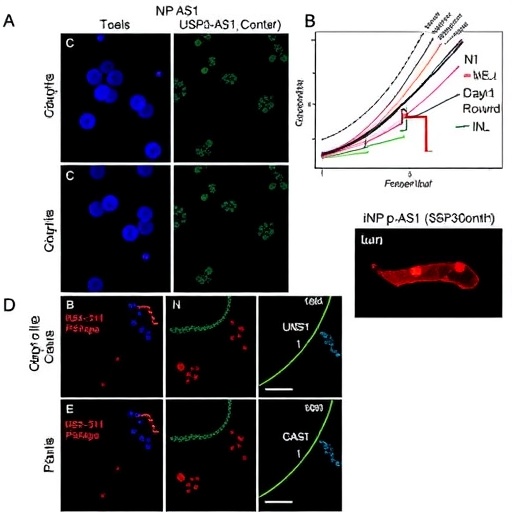
A groundbreaking study published in the distinguished journal Genes & Diseases reveals a critical regulatory mechanism driving breast cancer progression, spotlighting a unique long non-coding RNA (lncRNA) known as ubiquitin-specific peptidase 30 antisense RNA 1 (USP30-AS1). This research, conducted collaboratively by teams from Tsinghua University, Shenzhen University, Peking University Shenzhen Hospital, and Shenzhen Polytechnic University, marks a significant step forward in understanding how non-coding elements of the genome contribute to cancer biology.
USP30-AS1, transcribed antisense to the mitochondrial deubiquitinase gene USP30, emerges from this study not simply as a bystander but as a potent oncogenic driver in breast cancer pathogenesis. The team utilized comprehensive transcriptomic datasets, including TCGA breast cancer profiles and the GSE61304 dataset, to firmly establish that USP30-AS1 expression is markedly elevated in breast cancer tissues compared to normal breast tissue. This elevation is especially pronounced in aggressive molecular subtypes such as triple-negative and HER2-enriched breast cancers, highlighting its potential role in tumor aggressiveness.
Diving deeper into the transcriptional regulation of USP30-AS1, the researchers identified SPI1 — a member of the ETS family of transcription factors widely recognized for its role in hematopoietic differentiation — as a direct upstream activator. Bioinformatics tools like CHIP Base, GeneCards, and Animal TFDB pinpointed SPI1 binding motifs within the USP30-AS1 promoter region, a finding corroborated by chromatin immunoprecipitation assays and reporter gene analyses. Knockdown experiments demonstrated that reducing SPI1 levels substantially decreases USP30-AS1 expression, firmly establishing the transcriptional axis SPI1→USP30-AS1 in breast cancer cells.
Functionally, USP30-AS1 acts as a multifaceted oncogene, promoting breast cancer cell proliferation and facilitating cell-cycle progression both in vitro and in vivo. Using cell lines representative of different breast cancer phenotypes, including MCF-7 and the highly invasive MDA-MB-231, the authors showcased that USP30-AS1 silencing induces cell cycle arrest, apoptosis, and senescence. Xenograft models validated the in vivo tumor-suppressive potential of targeting USP30-AS1, as its depletion markedly curtailed tumor growth.
Mechanistic insights reveal that USP30-AS1 converges on the cyclin-dependent kinase inhibitor CDKN1A/p21, a pivotal checkpoint protein ensuring proper cell cycle control. The study unraveled a sophisticated dual-compartment regulatory mechanism: In the cytoplasm, USP30-AS1 binds the RNA-binding protein HnRNPF. This interaction prevents HnRNPF from stabilizing p21 mRNA, thereby accelerating its degradation and diminishing p21 protein levels. Lower p21 levels relieve inhibitory pressure on cyclin-CDK complexes, driving unchecked proliferation.
Intriguingly, USP30-AS1 also operates in the nucleus, where it interacts with Enhancer of Zeste Homolog 2 (EZH2), the enzymatic component of the Polycomb Repressive Complex 2 (PRC2). Unlike classical models where EZH2 silences gene expression via tri-methylation of histone H3 lysine 27 (H3K27me3), USP30-AS1 modulates EZH2 activity to restrain its recruitment at the c-Myc oncogene promoter. This impairs repressive histone modifications and promotes c-Myc transcription, culminating in an indirect but potent suppression of p21 transcription through a p53-independent pathway. This cascading effect underscores the lncRNA’s role as a master coordinator of epigenetic and post-transcriptional control mechanisms.
Notably, the oncogenic capacities of USP30-AS1 are uncoupled from its neighboring gene USP30, emphasizing the autonomous and independent regulatory role that antisense lncRNAs can possess. This decoupling is vital, as it negates the potential confounding influence of the protein-coding gene on cellular phenotypes and unambiguously assigns oncogenic function to the non-coding transcript.
The study’s findings underscore the complexity of lncRNA biology in cancer, revealing how a single lncRNA molecule can orchestrate gene expression programs across different cellular compartments to enforce malignant phenotypes. USP30-AS1’s dual action—modulating mRNA stability in the cytoplasm while simultaneously influencing chromatin dynamics in the nucleus—establishes it as a crucial integrator of cancer-promoting signals.
With breast cancer remaining a foremost cause of cancer-related mortality worldwide, the elucidation of USP30-AS1’s role opens promising avenues for therapeutic intervention. Targeting this lncRNA or its interaction partners presents a novel strategy to restore cell cycle checkpoints and curb tumor proliferation. Additionally, USP30-AS1 may serve as a robust biomarker for aggressive breast cancer subtypes, facilitating improved prognostic assessments.
This investigation not only deepens our understanding of breast cancer molecular drivers but also highlights the broader significance of non-coding RNAs in oncogenesis. By clarifying the multifaceted regulatory networks involving lncRNAs like USP30-AS1, researchers are better equipped to design innovative, targeted treatments that go beyond traditional protein-coding gene targets.
In sum, USP30-AS1 emerges as a pivotal oncogenic lncRNA that integrates transcriptional, post-transcriptional, and epigenetic mechanisms to suppress p21 expression and promote breast cancer progression. The SPI1→USP30-AS1 axis represents a key regulatory node ripe for therapeutic exploitation, and this study sets the stage for future research aimed at translating these molecular insights into clinical benefits for patients battling breast cancer.
News Publication Date: [Not explicitly provided]
Web References: http://dx.doi.org/10.1016/j.gendis.2025.101684
References: Data sourced from The Cancer Genome Atlas (TCGA), GSE61304 dataset, JASPAR database, CHIP Base, GeneCards, Animal TFDB
Cite Scienmag News
SCIENMAG. (February 20, 2026). USP30-AS1: A Dual-Localized lncRNA Fueling Breast Cancer Growth by Coordinating p21 Suppression. https://scienmag.com/usp30-as1-a-dual-localized-lncrna-fueling-breast-cancer-growth-by-coordinating-p21-suppression/
SCIENMAG. "USP30-AS1: A Dual-Localized lncRNA Fueling Breast Cancer Growth by Coordinating p21 Suppression." Scienmag, 20 February 2026, https://scienmag.com/usp30-as1-a-dual-localized-lncrna-fueling-breast-cancer-growth-by-coordinating-p21-suppression/. Accessed 28 August 2026.
SCIENMAG. "USP30-AS1: A Dual-Localized lncRNA Fueling Breast Cancer Growth by Coordinating p21 Suppression." Scienmag. February 20, 2026. https://scienmag.com/usp30-as1-a-dual-localized-lncrna-fueling-breast-cancer-growth-by-coordinating-p21-suppression/


