


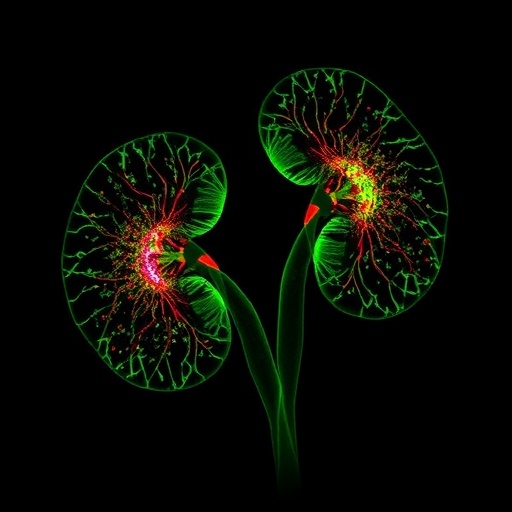
In a groundbreaking study published in Nature Communications, researchers have uncovered a crucial transcriptional regulatory loop involving Hypoxia-Inducible Factors (HIFs) that sustain the expression of EPAS1, a gene encoding the HIF-2α subunit, in renal clear cell carcinoma (ccRCC). This discovery sheds new light on the molecular complexities underlying ccRCC pathogenesis, opening avenues for precision-targeted therapies in a cancer type notoriously resistant to conventional treatments.
Renal clear cell carcinoma is the most common form of kidney cancer and is characterized by dysregulated oxygen sensing mechanisms. At the epicenter of this dysregulation lie the HIF transcription factors, which orchestrate cellular adaptation to hypoxia by regulating a multitude of genes involved in angiogenesis, metabolism, and survival. The study by Naas et al. reveals that HIFs not only respond to hypoxic stress but also establish a self-sustaining circuit that reinforces EPAS1 expression, perpetuating oncogenic signaling within ccRCC cells.
Utilizing state-of-the-art genomic and epigenomic profiling techniques, the researchers mapped the regulatory landscape surrounding the EPAS1 locus. They demonstrated that HIF binding sites are enriched in key enhancer regions upstream of EPAS1, facilitating robust transcriptional activation. Chromatin immunoprecipitation followed by sequencing (ChIP-seq) elucidated that both HIF-1α and HIF-2α bind cooperatively to these enhancers, creating a feedback loop that maintains elevated EPAS1 expression irrespective of extracellular oxygen levels.
Intriguingly, the study highlights that this HIF-driven regulatory circuit diverges from typical acute hypoxia responses, representing a chronic adaptation that tumors exploit. This persistent activation of EPAS1 transcription amplifies pro-tumorigenic pathways such as angiogenesis, glucose metabolism reprogramming, and cell proliferation. The authors’ integrative analysis, combining transcriptomics and proteomic data, underscores that the sustained expression of EPAS1 is pivotal for ccRCC progression and poor patient prognosis.
Furthermore, Naas and colleagues dissected the molecular intermediates responsible for this feedback loop. They identified epigenetic modifiers and coactivator complexes recruited by HIFs to EPAS1 enhancers, including members of the p300/CBP family. This recruitment facilitates an open chromatin state conducive to high transcriptional output. Through loss-of-function experiments using CRISPR-Cas9 mediated enhancer deletion, the team demonstrated that disrupting these enhancer elements significantly attenuates EPAS1 expression and impairs tumorigenic properties in vitro.
The implications of these findings are profound. By elucidating the feedback mechanism by which HIFs sustain EPAS1 transcription, the study provides a compelling rationale for therapeutic interventions targeting this regulatory axis. Traditional approaches to inhibit HIF activity have faced challenges due to the complex redundancy and compensatory mechanisms within hypoxia signaling pathways. However, this work suggests that disrupting enhancer-mediated transcriptional circuits could serve as a novel strategy to undermine tumor survival mechanisms.
Clinical translation of these insights could herald more effective, targeted treatments for patients afflicted with ccRCC. Current treatments, including tyrosine kinase inhibitors and immune checkpoint blockade, provide only limited and transient benefits. By focusing on the foundational regulatory circuits that enforce HIF-2α overexpression, novel small molecules or epigenetic drugs may be developed to achieve durable tumor suppression.
Importantly, this research also emphasizes the dynamic interplay between the tumor microenvironment and its intrinsic genetic programs. The HIF-EPAS1 regulatory circuit exemplifies how cancer cells exploit transcriptional plasticity to adapt and thrive under hypoxic stress, an environment characteristic of rapidly growing solid tumors. These adaptive mechanisms are likely generalizable to other hypoxia-driven malignancies, underscoring the broad impact of this discovery.
As the field moves forward, further exploration of the context-dependent roles of HIF isoforms in transcriptional networks will be essential. The differential contribution of HIF-1α versus HIF-2α in ccRCC and their respective enhancer landscapes may reveal additional vulnerabilities. The study paves the way for a deeper mechanistic understanding of cancer epigenomics and the development of context-specific interventions.
Moreover, the findings enhance our conceptual framework of oncogene regulation, illustrating how transcription factors can create self-reinforcing loops that stabilize aberrant gene expression programs. These insights resonate beyond renal cancer, offering potential paradigms for regulating other oncogenes involved in maladaptive transcriptional circuits.
In conclusion, the work by Naas et al. uncovers a vital transcriptional regulatory circuit wherein HIFs sustain EPAS1 expression in clear cell renal carcinoma. This positive feedback loop not only drives tumor progression but also represents a promising therapeutic target. By integrating sophisticated genomic tools, molecular biology techniques, and functional assays, this study marks a significant advancement in understanding the molecular underpinnings of ccRCC and highlights innovative avenues for tackling this formidable disease.
Such discoveries underscore the importance of continued investment in cancer epigenetics and transcriptional biology. As researchers delve deeper into the regulatory networks governing tumor behavior, the prospects for personalized, mechanism-driven therapies improve. The elucidation of self-sustaining oncogenic loops redefines therapeutic strategies and holds the promise of more durable remissions for patients challenged by renal clear cell carcinoma.
Cite Scienmag News
Rowan B. (February 19, 2026). HIF Drives EPAS1 Regulation in Kidney Cancer. Scienmag. https://scienmag.com/hif-drives-epas1-regulation-in-kidney-cancer/
Rowan B. "HIF Drives EPAS1 Regulation in Kidney Cancer." Scienmag, 19 February 2026, https://scienmag.com/hif-drives-epas1-regulation-in-kidney-cancer/. Accessed 29 August 2026.
Rowan B. "HIF Drives EPAS1 Regulation in Kidney Cancer." Scienmag. February 19, 2026. https://scienmag.com/hif-drives-epas1-regulation-in-kidney-cancer/


