


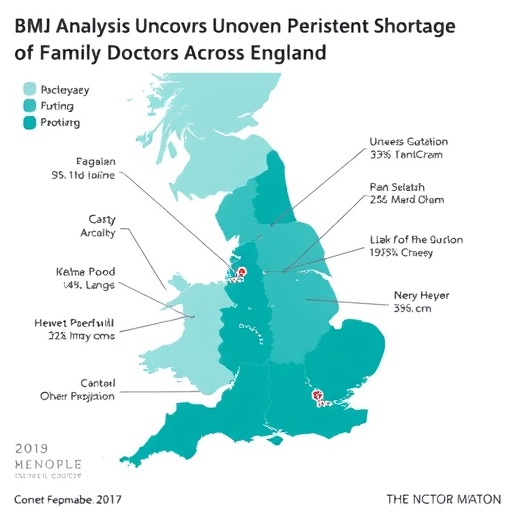
England’s integrated care boards (ICBs), which oversee the strategic planning and delivery of health services for local populations, are grappling with a critical shortage of general practitioners (GPs) that jeopardizes patient safety and places unsustainable strains on primary care systems. New analyses of NHS workforce data, recently published in The BMJ, reveal that four-fifths of ICBs would need to at least double the number of full-time equivalent (FTE) GPs to meet staffing benchmarks deemed necessary for safe and effective healthcare.
The British Medical Association (BMA) has stipulated a target ratio of one FTE GP per 1,000 patients by the year 2040 as a threshold for ensuring manageable workloads and safeguard patient care quality. Alarmingly, data from last month demonstrate that all 42 ICBs in England fall significantly short of this standard, with the national average standing at one GP per 2,220 patients. This deficit is not uniform: certain regions, particularly London, Bedfordshire, Luton, and Milton Keynes, exhibit alarming extremes, where each GP is responsible for care of more than 2,700 patients.
This imbalance between patient demand and GP capacity underscores an urgent and systemic crisis. “No matter where a patient resides in England, the safe workload limits are being exceeded,” states Katie Bramall, chair of the BMA’s GP Committee. The chronic nature of this shortage creates a paradox wherein increasingly burdened practicing GPs struggle to meet patient needs, even as there remain qualified GPs who find it difficult to secure employment within the NHS, highlighting structural inefficiencies in workforce planning and deployment.
The Royal College of General Practitioners, represented by chair Victoria Tzortziou Brown, calls attention to the worsening strain on general practice, emphasizing that pressures now far exceed sustainable or safe levels. These persistent stresses complicate recruitment and retention, particularly in socioeconomically deprived areas, which face the twin challenges of elevated patient-to-GP ratios and greater obstacles in hiring qualified doctors. Brown stresses that equitable distribution of primary care resources must be a policy priority to prevent inequities in healthcare access.
Despite these challenges, the UK Department of Health and Social Care (DHSC) highlights governmental claims of progress, noting that the current number of fully qualified GPs is the highest recorded since at least 2015. However, this quantitative growth is tempered by a concurrent 6% rise in registered patients over six years, compared to only a 2% increase in GP numbers. This mismatch exacerbates workforce shortages, diluting the proportion of healthcare professionals available per patient and escalating demand on existing practitioners.
The disparities between ICBs also reveal chronic geographic imbalances that have not improved significantly since 2019. The entrenched nature of these shortages indicates systemic workforce challenges rather than transient fluctuations, underscoring the need for transformative approaches in health human resource planning. Bedfordshire, Luton, and Milton Keynes ICBs acknowledge ongoing efforts, including training over 140 GPs in preparation to join the workforce; however, the limited availability of subsequent vacancies raises concerns about bottlenecks in career progression for newly qualified doctors.
Workforce analysts point out that expanding GP training capacity is imperative but must be substantial to meet growing patient demand. The number of applicants for GP specialty training posts has surged dramatically, with over 20,995 applications for 4,726 posts in 2025 — a nearly fivefold applicant-to-post ratio. This increase reflects heightened interest in general practice careers but also intensifies competition and underscores limitations in training infrastructure and resource allocation.
Paradoxically, the monthly number of GP appointments has risen by more than 10 million between December 2018 and December 2025, reaching unprecedented levels. This escalation in consultations exemplifies the relentless demand on primary care services and the necessity for structural reinforcement of the GP workforce. The DHSC maintains that GPs remain central to the NHS’s strategic shift from hospital-centric care towards community-based services. Consequently, primary care is expected to benefit from a rising share of NHS funding aligned with this transformation.
Nevertheless, medical leadership emphasizes the insufficiency of current measures without a comprehensive and robust decade-long workforce strategy. According to Tzortziou Brown, the health secretary’s pledges for increased GP numbers must be coupled with meaningful investments and recruitment and retention initiatives that align with evolving healthcare demands. Only through sustained commitment can the NHS secure the foundational general practice services essential for timely and effective patient care across all communities.
In sum, the GP workforce crisis in England is not a temporary shortage but a chronic structural challenge characterized by disproportionate patient loads, uneven geographic distribution, competitive training bottlenecks, and systemic recruitment and retention difficulties. Without urgent and coordinated policy actions to expand training capacity, incentivize retention, and ensure equitable workforce deployment, the safe delivery of primary care risks significant compromise—potentially undermining the very bedrock of the NHS.
News Publication Date: 18-Feb-2026
Web References: http://dx.doi.org/10.1136/bmj.s301
Cite Scienmag News
Ophelia Keating. (February 19, 2026). BMJ Analysis Uncovers Persistent Shortage of Family Doctors Across England. Scienmag. https://scienmag.com/bmj-analysis-uncovers-persistent-shortage-of-family-doctors-across-england/
Ophelia Keating. "BMJ Analysis Uncovers Persistent Shortage of Family Doctors Across England." Scienmag, 19 February 2026, https://scienmag.com/bmj-analysis-uncovers-persistent-shortage-of-family-doctors-across-england/. Accessed 5 September 2026.
Ophelia Keating. "BMJ Analysis Uncovers Persistent Shortage of Family Doctors Across England." Scienmag. February 19, 2026. https://scienmag.com/bmj-analysis-uncovers-persistent-shortage-of-family-doctors-across-england/


