


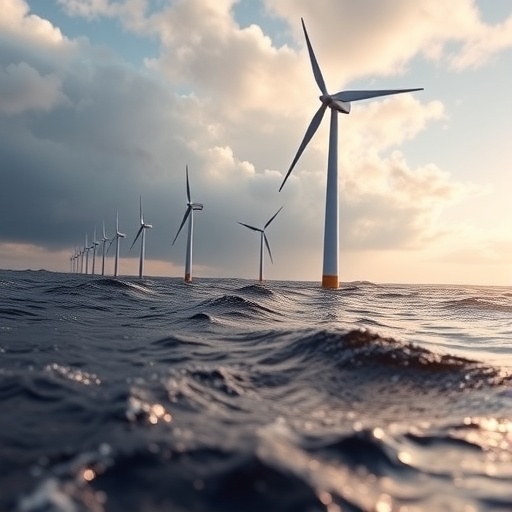
Offshore wind energy is rapidly becoming a cornerstone of the global transition towards sustainable power generation, heralding a new era in decarbonization and climate action. However, as offshore wind farms proliferate, particularly in critical marine regions such as the North Sea, researchers are grappling with understanding the broader environmental consequences beyond renewable energy benefits. A pioneering study led by Dr. Nils Christiansen and his team at the Helmholtz-Zentrum Hereon has broken new ground by rigorously analyzing the intertwined hydrodynamic effects of offshore wind farms on ocean currents and surface temperatures in the German Bight region. Their findings, recently published in the prestigious journal Nature, uncover complex interactions that reshape marine environments in unprecedented ways.
At the heart of this research lies the intricate phenomenon termed “wake effects,” encompassing both atmospheric and underwater dynamics induced by wind turbines. Specifically, turbine rotors extract kinetic energy from the wind, altering airflow patterns and in turn influencing surface ocean currents. Concurrently, submerged turbine structures function as physical impediments to tidal flows, generating underwater wakes that slow down and redirect currents. These dual wake phenomena do not act in isolation; rather, they interact to form spatially and temporally complex current patterns that reverberate throughout adjacent marine areas.
Through sophisticated computational simulations leveraging state-of-the-art modeling techniques, Christiansen’s team has unified these two traditionally separate hydrodynamic effects into a comprehensive analysis. The integrated modeling framework accounts for both atmospheric wind speed reductions caused by rotor wakes and the frictional drag on tidal currents due to turbine pilings. The scenarios examined extend to 2050, envisioning extensive offshore wind development aligned with European energy policy trajectories. The results paint a highly detailed picture of how expanded offshore wind infrastructure can significantly reshape the marine flow regime in the German Bight and potentially the wider North Sea.
One of the most striking revelations of the study is the formation of new, intricately structured flow patterns emerging from the superposition of wakes. These altered currents show up as reductions in peak flow velocities, with surface speeds dropping by up to 20 percent in densely farmed areas. Moreover, the frequency and spatial distribution of flows undergo notable changes, leading to shifts that propagate beyond the immediate vicinity of the turbines and can affect entire regional circulations. Such modifications have cascading impacts, altering sediment transport processes critical to seabed morphology and stability, as well as the vertical mixing of water layers that governs nutrient distribution and thermal stratification.
These hydrodynamic alterations carry significant ecological implications. Seawater mixing and current flows govern habitat conditions for myriad marine organisms, influencing schooling behavior, reproduction cycles, and migration pathways. By modifying these parameters, offshore wind farms could inadvertently induce shifts in ecosystem structure and function. Additionally, the recalibrated flow regimes potentially affect biogeochemical cycles, including oxygenation and carbon sequestration dynamics, thereby feeding back into broader climate and environmental processes.
The findings also underscore crucial considerations for maritime activities. Precise flow predictions underpin navigation safety, shipping route optimization, and disaster preparedness strategies such as oil spill response and search-and-rescue operations. Changes in current patterns and flow velocities could therefore necessitate updates to hydrographic charts and coastal management protocols, especially in heavily trafficked corridors within the North Sea.
Beyond mapping impacts, the research proactively explores mitigation strategies to minimize adverse environmental consequences. The modeling indicates that turbine spacing emerges as a pivotal factor in controlling the intensity and overlap of wake-generated turbulence. Increasing inter-turbine distances reduces wake superposition, thereby limiting excessive mixing and preserving more natural flow dynamics. Similarly, the selection of wind farm locations relative to prevailing tidal and wind conditions can modulate the magnitude of hydrodynamic disruption. These insights provide actionable guidance towards designing offshore wind farms that balance renewable energy ambitions with ecological sustainability.
The novel approach taken by Christiansen’s team also highlights the necessity for integrative, cross-disciplinary methodology in environmental science. The coupling of atmospheric and oceanographic phenomena within computational frameworks epitomizes advances in Earth system modeling. Employing digital twins—virtual replicas of real-world systems—facilitates high-resolution simulations that capture the multiscale interactions governing marine environments. Such tools are indispensable for anticipating the cumulative impacts of human infrastructure on natural systems in a warming world.
This research is timely, given the accelerating pace of offshore wind farm installations across Europe and globally. As governments set ambitious targets for offshore capacity, detailed environmental assessments become ever more critical to inform policy and regulatory frameworks. The study’s predictive scenarios equip decision-makers with scientifically robust projections, enabling informed planning that anticipates long-term hydrodynamic changes instead of reacting to unforeseen consequences.
Christiansen emphasizes that offshore wind power must not be viewed solely through the lens of energy production metrics. He calls for a holistic understanding of how the physical footprint of turbines reshapes oceanic environments, acknowledging that energy transition solutions must integrate sustainability across multiple dimensions. Establishing such a knowledge base is vital for fostering public trust, aligning economic interests with conservation goals, and optimizing investments in marine renewables.
As research at Helmholtz-Zentrum Hereon exemplifies, the intersection of cutting-edge simulation, empirical data, and interdisciplinary collaboration offers a powerful paradigm for tackling complex environmental challenges. The institute’s commitment to sustainability and resilience propels efforts to map and mitigate the multifaceted impacts of climate-related technologies. This study’s pioneering insights serve as a benchmark for future investigations and embody the imperative to innovate responsibly as humanity charts pathways to net-zero emissions.
In conclusion, as offshore wind farms herald a cleaner energy future, their hydrodynamic footprints necessitate meticulous scrutiny. The comprehensive work by Christiansen and colleagues reveals profound cumulative effects on North Sea currents and surface temperatures, shaping ecosystems, sediment dynamics, and marine human activities. Incorporating these insights into planning and policy will be crucial to harness the promise of offshore wind while safeguarding ocean health—a delicate balance at the frontier of climate adaptation and responsible innovation.
Cite Scienmag News
Violet Maxwell. (February 18, 2026). How Offshore Wind Farms Alter Ocean Currents: New Insights. Scienmag. https://scienmag.com/how-offshore-wind-farms-alter-ocean-currents-new-insights/
Violet Maxwell. "How Offshore Wind Farms Alter Ocean Currents: New Insights." Scienmag, 18 February 2026, https://scienmag.com/how-offshore-wind-farms-alter-ocean-currents-new-insights/. Accessed 4 September 2026.
Violet Maxwell. "How Offshore Wind Farms Alter Ocean Currents: New Insights." Scienmag. February 18, 2026. https://scienmag.com/how-offshore-wind-farms-alter-ocean-currents-new-insights/


