


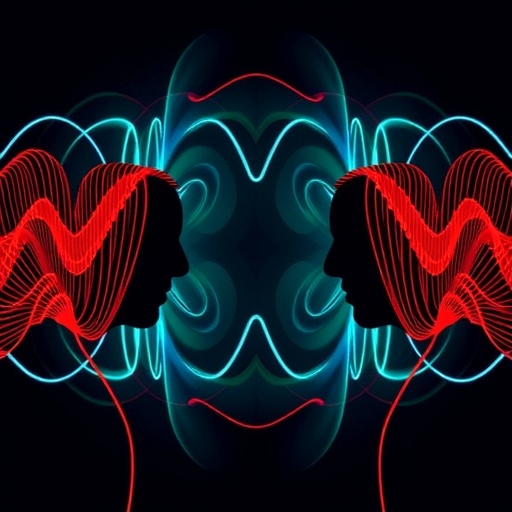
In recent years, the scientific community has witnessed an increasing fascination with the enigmatic phenomenon known as interpersonal physiological synchrony. At its core, this concept reflects the intricate temporal alignment of physiological signals—such as heart rate, respiratory rhythms, and skin conductance—between two or more individuals engaged in social interaction. Though studied for decades, the psychological implications of such synchrony remain a puzzle, a frontier at the crossroads of biology, psychology, and social neuroscience. A groundbreaking review published in Nature Reviews Psychology by Gordon and Bartsch (2026) seeks to distill the scattered body of research into a coherent narrative, providing clarity while simultaneously outlining the complexities and variabilities embedded in interpersonal physiological synchrony.
The notion that individuals’ bodily processes can align during interaction is not merely a curiosity; it is considered an emergent property of sociality and cooperation. This synchrony is thought to underpin the ways humans establish connections, influence one another, and coordinate actions seamlessly, often without conscious awareness. Yet, despite the allure of linking physiological harmony to social bonding and shared experience, the precise psychological meaning of these synchronous patterns remains elusive. The review authored by Gordon and Bartsch stands as a comprehensive synthesis of recent literature, focusing heavily on empirical findings from 2020 to 2024, a period marked by rapid advances in measurement technologies and analytic techniques.
One of the major contributions of the review is the conceptual clarification of synchrony’s correlates, which the authors categorize into three broad domains: social-oriented, performance-oriented, and self-oriented correlates. Social-oriented correlates encompass factors tied to interpersonal closeness, empathy, and rapport. Here, synchronous physiological activity is examined as a potential biological substrate of social connection, reflecting shared emotional and cognitive states. For example, couples exhibiting heightened physiological synchrony tend to report greater relationship satisfaction and emotional intimacy. Similarly, team members who synchronize may experience enhanced feelings of trust and cohesion.
Performance-oriented correlates, by contrast, emphasize synchrony’s role in collaborative and goal-directed activities. In such contexts, alignment of physiological rhythms can facilitate coordination, improve communication efficiency, and optimize group performance. Instances occur in musical ensembles, sports teams, or cooperative problem-solving tasks, where members’ bodily states dynamically lock into coordinated patterns that support collective effort. The review highlights findings in this arena that link physiological synchrony to superior joint action outcomes, reflecting the functional utility of coupling biological processes in real-time interaction.
The third domain—self-oriented correlates—addresses intrapersonal factors and how synchrony may mirror individual states such as stress, arousal, or self-regulation capabilities. Intriguingly, the review underscores that synchrony does not solely represent positive social experiences; it can also arise in contexts laden with conflict, anxiety, or mutual distress. This duality complicates the interpretation of synchrony as an unequivocal marker of social harmony. Instead, the authors propose more nuanced psychological frameworks that incorporate context, affective valence, and individual differences to better understand when and why synchrony occurs.
Central to the review’s analysis is the diverse methodological landscape across studies investigating physiological synchrony. There is a notable heterogeneity spanning measurement modalities, analytical techniques, timescales, and experimental paradigms. Some research utilizes electrocardiography (ECG) to capture heart rate variability, whereas others employ galvanic skin response or respiratory measures. In parallel, analytical strategies range from cross-correlation methods and windowed coherence analyses to advanced machine learning algorithms designed to detect synchronized patterns dynamically and non-linearly. These technical variances inevitably contribute to inconsistent findings and pose challenges for replication and generalization.
The authors emphasize that this methodological inconsistency is a major hurdle impeding the field’s progress. Synchrony metrics are often operationalized differently, making direct comparisons between studies difficult. Moreover, the temporal granularity—whether synchrony is examined across seconds, minutes, or even longer epochs—significantly influences the detection and interpretation of synchronous phenomena. Gordon and Bartsch advocate for establishing standardized protocols and shared analytic toolkits to foster comparability and cumulative knowledge building.
Beyond measurement, theoretical heterogeneity also underpins the empirical ambiguity. Different studies interpret physiological synchrony through distinct theoretical lenses—ranging from dynamic systems models emphasizing self-organization, to social cognitive theories prioritizing interpersonal understanding and shared mental representations. This plurality of perspectives can enrich the conceptual landscape but equally generates fragmentation that obfuscates overarching principles. The review suggests an integrative theoretical framework that reconciles biological, psychological, and social dimensions, capturing how synchrony emerges, evolves, and manifests in complex human interactions.
Importantly, Gordon and Bartsch bring attention to the contextual dependencies of physiological synchrony. Factors such as the nature of the social relationship, the emotional tenor of interaction, and situational demands critically modulate synchrony’s presence and significance. Synchrony that facilitates cooperation in one setting might be absent or reversed in another, illustrating a dynamic interplay between physiology and social context. Thus, researchers are urged to adopt experimental designs that reflect ecological validity, incorporating naturalistic interactions and real-world social environments.
The review also explores how individual differences—such as personality traits, empathic capacity, and clinical conditions—affect synchrony patterns. For instance, populations with social deficits, including individuals on the autism spectrum, often exhibit altered or diminished physiological synchrony, shedding light on potential biomarkers for social dysfunction. Conversely, expertise and familiarity within groups can enhance synchrony, pointing to learned or adaptive components of physiological alignment.
Technological innovation is portrayed as both an enabler and a complicating factor. The advent of wearable sensors allows for continuous ambulatory monitoring of physiological signals in naturalistic contexts, breaking free from laboratory confines. However, the integration of large, complex datasets necessitates robust data processing pipelines and statistical approaches capable of disentangling meaningful synchrony from noise and confounds. Gordon and Bartsch argue for multidisciplinary collaborations, combining expertise from physiology, psychology, computer science, and data analytics to push methodological rigor forward.
As the field moves toward future horizons, the review proposes several hypotheses and design recommendations aimed at refining the knowledge base. For instance, longitudinal studies tracking synchrony across developmental stages or relationship milestones could unravel temporal dynamics and causality. Experimental manipulations that selectively modulate social variables can test mechanistic theories linking synchrony with psychological outcomes. Additionally, multi-modal approaches combining physiological signals with neural and behavioral data promise richer, more comprehensive insights.
Ultimately, Gordon and Bartsch’s synthesis paints interpersonal physiological synchrony as a multifaceted and context-dependent phenomenon, reflecting the complexity of human sociality itself. Far from a simplistic biomarker, synchrony operates at the intersection of biology and social psychology, revealing how deeply bodily processes intertwine with social experience and cognition. As this burgeoning domain advances with more rigorous standards and integrative approaches, it holds revolutionary potential to uncover the biological fabric of human connection, cooperation, and communication.
This review sets a new benchmark for researchers and clinicians alike, providing a roadmap toward more verified, rigorous, and nuanced understandings of interpersonal physiological synchrony. By bridging empirical findings, addressing methodological pitfalls, and fostering theoretical integration, it opens doors to innovative applications spanning mental health diagnostics, social robotics, team performance enhancement, and beyond. The subtle dance of synchronized hearts and breaths may soon reveal profound truths about the human condition—how we merge our rhythms to become more than the sum of our parts.
Cite Scienmag News
Glenn Wilkins. (February 18, 2026). Understanding Interpersonal Physiological Synchrony and Variability. Scienmag. https://scienmag.com/understanding-interpersonal-physiological-synchrony-and-variability/
Glenn Wilkins. "Understanding Interpersonal Physiological Synchrony and Variability." Scienmag, 18 February 2026, https://scienmag.com/understanding-interpersonal-physiological-synchrony-and-variability/. Accessed 4 September 2026.
Glenn Wilkins. "Understanding Interpersonal Physiological Synchrony and Variability." Scienmag. February 18, 2026. https://scienmag.com/understanding-interpersonal-physiological-synchrony-and-variability/


