


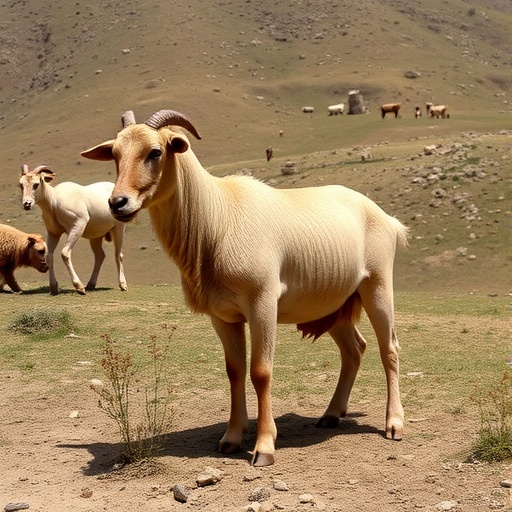
The domestication of animals and the rise of pastoralism in southwest Asia stand as pivotal chapters in the narrative of human evolution and cultural development. Among the most transformative shifts was the adaptation from hunting and gathering to agricultural and agropastoral lifeways, which dramatically redefined subsistence strategies. The widespread domestication of ruminants and the cultivation of cereals ushered in unprecedented changes in human diet, economy, and social organization. Yet, within this broad transition, the specific exploitation of dairy products—particularly from sheep and goats on the Iranian Plateau—has been insufficiently illuminated until now. A groundbreaking study published in Nature Human Behaviour reveals that early pastoral communities in the Zagros Mountains region were not only domesticating goats and sheep by the seventh millennium BC but were also actively harnessing their milk resources, signaling an advanced form of animal product utilization much earlier than previously confirmed.
For decades, the north and central Zagros Mountains on the Iranian Plateau have been recognized as a cradle for goat domestication, serving as a nexus for the diffusion of agropastoral innovations eastward. However, understanding the nuances of how early pastoralists exploited these animals beyond meat consumption has remained elusive due to limited direct evidence. Recent interdisciplinary research integrating biochemical analyses with archaeological data casts new light on this issue. By examining lipid residues trapped in ceramic pottery fragments alongside protein residues extracted from human dental calculus—the calcified plaque on ancient teeth—scientists have unearthed compelling molecular proof of caprine dairy exploitation dating back to the seventh millennium BC. This finding not only fills a critical knowledge gap but also reshapes our perception of early human dietary complexity in the region.
The methodology behind detecting ancient dairying practices relies heavily on advancing biomolecular techniques. Lipid residue analysis in pottery involves identifying specific fatty acid biomarkers that persist over millennia, capable of signaling the processing of milk products. Likewise, proteins, which can be remarkably resilient in dental calculus, offer complementary insights, directly confirming the consumption of dairy by ancient individuals. This multifaceted approach provides convergent lines of evidence, significantly strengthening confidence in interpreting early dairying. The study’s success showcases how cutting-edge proteomic and lipidomic tools can unravel intricate aspects of prehistoric lifeways with unprecedented accuracy.
Radiocarbon dating of the dairy residues themselves—a critical step performed in this research—anchors the practice of caprine milk exploitation to a precise temporal framework spanning the seventh millennium BC. This timing is strikingly contemporary with the well-documented use of cattle milk in Anatolia, another key center for early pastoralism in southwest Asia. The synchronous emergence of ruminant dairying strategies across these separated but interconnected geographic zones suggests parallel evolutionary trajectories in the development and spread of agropastoral systems. Such synchronicity hints at complex socio-economic and environmental interactions underpinning the Neolithic transition across this broader region.
Beyond mere chronology, the abundance of sheep and goat dairy residues indicates that these animals formed the backbone of pastoral dairy economies on the Iranian Plateau during this formative period. The predominance of caprines aligns with faunal assemblages recovered archaeologically, reinforcing the centrality of these species to subsistence strategies. The capability to process and exploit milk not only enhanced nutritional diversity but also likely facilitated population growth, mobility, and social complexity, given that dairy products provide a renewable resource distinct from meat. This resilience and flexibility would have conferred adaptive advantages in dealing with the region’s often challenging ecological conditions.
Parallel investigations into Anatolian Neolithic sites have documented cattle dairying, often hailed as the hallmark of early agropastoral innovation. The new findings from the Zagros Mountains complement and expand this narrative by emphasizing the equally important role played by sheep and goats. The dual regional patterns underscore a broader geographical mosaic where different species and pastoral strategies evolved independently yet in parallel. This realization challenges simplistic diffusionist models that frame agropastoralism as originating from a single core and radiating outward. Instead, the evidence supports a scenario of multiple, regionally specific developments of innovative livestock management and dairy production practices.
The implications of caprine dairy exploitation extend into multiple realms of archaeological and anthropological research. Understanding milk use contributes to our grasp of early dietary adaptations, lactase persistence genetic evolution, and the socio-cultural fabric of prehistoric communities. The capacity for milk processing—from simple fresh milk consumption to fermented products like yogurt and cheese—opens avenues for prolonged food storage and reduced lactose intolerance impacts. Furthermore, dairying might have influenced ritualistic and symbolic behaviors, given the centrality of animal products in many ancient cultural contexts. Hence, this study in the Zagros not only reveals practical dietary shifts but potentially intimates shifts in cultural ideologies and economic systems.
Complementing biochemical evidence, radiocarbon data derived directly from dairy residues serve to bypass ambiguities inherent in dating archaeological contexts based solely on associated artifacts or stratigraphy. By dating the organic residues themselves, researchers achieve a more precise temporal association, offering a direct window into the timing of dairying innovation. This approach enhances the resolution of Neolithic chronology and contextualizes pastoral developments within broader climatic, environmental, and social transformations taking place during the early Holocene epoch on the Iranian Plateau.
The study also affirms the importance of collaborative, multidisciplinary frameworks in archaeological science. Specialists in lipid chemistry, proteomics, faunal analysis, isotope geochemistry, and traditional archaeology coalesced to produce a robust, integrated interpretation. This amalgamation of expertise is indispensable when deciphering subtle, molecular-scale evidence from complex ancient deposition contexts. Future investigations will increasingly rely on such multifaceted methodologies to unravel nuanced subsistence practices in diverse prehistoric settings around the globe.
Looking forward, the findings provoke questions ripe for continued exploration: How did early pastoral communities manage seasonal variability in milk production? What technological innovations supported dairy preservation and processing? Were there trade networks facilitating the exchange of dairy products or genetics of dairy animals? How did dairying influence social hierarchies, gender roles, or settlement patterns? These avenues promise rich interdisciplinary inquiry bridging archaeology, ethnography, genetics, and environmental sciences.
In sum, the detection of sheep and goat milk exploitation on the Iranian Plateau from as early as the seventh millennium BC fundamentally enriches our understanding of Neolithic subsistence innovations. It complements and potentially reconfigures narratives centered on cattle dairying in adjacent regions. The research underscores a nuanced picture of early pastoral lifeways characterized by synchronous yet independently evolved dairying strategies. This insight recalibrates models of agricultural and pastoral diffusion, illuminating the sophisticated economic adaptations that underpinned one of humanity’s most consequential transitions.
The ongoing assessment of ancient dairy residues in varying Southwest Asian contexts is poised to refine and extend these revelations further. As more sites undergo biomolecular screening, a more comprehensive map of early dairying practices will emerge, elucidating not only when and where but also how pastoral innovations unfolded in space and time. The Iranian Plateau, with its unique environmental settings and rich prehistoric record, remains instrumental in unraveling the profound biological, economic, and cultural transformations marking humanity’s Neolithic revolution.
Ultimately, this pioneering research not only decodes a vital aspect of past human diets but also inspires a broader appreciation for the complexity and ingenuity of early agricultural societies. It paints a vibrant picture in which our ancestors not only domesticated plants and animals but also mastered their products in ways that continue to shape human civilization today. The caprine dairy residues in ancient pottery and human remains offer a testament to these sophisticated adaptations, bridging deep time with present-day understandings of food production and cultural evolution.
The revelations from the Zagros thus stand as a milestone in archaeological science, spotlighting the Iranian Plateau as a key locus for independently developed, sophisticated pastoral economies. They remind us that the story of agropastoralism is multidimensional, involving a diverse array of species, technologies, and cultural pathways. As we continue to probe these ancient innovations, each discovery offers fresh perspectives on the resilience and creativity that defined human prehistory and laid the foundations for modern lifeways.
Cite Scienmag News
Glenn Wilkins. (February 18, 2026). Ancient Caprine Dairy Farming Emerged on Iranian Plateau. Scienmag. https://scienmag.com/ancient-caprine-dairy-farming-emerged-on-iranian-plateau/
Glenn Wilkins. "Ancient Caprine Dairy Farming Emerged on Iranian Plateau." Scienmag, 18 February 2026, https://scienmag.com/ancient-caprine-dairy-farming-emerged-on-iranian-plateau/. Accessed 3 September 2026.
Glenn Wilkins. "Ancient Caprine Dairy Farming Emerged on Iranian Plateau." Scienmag. February 18, 2026. https://scienmag.com/ancient-caprine-dairy-farming-emerged-on-iranian-plateau/


