


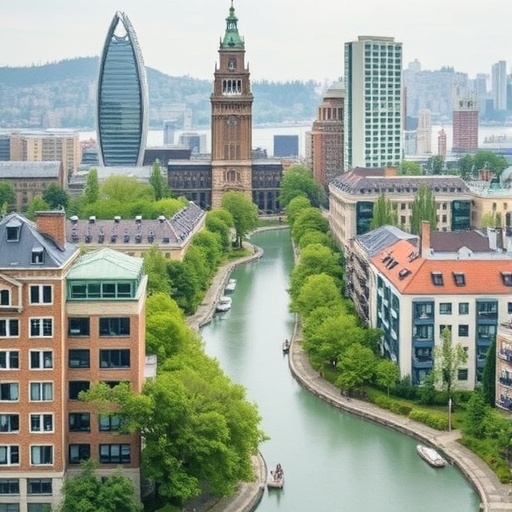
As the world hurtles toward the mid-21st century, urban centers stand at a critical crossroads where sustainability is no longer a mere aspiration but an imperative. A groundbreaking study published in npj Urban Sustainability by Elmqvist, Anderson, Andersson, and colleagues lays out a visionary scientific framework that transcends traditional adaptive strategies, proposing a paradigm shift from urban adaptation to regeneration by the year 2050. This landmark research meticulously articulates the scientific underpinnings and technical mechanisms required to transform aging, resource-depleted, and vulnerable cities into resilient, self-renewing ecosystems that support human well-being and biodiversity alike.
Urban sustainability science, as conceptualized in this study, integrates multifaceted disciplines ranging from urban ecology and environmental engineering to social sciences and economic modeling. The authors provide a comprehensive synthesis of how cities can move beyond incremental adaptation—efforts which often only mitigate existing problems—to embrace regenerative processes that restore degraded systems and unlock new potentials for ecological and social vitality. Central to their thesis is an understanding of cities as complex, dynamic systems that must be managed holistically through multi-scale interventions and cross-sectoral collaboration.
Technically, the framework leverages cutting-edge data analytics, including remote sensing technologies and urban metabolisms modeling, to map and quantify the flows of energy, materials, and information through urban environments. These quantifications enable decision-makers to identify critical leverage points where interventions can trigger systemic improvements. The study highlights that regenerative urban development employs circular economy principles, emphasizing resource recirculation, waste minimization, and renewable energy integration, thereby dramatically reducing cities’ ecological footprints.
A notable innovation in the research is the conceptualization of urban green and blue infrastructure as vital regenerative agents rather than static amenities. By enhancing connectivity among parks, wetlands, urban forests, and water bodies, the authors propose the creation of resilient ecological corridors that buffer climate impacts, purify air and water, and support urban biodiversity. These interconnected habitats not only reduce urban heat islands but also provide co-benefits such as improved mental health for city residents and enhanced social cohesion.
Social dynamics receive significant attention in the framework, underscoring that sustainability cannot be achieved without equitable inclusion and community empowerment. The researchers advocate for participatory governance models where local stakeholders, especially marginalized groups, have substantive roles in planning and managing urban regeneration projects. This democratization of urban sustainability science facilitates the co-creation of solutions that are culturally appropriate, socially just, and politically feasible.
Infrastructure innovation emerges as another pillar of the study. The authors envision a new generation of smart, adaptive infrastructures capable of responding autonomously to environmental and social cues. Examples include sensor-integrated water systems that optimize distribution while reducing leaks, dynamic energy grids that balance supply and demand with renewable inputs, and modular building designs that allow flexible use and easy retrofitting. These technologies not only improve efficiency but also create avenues for urban regeneration by enabling circular life cycles for building materials and utilities.
Climate resilience is woven throughout the research’s regenerative agenda. The authors emphasize that urban systems must be designed to anticipate and absorb shocks from extreme weather events, sea-level rise, and shifting climatic zones. They introduce advanced modeling frameworks that incorporate probabilistic climate scenarios alongside social vulnerability indices. This integrated approach enables planners to prioritize interventions that reduce risks while enhancing adaptive capacity, effectively turning cities into bastions of resilience rather than victims of environmental change.
The temporal dimension in the study’s road map to 2050 is critical. The authors outline staged milestones that progressively build urban regeneration capabilities, from immediate actions like renewable energy adoption and waste reduction to medium-term infrastructure overhauls and long-term socio-ecological restoration projects. This phased approach recognizes constraints in resources and political will while maintaining an ambitious trajectory toward transformative urban futures.
Economic considerations receive rigorous treatment, with models demonstrating how investments in regenerative infrastructure yield high returns through job creation, increased property values, health improvements, and disaster risk reduction. The study calls for innovative financing mechanisms including green bonds, public-private partnerships, and climate funds to mobilize capital flows at scales commensurate with urban regeneration challenges. By framing sustainability investments as economically strategic, the authors counteract prevalent perceptions that regenerative initiatives are cost-prohibitive.
The integration of information and communication technologies (ICT) enhances the framework’s potential impact. Smart city applications, big data analytics, and digital twins of urban environments provide continuous monitoring and feedback loops, optimizing regeneration processes in real time. This technological layer enables adaptive management that dynamically balances ecological, social, and economic objectives, a necessity in complex urban systems subject to frequent perturbations.
Education and capacity building underpin the regenerative vision as well. The paper highlights the importance of cultivating new expertise and transdisciplinary approaches among urban planners, engineers, ecologists, and local communities. By promoting knowledge sharing, innovation hubs, and collaborative networks, the authors aim to create an enabling environment that sustains momentum toward 2050 goals.
Importantly, the research recognizes regional variability and context-specific challenges, cautioning against one-size-fits-all solutions. It advocates for customized regeneration strategies that reflect local ecological characteristics, cultural values, governance structures, and socio-economic realities. This contextual sensitivity enhances the practical relevance and implementation success of urban sustainability science.
Finally, the study’s holistic and forward-looking perspective redefines urban sustainability not just as a means of coping with environmental threats but as a transformative opportunity to regenerate cities as thriving, inclusive, and adaptive ecosystems. By offering rigorous scientific insights alongside pragmatic strategies, Elmqvist and colleagues provide an invaluable blueprint for researchers, policymakers, and stakeholders committed to securing urban futures on a resilient and restorative foundation.
As the world collectively confronts accelerating urbanization and environmental crises, this pioneering research signals a hopeful paradigm shift. It invites us to envision cities not as static backdrops vulnerable to decline but as dynamic systems capable of continuous renewal and flourishing—ushering in an era where urban sustainability science guides global trajectories from mere survival toward vibrant regeneration by mid-century.
Cite Scienmag News
Gavin Prescott. (February 18, 2026). Urban Sustainability: From Adaptation to Regeneration by 2050. Scienmag. https://scienmag.com/urban-sustainability-from-adaptation-to-regeneration-by-2050/
Gavin Prescott. "Urban Sustainability: From Adaptation to Regeneration by 2050." Scienmag, 18 February 2026, https://scienmag.com/urban-sustainability-from-adaptation-to-regeneration-by-2050/. Accessed 5 September 2026.
Gavin Prescott. "Urban Sustainability: From Adaptation to Regeneration by 2050." Scienmag. February 18, 2026. https://scienmag.com/urban-sustainability-from-adaptation-to-regeneration-by-2050/


