


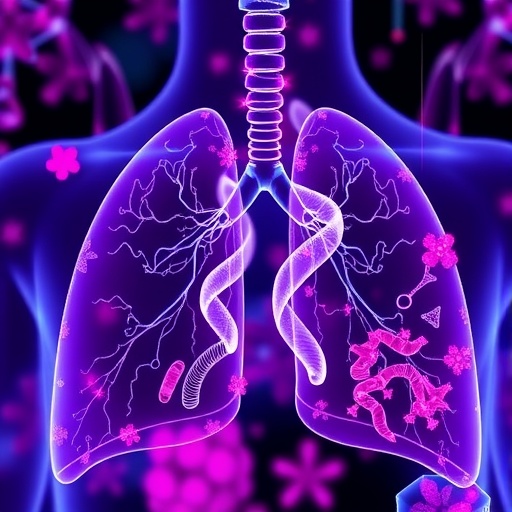
In recent years, the intersection of environmental toxicology and cancer genomics has emerged as a fertile ground for groundbreaking scientific inquiry. The growing awareness of how environmental factors contribute to malignant transformations in human tissues has pushed researchers to uncover the molecular underpinnings that link exposure to hazardous compounds with cancer pathology. In a pioneering study published in BMC Pharmacology and Toxicology, She, Sun, Xie, and colleagues embarked on an ambitious journey to identify a critical gene that could bridge endocrine-disrupting chemicals (EDCs) and the onset of lung adenocarcinoma, using a sophisticated blend of bioinformatics and machine learning techniques. This research not only advances our understanding of the genetic basis of environmentally induced cancers but also highlights novel methodologies that leverage computational power to decode complex biological interactions.
Endocrine-disrupting chemicals, a broad class of substances that interfere with hormonal systems, have been implicated in various health disorders including reproductive abnormalities, metabolic disorders, and increasingly, cancer. These chemicals, widespread in industrial products, plastics, and pesticides, can persist in the environment and bioaccumulate in human tissues. The challenge has been to elucidate the molecular mechanisms by which EDCs contribute to oncogenesis, particularly in lung tissues, where adenocarcinoma represents one of the most common and deadly forms of lung cancer worldwide. The study by She et al. confronts this challenge head-on, adopting an integrative approach that pairs genomic data mining with the predictive power of machine learning algorithms, ultimately identifying COL1A1 as a potential pivotal gene in this interplay.
COL1A1 encodes the alpha-1 chain of type I collagen, a fundamental component of the extracellular matrix (ECM), which not only provides structural support but also influences cellular signaling processes key to tissue homeostasis and tumor progression. Alterations in ECM components have been increasingly recognized for their role in shaping the tumor microenvironment, facilitating invasive behaviors in cancer cells, and impacting therapeutic responsiveness. The researchers postulate that COL1A1 could serve as a molecular nexus where endocrine disruption translates into aberrant extracellular matrix remodeling, fostering a microenvironment conducive to lung adenocarcinoma development.
To unravel this hypothesis, the team extracted comprehensive gene expression datasets from publicly available repositories, focusing on samples exposed to a range of EDCs alongside lung adenocarcinoma profiles. Employing rigorous bioinformatic filtering, they isolated genes with differential expression patterns suggestive of EDC-induced perturbation. Machine learning models—specifically ensemble algorithms capable of handling high-dimensional datasets—were instrumental in narrowing down candidate genes associated with both chemical exposure and tumorigenesis, with COL1A1 emerging consistently as a top predictive marker.
This approach exemplifies the power of computational biology in transforming vast, seemingly disparate datasets into coherent biological insights. Machine learning excels in modeling complex nonlinear relationships between genes, environmental factors, and phenotypic outcomes that traditional statistical methods might overlook. In this study, by training models on annotated gene expression signatures, the researchers could classify and predict the likelihood of certain molecular changes being associated with EDC exposure, revealing COL1A1’s strong linkage to both the chemical and oncogenic milieus.
Furthermore, pathway enrichment analyses unveiled that COL1A1 is intricately involved in multiple cellular pathways modulated by endocrine disruptors—ranging from hormone receptor signaling cascades to matrix metalloproteinase regulation. These pathways converge on processes such as cell proliferation, apoptosis evasion, and tissue remodeling, all hallmarks of cancer progression. By highlighting COL1A1’s centrality in these networks, the study proposes a mechanistic framework by which environmental chemicals exert oncogenic influence through disruption of ECM integrity and downstream signaling.
Another notable aspect of this work is the translational potential of identifying COL1A1 as a biomarker for EDC-associated lung adenocarcinoma risk. Current diagnostic modalities for lung cancer often detect disease at advanced stages, limiting treatment efficacy. Detecting COL1A1 expression alterations induced by environmental exposures could pave the way for early intervention strategies, potentially integrating screening programs for populations at high risk due to occupational or environmental factors. Such a biomarker could inform personalized medicine approaches, guiding preventive measures and therapeutic decisions tailored to environmentally induced molecular subtypes of lung adenocarcinoma.
The study also opens new research directions into the therapeutic targeting of ECM components in cancer. Given that COL1A1 contributes to matrix composition and integrity, drugs or biologics designed to modulate collagen synthesis, deposition, or interaction with cancer cells may complement existing treatments. Moreover, understanding the interplay between endocrine disruptors and ECM remodeling could inspire novel combinatorial therapies that simultaneously address environmental factors and tumor microenvironment vulnerabilities.
Importantly, the researchers acknowledge that while bioinformatics and machine learning analyses provide powerful hypothesis-generating insights, experimental validation remains crucial. Future studies employing in vitro and in vivo models exposed to specific endocrine disruptors will be necessary to confirm COL1A1’s causal role and to dissect the precise molecular events mediating its influence on tumorigenesis. Such experiments could also illuminate dose-response relationships and temporal dynamics of gene expression after chemical exposure, addressing critical gaps in toxicogenomics.
The investigation carried out by She and colleagues embodies the frontier of interdisciplinary science, merging environmental health studies, cancer biology, and artificial intelligence to tackle a pressing public health issue. Their findings underscore the importance of considering environmental exposures in the molecular etiology of cancer and exemplify how emerging computational tools can accelerate discovery in biomedicine. As environmental pollution continues to pose substantial risks worldwide, this research represents a significant step towards integrated understandings that enable protective measures against carcinogenic insults mediated by endocrine disruptors.
By drawing attention to COL1A1’s role in linking endocrine-disrupting chemicals with lung adenocarcinoma, this work also raises awareness of the broader implications of environmental contaminants on respiratory health. Lung adenocarcinoma, a subtype traditionally associated with tobacco smoking, now increasingly accounts for cases arising in ostensibly low-smoking populations, with environmental contributions suspected. Uncovering genes like COL1A1 that mechanistically connect chemical exposures with oncogenic processes invites re-evaluation of lung cancer risk factors, emphasizing the environment rather than solely lifestyle determinants.
Technologically, this study represents a blueprint for future investigations aiming to decode the molecular consequences of complex chemical mixtures on human health. The combined usage of large-scale genomic data repositories, advanced machine learning frameworks, and pathway-oriented bioinformatics holds promise for unraveling multifactorial diseases driven by environment-genome interactions. It further illustrates how open-access data and cross-disciplinary collaboration can generate insights with immediate relevance for public health policies and clinical innovation.
In conclusion, the exploratory identification of COL1A1 as a gene underpinning the association between endocrine-disrupting chemicals and lung adenocarcinoma marks a pivotal advance in environmental oncology. This research encapsulates the transformative capacity of bioinformatics and machine learning to illuminate otherwise cryptic linkages in disease pathogenesis. As scientific communities endeavor to mitigate cancer burden linked to environmental insults, studies like this chart the course towards precision diagnostics and targeted interventions informed by the molecular ecology of human disease.
Cite Scienmag News
Juliet Wilcox. (February 17, 2026). COL1A1: Key Gene Linking Chemicals to Lung Cancer. Scienmag. https://scienmag.com/col1a1-key-gene-linking-chemicals-to-lung-cancer/
Juliet Wilcox. "COL1A1: Key Gene Linking Chemicals to Lung Cancer." Scienmag, 17 February 2026, https://scienmag.com/col1a1-key-gene-linking-chemicals-to-lung-cancer/. Accessed 3 September 2026.
Juliet Wilcox. "COL1A1: Key Gene Linking Chemicals to Lung Cancer." Scienmag. February 17, 2026. https://scienmag.com/col1a1-key-gene-linking-chemicals-to-lung-cancer/


